


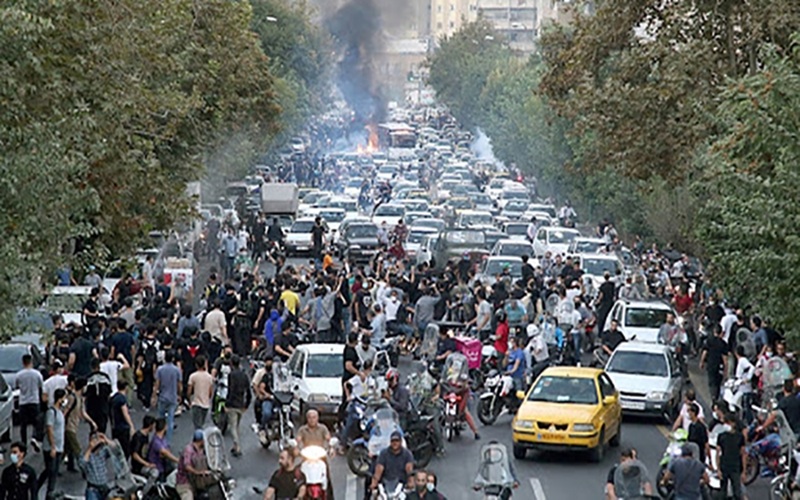

As executions, mass arrests, and political manipulation intensify, the Iranian regime seeks survival through repression while monarchist forces attempt to revive a discredited past. Yet Iran’s younger generations are increasingly defining a different future—one centered on democracy, secularism, equality, and popular sovereignty.
Iran is passing through one of the most consequential political periods in its modern history. Beneath the daily headlines, a deeper confrontation is unfolding between a ruling establishment trapped in structural crises and a society increasingly determined to pursue fundamental change. The regime’s strategy for survival has become increasingly clear: divert public attention through regional tensions and external conflicts while simultaneously escalating repression at home.
Recent developments suggest that this strategy is not a sign of confidence or strength. Rather, it reflects a growing fear within the state apparatus about the potential for widespread social unrest and the possibility of a political transformation that it can no longer easily control.
Repression as a Sign of Vulnerability
The sharp rise in executions, arrests, and security crackdowns over recent months reveals a regime attempting to contain a crisis rather than resolve it. Iranian regime authorities have accelerated the implementation of death sentences against political prisoners and individuals accused of involvement in anti-government protests. Numerous young Iranians have been sentenced or executed on charges ranging from participation in uprisings to alleged links with organized opposition networks.
The purpose of these measures is clear: to create an atmosphere of fear and discourage further dissent.
At the same time, senior security officials have publicly acknowledged the arrest of thousands of individuals during recent security operations. Reports indicating that authorities have identified hundreds of detainees as being connected to organized opposition activities highlight the depth of the regime’s security concerns.
These developments suggest that Tehran’s greatest challenge is not external pressure but the persistence of internal opposition and the continued existence of organized networks capable of mobilizing resistance despite extensive security measures.
The regime frequently seeks to frame regional conflicts and foreign threats as the central issue facing the country. Yet this narrative cannot conceal the reality that many of the grievances driving public anger—economic hardship, political exclusion, corruption, social discrimination, and the absence of basic freedoms—remain unresolved.
As long as these underlying causes persist, repression alone cannot eliminate the demand for change.
The Danger of Looking Backward
While the ruling establishment struggles to preserve its authority, the broader opposition landscape faces challenges of its own.
Among these is the attempt by some monarchist circles to repackage the legacy of the former Pahlavi dictatorship as a viable political alternative. In recent years, certain supporters of the monarchy have sought to sanitize aspects of Iran’s pre-1979 authoritarian system, sometimes defending repressive practices associated with that era or advocating the symbolic revival of institutions that many Iranians associate with political oppression.
Such efforts risk creating a false political choice: either the continuation of the current theocratic system or a return to an earlier form of authoritarian rule.
Ironically, this binary narrative can benefit the current regime. By portraying its opponents as advocates of restoring a previous dictatorship, the authorities attempt to convince society that any alternative would merely replace one form of repression with another.
Yet the political realities of contemporary Iran suggest a different picture. The country’s younger generations have grown up under conditions vastly different from those that shaped previous eras. Their aspirations are increasingly focused not on restoring the past but on creating a political system capable of addressing the demands of the present.
A Society That Has Learned from History
One of the most significant miscalculations made by both the regime and some opposition currents is the underestimation of Iranian society’s political maturity.
The generations that have come of age in recent decades have witnessed the consequences of both religious authoritarianism and centralized systems of power. Their political consciousness has been shaped not only by historical memory but also by direct experience with economic decline, social restrictions, and political repression.
This evolving political awareness is increasingly reflected in public discourse, protest slogans, and grassroots activism.
Many Iranians are no longer willing to accept a political future defined by either clerical rule or the restoration of outdated models of governance. Instead, there is growing support for principles that transcend traditional ideological divisions and place democratic rights at the center of political life.
The emerging vision is rooted in the rejection of all forms of authoritarianism, regardless of whether they are justified in the name of religion, ideology, nationalism, or individual leadership.
The Foundations of a Democratic Alternative
The political aspirations increasingly visible within Iranian society point toward a democratic republic built upon several fundamental principles.
The first is the separation of religion and state. Decades of theocratic rule have demonstrated the dangers of concentrating political authority in religious institutions. A secular political system would provide equal protection for citizens of all beliefs while preventing religion from being used as an instrument of state repression.
The second is full equality between women and men. Women have played a leading role in many of Iran’s recent protest movements, often at tremendous personal risk. Any democratic future for Iran will require the elimination of discriminatory laws and the full participation of women in political, economic, and social life.
The third is the recognition of the rights of Iran’s diverse nationalities and ethnic communities. Addressing longstanding grievances through meaningful political participation, cultural rights, and local self-governance within the framework of Iran’s territorial integrity would strengthen rather than weaken national unity.
Together, these principles offer a vision fundamentally different from both the current system and the authoritarian models of the past.
The Direction of History
The Iranian regime appears trapped in a strategic dead end. More executions, more arrests, and more intimidation may delay political change, but they cannot extinguish the demand that drives it. History repeatedly demonstrates that repression can suppress symptoms temporarily, but it rarely resolves the crises that produce them.
Likewise, efforts to revive political projects rooted in previous eras face significant obstacles in a society increasingly oriented toward the future rather than the past.
Iran today is experiencing a difficult and uncertain transformation. The outcome remains unwritten, but the broader trajectory is becoming increasingly visible. A growing segment of society is seeking neither the continuation of the existing theocracy nor the restoration of monarchy. Instead, it is pursuing a democratic republic founded on secular governance, equal rights, and popular sovereignty.
The future of Iran will not ultimately be determined by the architects of repression or by attempts to recreate past systems. It will be shaped by the aspirations of a society that has paid a heavy price for freedom and that increasingly seeks a political order capable of reflecting the demands and dignity of its people.