


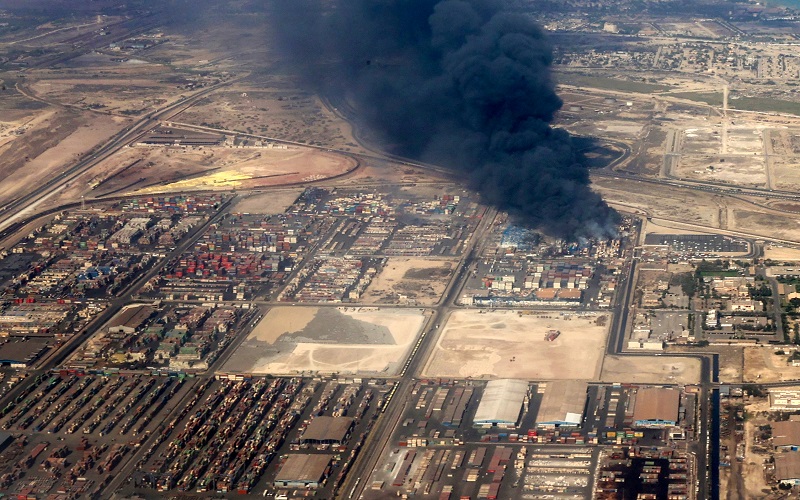

In recent years, Iran has witnessed a series of devastating incidents — from the downing of a Ukrainian passenger plane and catastrophic building collapses to deadly fires and explosions. These tragedies have not only claimed hundreds of lives but have also exposed deep structural weaknesses, rampant corruption, and widespread safety crises within the country.
Catastrophe at Rajaee Port: Over 100 Dead in Massive Explosion
On the afternoon of April 26, 2025, a massive explosion rocked Bandar Rajaee Port in Bandar Abbas, shaking the surrounding area for kilometers and causing extensive damage. As of this writing, at least 110 people have been confirmed dead, and over 1,250 injured.
According to The New York Times, the explosion was caused by the improper storage of sodium perchlorate, a chemical used in solid rocket fuel.

State-run Ham Mihan newspaper also speculated on the possibility of sabotage, noting the timing coincided with Iran-U.S. expert talks. Meanwhile, a maritime security company blamed the disaster on the mishandling of missile cargo.
The blast severely damaged Rajaee Port’s office buildings. The containers involved were owned by Banagostar Company, a subsidiary of Sepehr Energy Holding, which had been previously sanctioned by the United States.
Tabas Coal Mine Explosion: Negligence Leads to 53 Deaths
On September 20, 2024, an explosion devastated the Tabas Miner Coal Mine, killing 53 workers and injuring 20 others.
Investigations revealed the tragedy was caused by the accumulation of methane gas, insufficient ventilation, and a failure to use proper gas monitoring equipment. Lack of warning systems and unsafe drilling practices were also cited as major factors.
Beyond the mine’s management, the provincial Industry, Mining, and Trade Organization and the Labor Department were found responsible for negligence and poor supervision. Many workers had already succumbed before rescue teams could reach them.
Fire at Langarud Addiction Treatment Camp: 36 Lives Lost to Mismanagement
On November 3, 2023, a fire erupted at the “First Step to Liberation” addiction treatment camp in Langarud. Thirty-two people perished at the scene, with four more dying later in hospital, bringing the death toll to 36.
While initial reports cited a technical fault in a heater, later investigations determined the fire was deliberately set by an individual with a personal grudge against the camp’s owner. The camp director was arrested for gross negligence regarding safety and the lack of firefighting equipment; he died in prison two months later.
The Welfare Organization and the municipal administration were also criticized for their oversight failures, as victims’ families demanded greater transparency in the investigation.
Evin Prison Fire: Deaths Amid Uprising
On October 15, 2022, during the height of the nationwide uprising, a massive fire broke out in Tehran’s notorious Evin Prison, resulting in nine deaths and 61 injuries.
Authorities blamed a fight among inmates for the fire, but eyewitnesses and independent reports suggested that security forces may have contributed to or exacerbated the disaster. Satellite images and video footage captured the intensity of the blaze and subsequent explosions.
In the aftermath, 40 prisoners were tried and given harsh sentences, including imprisonment and flogging, though many families considered these prisoners to be victims rather than perpetrators.
Metropol Building Collapse in Abadan: A Tragedy Born of Corruption
On May 23, 2022, the unfinished Metropol building in Abadan collapsed, killing 43 people and injuring 37 others.
Investigations revealed extensive violations during construction, including unauthorized addition of floors and neglect of engineering standards. Hussein Abdulbaqi, the project’s owner and a key figure blamed for the disaster, reportedly died during the collapse.
Twenty-one city officials and project supervisors were convicted for their roles in approving and supervising the unsafe construction. The Metropol tragedy sparked widespread public outrage and protests across Iran.
Flight PS752: IRGC Shoots Down Passenger Plane
On January 8, 2020, Ukraine International Airlines Flight 752 was shot down by two IRGC-fired missiles shortly after taking off from Tehran’s Imam Khomeini Airport, killing all 176 people aboard.
The regime initially denied responsibility for three days but eventually admitted to the missile strike under mounting international pressure. Officially attributed to “human error,” further evidence — including an audio recording of then-Foreign Minister Mohammad Javad Zarif — revealed that IRGC officials were aware of the missile strike immediately after the event.
In 2021, the Ontario Superior Court of Justice ruled that the downing was a deliberate act of terrorism.
Sanchi Oil Tanker Disaster: 32 Lives Lost, Questions Remain
On December 6, 2017, the Iranian oil tanker Sanchi, carrying 136,000 tons of gas condensate, collided with the Chinese vessel CF Crystal east of China.
The tanker exploded and burned for eight days before sinking, killing all 32 crew members. The rescue effort was hampered by toxic fumes and intense heat, and though Iranian authorities defended the Chinese response, many questioned the effectiveness of the operation.
In 2022, the Herischi Human Rights Law Center, representing families of the victims, claimed to have evidence that 22 crew members survived the explosion and were later detained by Iranian authorities — an allegation implicating the IRGC Intelligence Organization and the Supreme Leader’s office.
Plasco Building Collapse: A Wake-Up Call Ignored
On January 19, 2017, Tehran’s Plasco Building, an aging 17-story commercial center, collapsed after a prolonged fire, killing 21 people, including 16 firefighters, and injuring over 235 others.
Warnings about the building’s deteriorating condition had been repeatedly ignored by both municipal authorities and building owners. The collapse displaced nearly 3,000 workers and destroyed 560 garment workshops, highlighting Tehran’s broader crisis of unsafe, neglected infrastructure.
The Plasco tragedy became a national symbol of systematic negligence and the urgent need for building safety reforms — calls that have yet to be fully answered.