


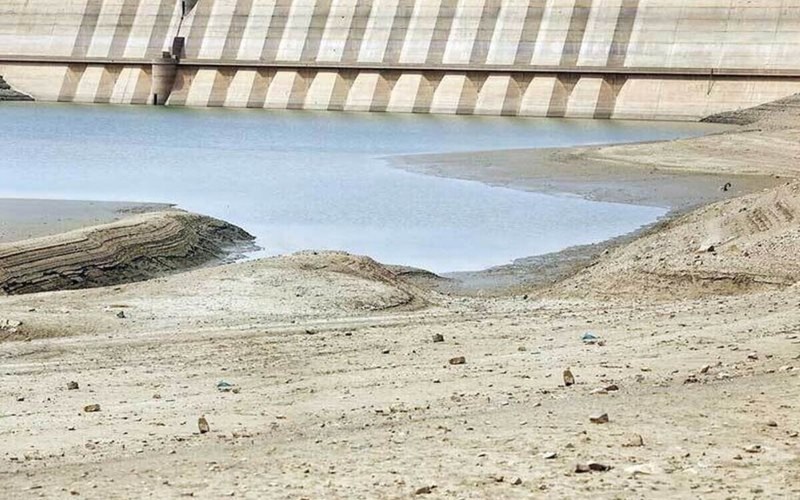

From the Caspian Sea to Lake Urmia and the Shadgan Wetland, Iran’s water bodies are disappearing—experts warn that mismanagement, corruption, and systemic failures pose a greater threat than drought itself.
A Nation in the Throes of Water Bankruptcy
As drought expands across Iran and even the capital Tehran faces severe shortages, new warnings from environmental officials highlight an even more alarming crisis: the ecological collapse of the Caspian Sea. Once considered insulated compared to Iran’s inland lakes and wetlands, the Caspian is now reaching levels described by government officials as “a red-alert environmental crisis.”
Ahmadreza Lahijanzadeh, deputy head of Iran’s Marine and Wetlands Office within the Environmental Protection Organization, warned that the Caspian’s water level has dropped by one meter in the past five years alone—enough to devastate coastal wetlands, marine habitats, fishing industries, tourism, and port activities.
The message is clear: the country’s largest water bodies are dying, and with them, the ecosystems and local economies that depend on them.
More Than Drought: A Systemic Failure
While the regime authorities blame low rainfall and climate change, environmental experts point to the deeper causes: decades of destructive policymaking and institutionalized mismanagement. From reckless dam construction and uncontrolled groundwater extraction to industrial pollution, sewage discharge, agricultural overuse, and urban sprawl, Iran’s water crisis is overwhelmingly man-made.
Experts repeatedly note that environmental collapse in Iran is not a natural disaster—it is a governance disaster.
Local Economies Crumbling as Water Levels Fall
The shrinking Caspian Sea is not only a threat to biodiversity but to regional livelihoods as well. Café owners, fishermen, and tourism workers along the northern coast are experiencing income loss as beaches retreat and marine resources collapse. What was once a regional economic engine is now a zone of uncertainty, with communities watching the shoreline recede year after year.
These local hardships reflect a national tragedy: the erosion of Iran’s environmental resilience, alongside the destruction of sectors dependent on water—from farming to fisheries to tourism.
“Water Bankruptcy” as Iran’s Biggest National Threat
In an interview with ISNA, environmental researcher Mehrdad Nahavandchi issued one of the starkest warnings yet: Iran is facing “water bankruptcy.” He described this as a structural failure where water demands far exceed renewable resources, leaving ecosystems depleted and unable to recover. Nahavandchi warned that the continuation of current water-management practices will trigger consequences such as forced migration, collapse of water-dependent industries, food security crises, and irreversible ecological damage. Cities such as Tehran, Mashhad, and Isfahan—already strained by overpopulation and water scarcity—may experience reverse migration as their water supplies diminish, which would push economic growth into negative territory.
Lake Urmia: Near Total Death
The catastrophe is equally visible in the northwest, where Lake Urmia—once the Middle East’s largest salt lake—is on the verge of disappearing entirely. The Lake Urmia Restoration Headquarters announced on November 11 that, water volume has fallen below 40 million cubic meters, less than one percent of the lake’s natural capacity.
With the regime’s Ministry of Energy allocating less than 10 percent of the lake’s legally mandated water share, recovery is virtually impossible. According to Saeed Issa-Pour of the Restoration Headquarters, reduced rainfall accounts for only 20–30 percent of the crisis; the main culprits are agricultural over-extraction and destructive dam-building policies.
The lake is now a salt flat—a ghost of what it once was—and a reminder of how state policies can kill an entire ecosystem.
Shadgan Wetland: A Ramsar Site Reduced to Dust
In the south, the internationally recognized Shadegan Wetland—home to dozens of rare migratory bird species—has lost 58 percent of its freshwater sections, with western and southern areas almost entirely dry. The wetland received only half of its required water this year, leaving its ecological collapse on full display through satellite imagery.
The disappearance of Shadegan is a devastating blow to biodiversity, local livelihoods, and Iran’s obligations under the international Ramsar Convention. Its decline is a symbol of nationwide environmental neglect and corruption.
A Crisis No Longer Reversible
Environmental experts stress that Iran’s situation has moved beyond emergency and into collapse. The combination of climate vulnerability and catastrophic governance has created a reality in which even long-term, well-designed reforms may come too late. Decades of over-extraction, poor agricultural policy, lack of enforcement, unregulated industrial waste, political prioritization of short-term interests, and entrenched corruption have pushed the country to a point where recovering lost lakes, rivers, and wetlands may no longer be feasible.
The Future: Migration, Instability, and Economic Decline
Environmental collapse is no longer a distant threat. It is now one of the greatest national security challenges facing Iran—one that could trigger mass displacement, unemployment, and economic breakdown on a scale unseen in modern Iranian history.
In a nation where governance has consistently prioritized ideology and profit networks over science and sustainability, Iran’s water bankruptcy is not an accident. It is the predictable result of decades of destructive decisions.
And unless this cycle of mismanagement and corruption ends, the map of Iran—its lakes, wetlands, cities, and even its population centers—may look very different in the years to come.