


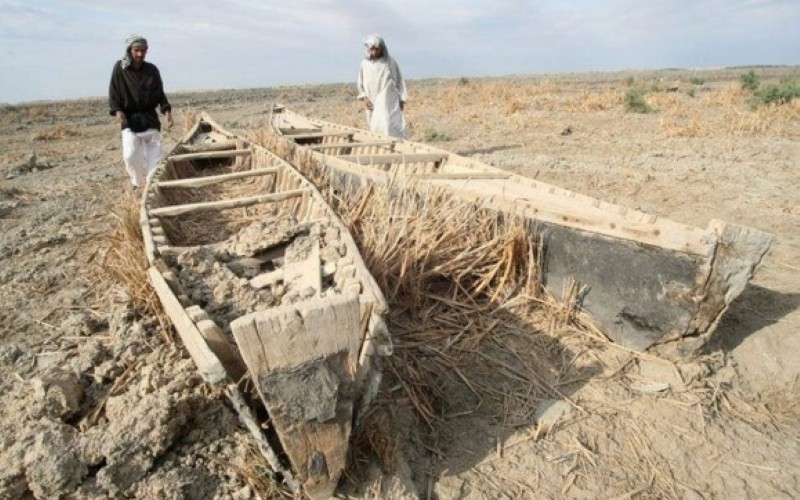

Iran’s environmental disaster is not a technical failure but the direct outcome of a political system that built development on power, denial, and the destruction of its own land.
For decades, development in Iran advanced without grounding in local knowledge, ecological capacity, or public participation. Instead of a model built on sustainability and science, the ruling system turned development into a political instrument for power accumulation.
The land paid the price, and today the consequences appear in the form of an environmental and water crisis that has reached irreversible dimensions. This is the story of a nation silenced by an approach to development that pushed the country toward collapse.
Warnings came too late, even though the reality had already unfolded. Years ago, water expert Kaveh Madani emphasized that Iran was no longer facing a water crisis but had entered a state of “water bankruptcy,” a point at which renewable resources lose the ability to recover from over-extraction.
His assessment was not an exaggeration; it was an accurate description of the long-term consequences of a developmental model detached from environmental science and imposed through political dominance.
For decades, Iran extracted ninety-seven percent of its surface water, as noted by former regime official Isa Kalantari, placing the country alongside Egypt among the world’s most extreme consumers of surface water. This occurred despite global averages that typically range between twenty and thirty percent.
These figures reveal more than an environmental tragedy; they reflect the collapse of a development strategy built without restraint, without scientific guidance, and without any vision for future generations.
Kalantari repeatedly warned that if the destructive trajectory continued, tens of millions of Iranians would eventually be forced to migrate. His warning was not alarmist; it was a precise prediction of a country that long ago surpassed its ecological capacity.
Despite these realities, the regime refused to acknowledge its historic responsibility and continued its centralized, show-oriented development policies. The aim was not ecological preservation but the projection of superficial achievements.
Industrial expansion in arid regions, traditional agriculture imposed on water-scarce basins, and demographic growth in already overstretched megacities became defining features of an approach that ignored the environmental limits of the land and prioritized political imagery.
Even official institutions have been forced to admit the collapse. In 2025, Iran’s water industry spokesperson acknowledged that national development models were neither based on land-use planning nor compatible with the resilience of aquifers.
Yet the admission had no impact on ongoing policies. The structure that created the crisis is the same one that benefits from it, leaving little space for correction or accountability.
While much of the crisis stems from decades of ecological overloading, the state continues to frame the problem as one of “managing consumption,” shifting responsibility onto the population rather than reforming strategic decisions.
This narrative reflects the continuation of the same distorted development logic: simplifying a systemic crisis and ignoring its political roots. Independent research shows that Iran’s water disaster did not arise over a short time; it is the cumulative result of more than sixty years of authoritarian policymaking and environmental degradation.
As analyst Jafar Behkish notes, freshwater consumption soared to unprecedented levels over this period, even as climate change and declining renewable water resources sharply reduced the country’s ability to cope.
More than ninety percent of Iran’s extracted water goes to agriculture, a sector neither modernized nor efficient and completely mismatched with the country’s available resources. This agricultural structure was not shaped by farmers but imposed by the regime through decades of populist slogans such as “self-sufficiency,” used to mask economic mismanagement and chronic policy failures.
The resulting ecological destruction—from the drying of Zayandeh Rud and Lake Urmia to the land subsidence across central plains—is not merely a sign of crisis. It is the direct consequence of a development model that treated the land as an inexhaustible reservoir.
Understanding Iran’s environmental disaster is impossible without examining the political architecture behind it. Development in the Islamic Republic has never been a scientific or participatory process.
Decisions were centralized, independent experts were marginalized or pushed out of the country, civil society was weakened, and critical environmental voices were silenced. The resulting model was not a mistake but the predictable outcome of a system built on control, monopoly, and propaganda.
The environmental catastrophe unfolding today is the product of a structure that consistently elevated political interests over the survival of the nation’s ecosystems.
Iran’s water collapse is not a technical problem but a political crisis rooted in authoritarian governance, corruption, managerial incompetence, and contempt for scientific evidence.
The land now speaks with a wounded but decisive voice: this path can no longer continue. Persisting on the current trajectory will end not only in ecological destruction but in the loss of the homeland for millions of its rightful inhabitants.