


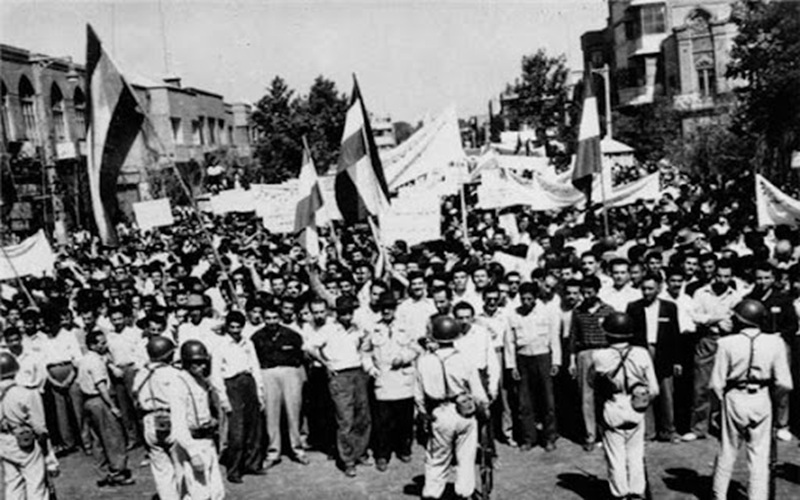

How the People of Iran Rose with the Cry “Death or Mossadegh” to Defend Democracy and Sovereignty
On July 21, 1952 (30 Tir 1331), the people of Iran, led by the rallying cry “Death or Mossadegh,” rose in a massive, nationwide uprising against the monarchical dictatorship of Mohammad Reza Shah. Their goal: the reinstatement of Dr. Mohammad Mossadegh, the leader of the national movement and democratically elected Prime Minister, who had resigned in protest against the Shah’s refusal to relinquish control over the Ministry of War.
This was not just a political confrontation—it was the awakening of a nation resisting imperialist exploitation and monarchical subjugation. The uprising culminated in bloody street battles in Tehran, where demonstrators faced off against tanks and armed forces. Dozens were killed and hundreds injured, but the people’s determination prevailed. The Shah was forced to reverse his decision and reinstate Dr. Mossadegh.
The Roots of the Revolt: Oil, Injustice, and National Aspiration
The struggle of July 21 was deeply rooted in a long history of foreign domination over Iran’s vast oil wealth. Beginning with the 1901 D’Arcy Concession, which granted Britain near-total control over Iranian oil for 60 years, successive governments failed to challenge foreign powers. Revenues from oil were minimal—just 13% of net profits went to Iran—and even that was consumed by the corrupt Qajar and Pahlavi courts.
The situation worsened with the 1933 agreement under Reza Shah, which again prioritized British interests while Iranian workers lived in dire poverty. By the mid-20th century, frustration had reached a boiling point. It was Dr. Mossadegh who stepped forward, launching a historic campaign to nationalize Iran’s oil industry and reclaim the country’s wealth and sovereignty.
Mossadegh’s Rise and the Road to Confrontation
As leader of the opposition in the 14th Majles (parliament), Mossadegh had long criticized the oil agreements and foreign influence. In 1949, he and the National Front succeeded in passing the oil nationalization law. On March 20, 1951, the Iranian parliament voted unanimously to nationalize the oil industry. Less than two months later, Mossadegh became Prime Minister.
Yet Mossadegh’s defiance of Britain and assertion of national sovereignty made him a target. London took Iran to the International Court of Justice, where Mossadegh boldly denied the court’s jurisdiction. British agents and domestic royalists plotted to remove him. Tensions mounted when Mossadegh demanded full control of the Ministry of War to curb royalist conspiracies. The Shah refused, prompting Mossadegh’s resignation on July 16, 1952.
The Shah quickly appointed Ahmad Qavam, a staunch royalist and British ally, as Prime Minister. Qavam immediately issued threats against protesters and deployed military units into the streets. But his intimidation backfired. On July 21, the people of Tehran and other cities erupted in protest.
The Day of Uprising: July 21, 1952
That morning, Tehran was paralyzed. Workers, shopkeepers, and students abandoned their posts to join massive demonstrations. “Death or Mossadegh,” they chanted, confronting police and military units with bare hands and unshakable resolve.
By 7 a.m., crowds surged toward Baharestan Square. Tanks opened fire on unarmed demonstrators. Dozens were killed, hundreds wounded. But the Shah’s use of force only fueled the uprising. By late afternoon, realizing the scale of national resistance, the Shah dismissed Qavam and invited Mossadegh to return as Prime Minister.
That evening, an emotional Mossadegh appeared on the balcony of his home. With tears in his eyes, he addressed the people:
“I wish I had died before seeing the nation mourn like this… Independence was lost, but you reclaimed it with your courage.”
A Turning Point in Iranian History
The 30 Tir uprising marked a watershed moment. It was the first time in modern Iranian history that the will of the people had decisively overturned a monarchical decision. Mossadegh’s return to power symbolized not only a political victory but also a profound statement on national identity and sovereignty.
Dr. Mossadegh would later insist on being buried among the martyrs of that day, honoring their sacrifice for liberty.
Clerical Opposition and Reactionary Backlash
Despite Mossadegh’s popular support, powerful clerical figures—most notably Abol-Ghasem Kashani, who had once supported the national movement—turned against him. Aligning with the Shah and the British, they sought to derail the democratic momentum. Ruhollah Khomeini, who would later become Supreme Leader after the 1979 revolution, publicly despised Mossadegh and dismissed the idea of national sovereignty as irrelevant compared to clerical rule.
In a 1979 speech, Khomeini mocked the nationalization of oil and declared:
“We don’t care about nationalizing oil; our goal is Islam. Islam will bring us oil and everything else.”
Such statements laid bare the ideological gulf between Iran’s democratic aspirations under Mossadegh and the theocratic authoritarianism that would follow decades later.
U.S. and British Collusion: The Shadow of August 1953
Despite the popular victory on July 21, the forces arrayed against Mossadegh were formidable. Declassified U.S. documents show how, just months before the uprising, American officials were already in contact with Qavam and exploring his viability as a pro-Western alternative to Mossadegh. In 1953, the CIA and MI6 launched Operation Ajax, a covert coup that overthrew Mossadegh and reinstated the Shah with expanded dictatorial powers.
The coup of August 19, 1953, remains one of the darkest chapters in U.S.-Iran relations and a bitter reversal of the democratic progress sparked on July 21.
Legacy and Lessons of 30 Tir
Despite its eventual suppression, the 30 Tir uprising ignited a fire that would continue to burn through Iran’s political consciousness. Mossadegh’s stand remains a symbol of integrity, national dignity, and democratic struggle. As he stated in his message on the first anniversary of the uprising:
“This sacred movement showed that the Iranian nation, when it comes to the honor and independence of the homeland, prefers death over life tainted with shame… If life is not accompanied by freedom and independence, it is not worth a penny.”
The uprising also exposed those who betrayed the national cause—opportunists, foreign agents, and reactionary clerics. It forged a clear dividing line between true patriots and those who sought power through subservience and repression.
Continuation of a Democratic Struggle
Though Mossadegh’s government was crushed by foreign-backed coup plotters, the ideals of 30 Tir lived on. A new generation took up the banner in later decades—culminating in revolutionary resistance against both monarchy and theocratic dictatorship. As the Iranian Resistance affirms today, the path that Mossadegh opened is still being walked, now with the goal of building a democratic, secular, and pluralistic republic.
Today, on July 21, 2025, as we mark the 73rd anniversary of the 30 Tir uprising, its message is more relevant than ever: national sovereignty, popular will, and democratic values cannot be permanently suppressed. The sacrifices of those who gave their lives in 1952 continue to inspire the Iranian people’s enduring struggle for freedom.
“The people of Iran have chosen their path and will not turn back.” — Dr. Mohammad Mossadegh