


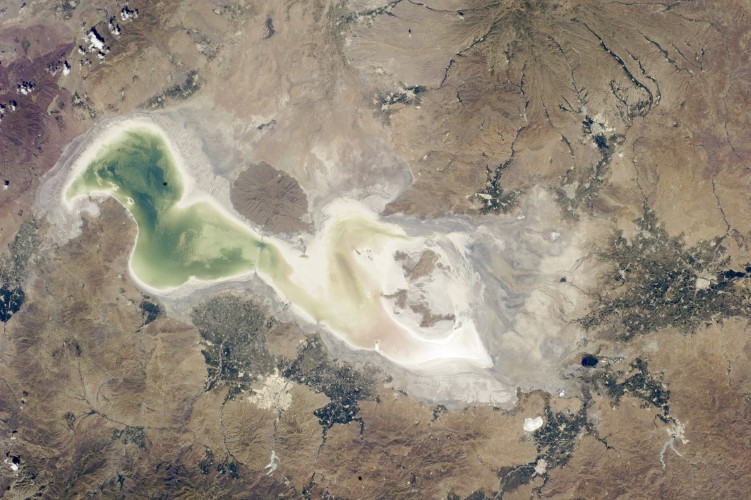

Once a vast inland sea, Lake Urmia has turned into a toxic salt desert—an ecological, economic, and human tragedy caused by decades of destructive policies.
Once among the world’s twenty largest lakes and the largest inland body of water in Iran, Lake Urmia has now become a lifeless expanse of salt. The once-vibrant ecosystem that sustained agriculture, livestock, and climate balance in northwest Iran has collapsed. What remains is a vast, white desert where salt storms choke the air and entire communities struggle to survive.
Experts stress that this catastrophe was not inevitable, nor merely the result of climate change. It is the direct outcome of decades of destructive, unscientific policies pursued by Iran’s ruling regime—policies that sacrificed water resources to uncontrolled dam construction, wasteful irrigation, and unsustainable agricultural expansion.
From a lake to a wasteland
The drying of Lake Urmia is not just the loss of a lake—it is the annihilation of an entire ecosystem. Its disappearance has triggered widespread health crises, depression, respiratory illnesses, soil degradation, and mass migration. Environmental experts emphasize that beyond the physical devastation, the psychological toll of losing the lake has deeply affected the identity and morale of the region’s inhabitants.
For the past 18 months, salt storms from the dried lakebed have intensified, engulfing nearby villages. Agriculture and livestock—once the backbone of the local economy—have been wiped out. Men migrate to nearby cities for low-paying labor jobs, while women are left behind in polluted, desolate villages with no income. Respiratory and mental health disorders are rising rapidly, and what was once a blue horizon has turned into a gray haze of salt and dust.
A crisis created by policy, not nature
The Lake Urmia disaster is a structural failure of governance. Since the 1990s, agricultural land in the basin has more than doubled—from 320,000 to 680,000 hectares—devouring the lake’s vital inflows. Water consumption for agriculture has reached 6.8 billion cubic meters, despite the region’s capacity being less than half that.
Meanwhile, the regime allowed the number of wells to explode from 7,000 to over 90,000, and constructed more than 105 dams on the 14 rivers feeding the lake. The outcome: 96% of Lake Urmia has vanished, leaving only shallow patches of brine behind.
The regime repeatedly promised revival. Under Hassan Rouhani’s government, officials claimed a $1.5 billion fund was allocated to restore the lake. But even regime insiders now admit the money “never existed.” Masoud Pezeshkian’s deputy recently confirmed that the funds were never delivered—just another hollow promise.
Instead of addressing the root causes, the regime has pursued hasty, politically driven projects that accelerated the collapse. Experts warn that unregulated agriculture and relentless dam-building remain the main culprits.
Toxic dust, spreading disease, and invisible threats
Rahimzadeh, an oncology specialist at Urmia University of Medical Sciences, warns that newly exposed salt flats pose an unknown biological danger: “No one knows what kinds of microbes or bacteria may be released from the million-year-old lakebed. It’s an unpredictable risk.”
Fine salt and dust particles, measuring between two and ten microns, penetrate deep into the lungs, increasing the risk of cancer, respiratory disease, and heart problems. These salt storms can spread across 12 Iranian provinces, turning a local disaster into a national health emergency.
The psychological and social costs are equally severe. Experts link the crisis to rising depression, anxiety, and even domestic violence. As entire villages disintegrate, collective identity and community cohesion vanish with them.
A national environmental collapse
The tragedy of Lake Urmia is not isolated. Ahmad Lahijanzadeh, deputy head of Iran’s Department of Environment, has warned that if current trends continue, the Caspian Sea’s retreat and the drying of the Miankaleh and Gorgan wetlands will destroy an additional 50,000 hectares of wetlands within four years. The warning underscores that Iran’s ecological collapse now spans multiple ecosystems.
A future sacrificed
Experts are united on the solution: restore the lake’s water rights, reduce water-intensive agriculture, invest in renewable energy, and establish a single, science-based management system for all river basins. But the regime continues to block such structural reforms, preferring short-term, image-driven projects that yield no results.
Forced migration, collapsing agriculture, rising disease, and expanding dust storms now threaten not only livelihoods but national security. While advanced countries have shifted toward green economies and sustainable resource management, the Iranian regime remains trapped in wasteful, outdated, and politically motivated practices.
The fate of Urmia, Miankaleh, the Caspian, Gavkhouni, Hamun, Hoor al-Azim, Shadegan, Anzali, Bakhtegan, and other lakes and wetlands is no longer about nature alone—it is about the future of a nation that once led environmental stewardship in the region, but now stands as one of its greatest victims of environmental mismanagement and corruption.