


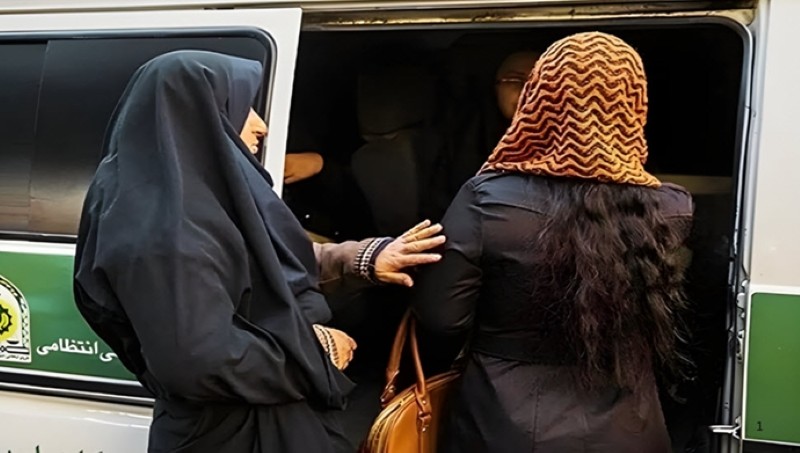

A new wave of repression targets women’s freedom as regime authorities launch the “Hijab and Chastity Command Room” and deploy 80,000 surveillance agents across the capital.
In another attempt to tighten its grip on society and suppress women’s rights, Tehran’s so-called “Morality Headquarters” has announced the creation of a new repressive structure known as the “Hijab and Chastity Command Room.” This initiative, led by Ruhollah Momen-Nasab, the regime’s chief of the morality enforcement body in Tehran, marks a new escalation in the systematic oppression of Iranian women under the pretext of enforcing “virtue.”
Momen-Nasab proudly declared that over 80,000 trained morality enforcers would be deployed across Tehran to “create a major transformation” in enforcing dress codes. In practice, this means expanding surveillance, harassment, and punishment of women who reject compulsory veiling — a policy that has become a central tool of political control.
Observers note that this vast network of informants and enforcers equals the capacity of Tehran’s Azadi Stadium, a chilling reminder of the regime’s willingness to mobilize entire structures of repression to monitor its citizens.
At the same time, reports from Tehran, Qom, and Isfahan confirm the reappearance of morality patrol vans, signaling a coordinated nationwide effort to restore the same mechanisms of fear that fueled public outrage after the killing of Mahsa Amini in 2022.
While regime spokespersons claim that “no budget” has been allocated for such measures and that “the morality patrol has failed,” the reality on the ground tells another story. Momen-Nasab openly described a “smart, multilayered, data-driven operation” designed to track and analyze citizens’ behavior — in the streets, workplaces, and even online.
Despite public opposition and the visible defiance of countless women across Iran, authorities continue to enforce punitive measures:
- Closure of businesses accused of non-compliance,
- Fines for car owners,
- Dismissal of unveiled female employees,
- and bans on artists and athletes deemed “non-conforming.”
Even though the so-called “Hijab and Chastity Bill” was suspended by the regime’s security council, its implementation continues in practice, demonstrating how repression in Iran often bypasses even the regime’s own legal framework.
Divided Power, United in Repression
While regime President Masoud Pezeshkian has admitted that “force doesn’t work,” other regime institutions — including the morality headquarters, the parliament, and clerical networks — demand even harsher enforcement. This division reflects the regime’s broader crisis: it can no longer control a society that has outgrown its coercive structures.
Across Iran, women now openly appear in public without headscarves — from city streets to airports — a form of silent, powerful civil disobedience. Iranian society has written its own unwritten law — one that no command room or morality patrol can suppress.
From Street Patrols to Digital Surveillance
The morality patrol has not disappeared; it has mutated. The loud, visible vans of the past are being replaced by quieter, more insidious tools: digital tracking, message warnings, business closures, and networks of regime loyalists acting as informants.
This transformation marks a shift from overt violence to covert control, but the threat remains the same — the erosion of privacy, dignity, and basic human rights. The blurred boundaries of enforcement now mean that anyone — a neighbor, employer, or even a taxi driver — can act as an unofficial enforcer.
In such a system, no one is safe.
A Society Moving Forward
Three years after Mahsa Amini’s death, the regime has returned to its starting point — repression masked as “virtue.” Yet the people have changed. Iranian women, through their everyday acts of defiance, have turned “optional hijab” into a symbol of broader resistance — for personal choice, for dignity, and for freedom.
Repressive systems can suspend laws, fabricate fear, and issue threats, but they cannot halt a society that has already decided to move forward.
As the movement for women’s freedom grows, one truth becomes clear: fear may delay change, but it can no longer prevent it.