


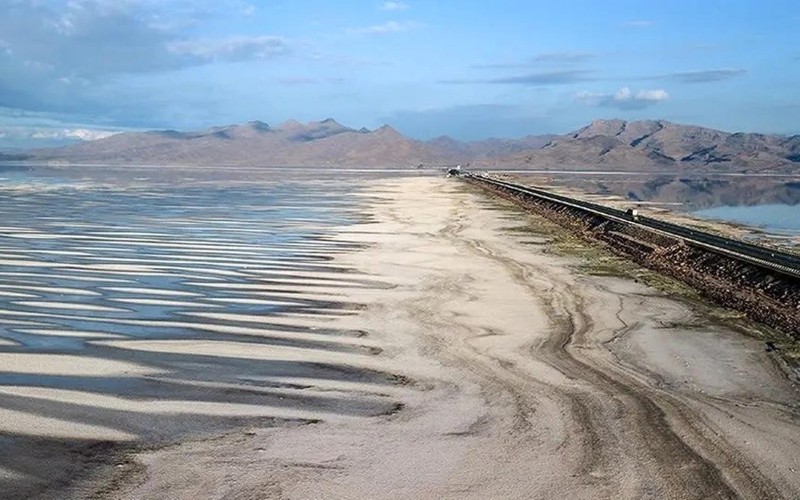

Once the world’s second-largest saltwater lake, Lake Urmia has vanished, leaving behind a salt flat that symbolizes corruption, failed policies, and an unfolding humanitarian disaster in northwestern Iran.
Once the world’s second-largest saltwater lake, Lake Urmia in northwestern Iran has completely dried up, turning into a barren salt flat and exposing one of the most catastrophic environmental failures in the Middle East. NASA satellite images confirm the disappearance of what was once a vital ecosystem, now reduced to lifeless salt plains stretching across former shorelines.
A Symbol of Regime Corruption and Mismanagement
The death of Lake Urmia is not a natural disaster but the direct result of the Iranian regime’s structural corruption and chronic mismanagement over the past 46 years. More than 40 dams on rivers feeding the lake, viaduct construction, and the expansion of water-intensive crops accelerated its decline.
In 1995, the lake held more than 32 billion cubic meters of water and covered 5,700 square kilometers. Today, more than 98 percent of its water has vanished.
On September 18, the head of the West Azerbaijan Provincial Assembly of Representatives warned:
“The drying up of Lake Urmia is no longer just an environmental crisis, but has become a social, political, and economic threat. If urgent action is not taken, neighboring provinces will face an increase in diseases and economic losses.”
By the first half of 2025, the lake had dried up entirely, exposing millions of people in northwestern Iran to its direct consequences.
Agriculture and Dam Projects at the Core of the Crisis
A major share of the lake’s destruction stems from reckless agricultural expansion. Thousands of hectares of apple orchards and other water-intensive crops drained its resources, upsetting the traditional balance between farming and the environment. What was once touted as proof of Iranian agricultural competitiveness has instead become a grim symbol of failure—millions of tons of apples rotting on roadsides while the lake that sustained the region vanished.
Former regime minister Mostafa Hashemitaba admitted in the Shargh newspaper:
“The solution is very simple: give the lake its water rights for one year. But instead of this, billions of tomans were spent on fruitless projects.”
Broken Promises and Failed “Restoration”
During Hassan Rouhani’s presidency, the Urmia Lake Restoration Headquarters was established and heavily promoted as one of the government’s flagship projects. However, these plans collapsed due to poor implementation, corruption, and disregard for environmental realities.
In 2019, heavy rainfall temporarily revived the lake, but this natural event—not government action—was misleadingly claimed as a success. Later, projects such as the Zab Tunnel, which diverted millions of cubic meters of water, proved largely irrelevant to the lake’s actual need of 15 billion cubic meters.
Parliament eventually called for an investigation into the failure of the Restoration Headquarters. Yet, the final report—accusing senior officials including Issa Kalantari and Eshagh Jahangiri of mismanagement and wasting resources—was quietly buried in the regime’s media machinery.
Human and Environmental Consequences
The drying up of Lake Urmia has devastated its unique ecosystem. Wildlife, including the endangered Iranian yellow deer and Armenian ram, lost their habitats on the lake’s islands. With water gone, hunters easily accessed these areas, pushing populations into steep decline.
A larger danger now looms for human populations. Experts warn that strong winds will carry salt particles across the region, salinizing farmland and poisoning the air. Cities such as Urmia, Tabriz, and Khoy—home to more than 14 million people—face the prospect of salt storms, toxic air, and agricultural collapse.
Part of a Wider Environmental Crisis
Lake Urmia is not an isolated tragedy. Other rivers, wetlands, and lakes—including the Zayandeh River, Gavkhoni Wetland, Miankaleh, Lake Bakhtegan, Lake Parishan, Hamoon, Shadegan, Hur-al-Azim, and Anzali Wetland—have met the same fate under Tehran’s policies.
The nationwide water crisis is now visible in daily life. This summer, water cuts lasting six to twelve hours per day affected cities across Iran, revealing the systemic nature of the disaster.
A Disaster Rooted in Regime Policy
Environmental experts stress that restoring Lake Urmia is still technically possible—if the lake’s water rights are respected, dams are removed, and agricultural practices are reformed. However, without a fundamental shift in governance, no billion-dollar project or temporary rainfall will save the region.
The collapse of Lake Urmia is more than an environmental crisis. It is a stark symbol of the Iranian regime’s chronic failure in policymaking and governance. If Tehran continues to procrastinate and avoid accountability, the consequences will not be limited to one lake—they will transform into a humanitarian disaster threatening the health, economy, and survival of millions in northwestern Iran.