


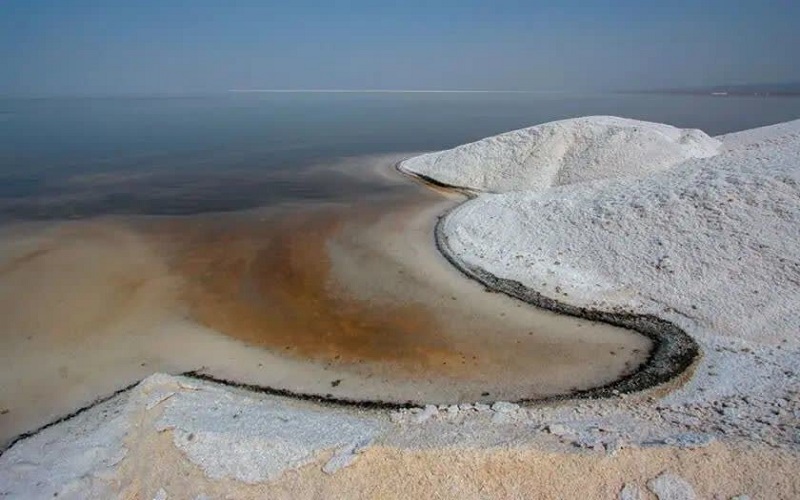

Ali Tahmasbi, the secretary of Iran’s National Dust Management Headquarters, has warned that Qom Salt Lake is at risk of transforming into a significant dust storm hotspot, potentially endangering the health of 20 million people across the country.
Speaking at the National Conference on Strategies for the Sustainability of the Salt Lake Ecosystem and Dust Control in Qom on Wednesday, Tahmasbi emphasized that the situation in the Sarajeh region, located near the lake, has reached a critical point. He cautioned that any mismanagement of the lake could expose a quarter of Iran’s population to severe dust storms.
Environmental experts and activists have long warned that failing to secure Qom Salt Lake’s water rights could lead to disastrous consequences, turning the lake into a major source of pollution. Experts highlight that salt dust, which contains heavy metals, poses serious health risks.
While Tahmasbi acknowledged that Qom Salt Lake is not currently the primary source of dust in Iran, he stressed that projects such as salt and mineral extraction could destabilize the ecosystem and turn the lake into one of the country’s most hazardous dust storm origins.
The official also pointed to the role of water mismanagement in accelerating desertification in the region. He noted that 50 million hectares of land in Iran are now at risk of dust storms due to the depletion of water resources. Official statistics reveal that in the past seven years, the area affected by dust storms in Iran has increased by 47%, while 65% of the country’s wetlands have been destroyed.
Tahmasbi further noted that in the past, dust storms primarily affected smaller villages, but today, major cities such as Tehran, Isfahan, and Ahvaz are facing crisis-level air pollution due to increasing dust storms.
The issue of Iran’s water crisis has been repeatedly highlighted. In February of last year, several Iranian newspapers marked International Wetlands Day by drawing attention to the severe drought, shrinking water bodies, and the neglect of environmental authorities. According to the Global Water Crisis Atlas, Iran ranks among the worst-affected countries in terms of water shortages, with groundwater levels plummeting and major lakes and rivers nearing complete desiccation.