Ricketts urges E3 to act swiftly against Iran’s nuclear threats, while White House advisor Gorka underscores U.S. support for Iranian people’s self-liberation.
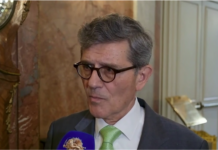
WASHINGTON, D.C. – July 23, 2025 – U.S. Senator Pete Ricketts (R-NE) delivered a forceful speech on the Senate floor Wednesday urging America’s European allies to trigger the snapback mechanism of United Nations sanctions against Iran without further delay. The call came ahead of anticipated talks between Iran and the E3 (United Kingdom, France, and Germany) in Istanbul, where Iran is expected to seek further concessions on its nuclear program.
“Iran cannot have a nuclear weapon,” Ricketts declared. “This has been a red line for decades… and the reason is because the results would be catastrophic.”
Ricketts, joined by 19 Senate co-sponsors, introduced a resolution encouraging the E3 to act immediately should Iran fail to make “firm, tangible, and verifiable” commitments to halt its nuclear activities. He warned that Tehran is using familiar tactics to stall enforcement measures.
“Unsurprisingly, the Iranian regime is resorting to its longstanding playbook to delay, to delay, to delay,” he said, urging European leaders not to be “fooled by Iranian assurances” or threatened into retreat.
He also stressed that the current moment—following recent U.S. strikes that reportedly damaged Iran’s nuclear infrastructure—offers a rare opportunity.
“Iran is as weak now as it has ever been since the 1980s, and probably weaker,” said Ricketts. “But in order to seize this moment, the U.S. and our allies must impose maximum pressure to the highest extent possible.”
“A window now exists to completely change the trajectory of the Middle East for the better,” he added. “But that window will close unless we convince Iran that its nuclear weapons program will never be tolerated, period.”
Gorka Reiterates White House Strategy: “Max Pressure, Not Regime Change”
On the same day, White House senior counterterrorism advisor Sebastian Gorka emphasized the administration’s position on Iran in a separate statement, clarifying that the United States is not pursuing regime change but will continue to apply relentless pressure.
“Max pressure, max pressure, max pressure,” Gorka said, summarizing the administration’s approach. “We are not in the business of deploying the 82nd Airborne to do regime changes anywhere.”
Instead, Gorka expressed confidence in the Iranian people’s ability to bring about political change themselves.
“We would like the people of Persia, including all the minorities in Persia, to eventually liberate themselves,” he said.
Gorka underscored two non-negotiable demands from Washington: that Iran must never obtain nuclear weapons, and it must end its support for proxy militias that threaten regional stability.
“Iran must not support any group that poses a threat,” he added, echoing the administration’s longstanding position.
While Ricketts’ call for immediate action is directed at America’s European allies, Gorka’s remarks reinforce the broader U.S. strategy of exerting overwhelming pressure on Tehran while publicly distancing Washington from direct efforts to force regime change.
Together, the statements reflect a unified U.S. posture: isolate and pressure the Iranian regime diplomatically and economically, while keeping the door open for the Iranian people to shape their own future.