


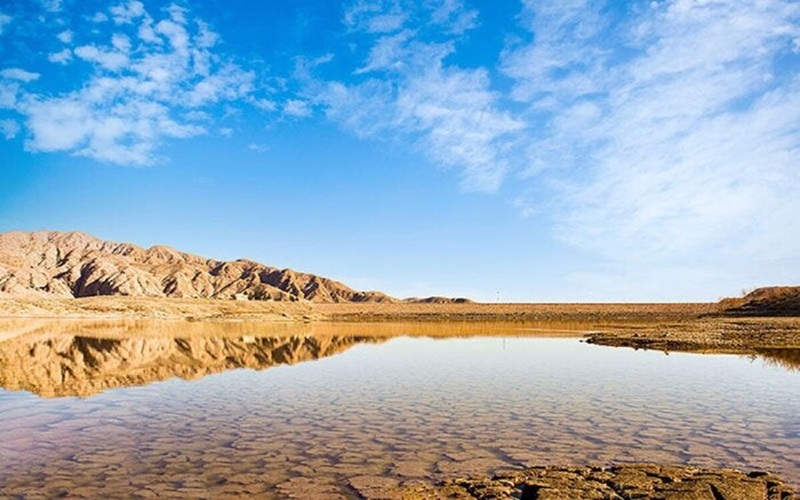

Twenty-six consecutive years of drought, relentless groundwater depletion, and delayed reforms have pushed South Khorasan beyond a water crisis and into what officials now describe as “water bankruptcy.”
South Khorasan is no longer confronting a temporary water shortage or a passing drought. After 26 consecutive years of below-average rainfall, the depletion of groundwater reserves, and accelerating land subsidence, the province has entered a far more dangerous phase—one local officials themselves describe as “water bankruptcy.”
The term is significant. It reflects a reality in which natural water reserves are being consumed faster than they can ever be replenished. While climate change has intensified the problem, South Khorasan’s environmental collapse is equally the result of decades of unsustainable groundwater extraction and policies that ignored the province’s severe ecological limitations.
Far from being an isolated provincial issue, South Khorasan has become one of the clearest examples of the broader environmental crisis unfolding across Iran under decades of failed resource management.
Twenty-Six Years of Relentless Drought
The province has endured continuous drought since the 1999–2000 water year, making it one of Iran’s longest-running climate emergencies.
Meteorological assessments paint an alarming picture. According to the 10-year Standardized Precipitation-Evapotranspiration Index (SPEI), approximately 73 percent of South Khorasan is experiencing severe drought, while another 21 percent faces extreme drought. In total, virtually the entire province—99.98 percent of its territory—is affected.
Although the current water year brought approximately 120 millimeters of rainfall, a noticeable improvement over the previous year, the additional precipitation has done little to reverse decades of accumulated water deficits.
The reason is straightforward: a single wetter year cannot replenish groundwater reserves that have been systematically depleted over more than two decades.
Climate Change Meets Chronic Mismanagement
Climate change has unquestionably intensified South Khorasan’s water shortages.
Higher temperatures, increased evaporation, and declining soil moisture mean that even relatively favorable rainfall is far less effective at recharging underground aquifers than it once was. Scientific assessments by the Intergovernmental Panel on Climate Change (IPCC) have repeatedly warned that arid and semi-arid regions face precisely these challenges.
Yet climate alone cannot explain the scale of today’s crisis.
The transformation of prolonged drought into full-scale water bankruptcy has been driven largely by excessive groundwater extraction.
International standards generally consider groundwater withdrawals of around 40 percent of natural recharge to be sustainable, while extraction approaching 60 percent signals a serious crisis. In South Khorasan, however, annual withdrawals have reached approximately 130 percent of the aquifers’ renewable capacity, meaning more water is removed each year than nature can replace.
The result has been devastating.
Over the past three decades, the province has accumulated an estimated 4.2 billion cubic meters of groundwater deficit, reflecting years of systematic overexploitation that has steadily emptied underground reservoirs.
Development Beyond Environmental Limits
The roots of South Khorasan’s water crisis extend beyond rainfall and groundwater depletion.
For decades, development policies encouraged economic activities—particularly agriculture—that depended heavily on groundwater despite the province’s location in one of Iran’s driest regions.
In water-scarce environments, expanding agriculture without regard for ecological limits amounts to consuming natural capital for short-term production. The UN Food and Agriculture Organization (FAO) has consistently emphasized that sustainable farming in arid regions requires higher water efficiency, revised cropping patterns, and strict demand management.
Although provincial authorities have announced various adaptation plans aimed at reducing groundwater extraction and improving water management, implementation has lagged significantly. Reports indicate that many of these programs remain roughly 24 percent behind their planned targets, delaying measures that could have slowed environmental degradation.
Consuming Water That Nature Cannot Replace
Perhaps the clearest indication that South Khorasan has moved beyond an ordinary water crisis is its growing dependence on ancient groundwater reserves.
Scientific dating of groundwater in parts of the province has revealed that some of the water extracted from the Birjand Plain is between 4,000 and 17,000 years old, while groundwater in other areas dates back several decades.
Unlike renewable water resources, these ancient reserves were accumulated over thousands of years and cannot be replenished within any meaningful human timescale.
This distinction explains why experts increasingly describe the province’s condition as water bankruptcy rather than simply a water crisis. In a conventional crisis, depleted resources may eventually recover through improved management and favorable weather. In water bankruptcy, a substantial portion of the resource base has effectively been lost permanently.
The Silent Earthquake Beneath the Surface
The collapse of groundwater reserves is now producing another irreversible consequence: land subsidence.
Often referred to as the “silent earthquake,” land subsidence has affected 17 study areas across nine counties in South Khorasan. Officials report that the province’s vulnerability to subsidence is approximately twice the national average.
The danger extends far beyond environmental concerns.
Subsidence threatens roads, public infrastructure, residential areas, irrigation systems, and agricultural land. Unlike many natural disasters, however, land that has permanently sunk cannot simply be restored to its original condition.
Each additional centimeter of subsidence represents another irreversible loss.
Water Scarcity Reaches Daily Life
The environmental crisis has increasingly become a humanitarian challenge.
More than 400 villages, home to approximately 45,000 residents, now rely on tanker trucks for drinking water. Meanwhile, nine cities and 27 rural water supply networks face persistent water shortages.
South Khorasan also depends on groundwater for approximately 88.7 percent of its total water consumption—far above the national average of around 55 percent.
This extraordinary dependence leaves the province especially vulnerable to continued drought and further groundwater decline.
The consequences are already visible through shrinking agricultural production, mounting pressure on livestock farming, and growing rural migration as communities struggle to maintain their livelihoods.
A Warning for All of Iran
South Khorasan’s experience is not unique.
Several other provinces—including Isfahan, Yazd, Kerman, and Fars—are also grappling with depleted aquifers and widespread land subsidence. What distinguishes South Khorasan is the severity of its groundwater dependence and the lack of viable alternative water sources.
The province illustrates a broader national reality: Iran’s water emergency is not simply the product of declining rainfall. It is the cumulative outcome of climate change combined with decades of unsustainable water management, excessive groundwater extraction, and development policies that ignored environmental limits.
South Khorasan today stands at the intersection of multiple crises—prolonged drought, rising temperatures, groundwater depletion, delayed reforms, and ecological mismanagement.
Twenty-six consecutive years of drought, groundwater withdrawals exceeding natural recharge by 30 percent, subsidence across 17 plains, hundreds of villages dependent on water tankers, and rapidly disappearing underground reserves all demonstrate that this is no longer a warning about the future.
It is a crisis unfolding in real time.
Without fundamental reforms—including strict limits on groundwater extraction, sustainable agricultural planning, realistic development policies, and responsible stewardship of remaining water resources—the province’s environmental decline is likely to become irreversible. More importantly, South Khorasan serves as a stark reminder that Iran’s broader water crisis cannot be solved through emergency measures or infrastructure projects alone. It requires a comprehensive shift toward sustainable resource management—one that has been delayed for far too long.