



From censorship of Masoud Pezeshkian to renewed fuel price debates, the Iranian regime’s competing factions expose growing instability while attempting to contain mounting public anger.
Regime Infighting Reaches a New Level
Public disputes among Iran’s ruling factions intensified this week, extending from state television to parliament and once again exposing the regime’s growing internal instability. Although rival camps continue blaming one another for political failures, their increasingly public confrontations reveal a shared concern: the fear that worsening economic conditions could trigger another nationwide uprising.
The latest episode centered on state television’s censorship of remarks by President Masoud Pezeshkian, reportedly followed by efforts to formalize tighter control over public references to the regime’s supreme leader. The controversy has further highlighted divisions within the ruling establishment over negotiations, media control, and political messaging.
State Television Tightens Control
According to reports circulating within regime-affiliated media, portions of Pezeshkian’s recent speech were removed because he described receiving approval from the regime’s leadership to pursue negotiations after previously declaring that talks with the United States would not continue.
The incident reportedly prompted the head of the state broadcaster to seek new procedures requiring prior approval before officials publicly quote the supreme leader. The move follows several previous cases in which speeches by senior regime officials were also edited or interrupted before broadcast, suggesting that censorship has become another battlefield in the struggle between competing factions.
Critics from rival political camps have responded by intensifying attacks against figures associated with hardline circles, demonstrating that factional competition is increasingly spilling into public view rather than remaining behind closed doors.
Fuel Prices Remain a Political Minefield
At the same time, the government has again raised the possibility of increasing fuel prices in an attempt to address severe budget deficits.
The proposal immediately revived memories of the nationwide protests triggered by the November 2019 gasoline price hike, when demonstrations rapidly spread across Iran before being violently suppressed. Since taking office, officials within Pezeshkian’s administration have repeatedly floated the idea of fuel price reforms only to retreat amid concerns over public reaction.
The repeated cycle illustrates the regime’s dilemma. While deteriorating economic conditions continue to pressure authorities toward unpopular fiscal measures, officials remain acutely aware that another sudden increase in gasoline prices could become the catalyst for renewed nationwide unrest.
Parliament Reflects Growing Divisions
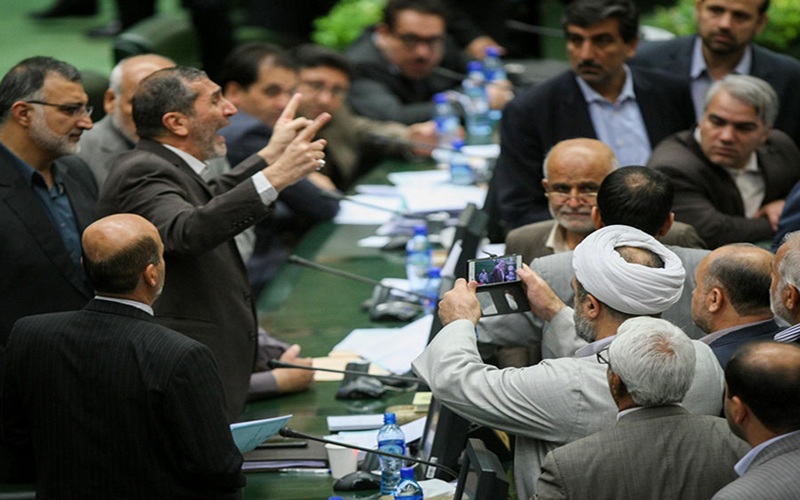
The regime’s internal tensions have also become increasingly visible inside parliament. Recent televised debates between lawmakers descended into personal insults and heated exchanges over strategic issues, including policy toward the Strait of Hormuz and broader regional questions.
Rather than presenting a unified political front, the confrontations reflected deep disagreements over both domestic and foreign policy at a time when the regime faces mounting economic, social, and political pressures.
A Common Fear Behind Every Dispute
Although the regime’s competing factions continue accusing each other of incompetence and policy failures, their disputes ultimately point to a broader reality. Whether over censorship, economic policy, or political appointments, each faction appears increasingly concerned about preserving the system amid growing public dissatisfaction.
With inflation, economic hardship, and social discontent continuing to intensify, even routine policy debates—particularly over sensitive issues such as fuel prices—are viewed through the prism of preventing another nationwide uprising. The increasingly public nature of these internal conflicts suggests that the regime’s political establishment is struggling not only with factional rivalry but also with the mounting pressure generated by a society that has repeatedly demonstrated its willingness to challenge the ruling system.