A surge in secret transfers, rushed executions, and coerced confessions reveals a judicial system increasingly weaponized to suppress dissent.
In the Iranian regime’s expanding machinery of repression, the prison system has become a frontline instrument for silencing dissent. Recent developments at Qezel Hesar Prison illustrate a deeply troubling pattern—one that combines secrecy, accelerated executions, and systemic violations of due process into a coordinated campaign against political prisoners.
On the evening of March 29, 2026, special anti-riot units reportedly stormed Ward 4 of Qezel Hesar Prison, forcibly transferring 22 political prisoners to undisclosed locations. The operation, carried out without explanation or subsequent transparency, immediately triggered alarm over the fate of those detained—particularly individuals already sentenced to death.
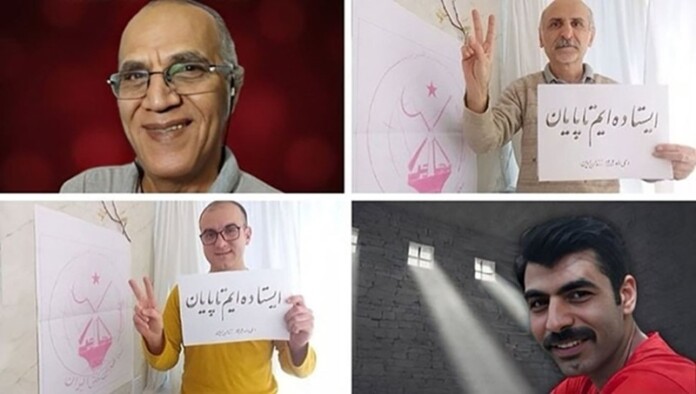
Those fears were not unfounded. Within 48 hours, on March 30 and 31, four political prisoners—Mohammad Taqavi, Akbar Daneshvar Kar, Babak Alipour, and Pouya Ghobadi—were executed. Their deaths, carried out in rapid succession, reinforced concerns that the transfers were not administrative but preparatory. Meanwhile, no information has emerged regarding the whereabouts of other detainees, including Vahid Bani Amerian and Abolhassan Montazer, both reportedly facing confirmed death sentences.
The silence surrounding these cases has drawn international concern. Amnesty International has warned that the enforced disappearance of detainees—combined with authorities’ refusal to provide information to families or legal representatives—raises serious fears of imminent executions. The organization has also highlighted credible reports of torture and grave violations of fair trial standards in these cases.
Parallel developments further expose the structural flaws of Iran regime’s judicial process. An investigative report by Deutsche Welle sheds light on another group of detainees sentenced to death following the January 2026 protests. Seven individuals—Mohammadamin Biglari, Shahin Vahedparast Kalur, Abolfazl Salehi Siavashani, Amirhossein Hatami, Ali Fahim, Shahab Zahdi, and Yaser Rajaiifar—were convicted of “enmity against God,” a broadly defined charge frequently used in political cases.
According to the report, these individuals were accused of involvement in the burning of a Basij base in eastern Tehran. However, their legal representatives argue that available video evidence contradicts the official narrative. The footage allegedly shows plainclothes individuals—believed to be linked to security forces—guiding civilians into a building, locking the exits, and then setting it on fire. Witness accounts describe panic inside the structure, with people shouting for others not to push and attempting to escape by breaking windows.
Despite these discrepancies, the seven defendants were arrested after emergency responders extinguished the fire and were swiftly prosecuted. Their cases were referred to Branch 15 of the Revolutionary Court, where death sentences were reportedly issued in less than a month. During this period, the accused were denied access to independent legal counsel and were largely cut off from their families.
Human rights sources indicate that confessions used in court were extracted under torture and coercion. Some of the defendants were reportedly among the most vulnerable segments of society, including individuals experiencing homelessness and minors under the age of 18—factors that further undermine the legitimacy of the proceedings.
Although the intervention of independent lawyers led to a review by Iran regime’s Supreme Court, initial resistance from at least one judge—who declined to confirm the death sentences due to evidentiary concerns—did not halt the process entirely. Reports suggest that security agencies continued to exert pressure, in some cases obtaining judicial approvals for executions during nighttime proceedings.
One lawyer cited in the report described how intelligence agents secured a signature from a Supreme Court judge overnight, despite earlier objections to the ruling. According to this account, the presiding judge had insisted that the case required annulment and retrial. Instead, the execution order was expedited through extraordinary channels, bypassing standard judicial safeguards.
The execution of 18-year-old Amirhossein Hatami in the early hours of April 2, 2026, underscores the urgency of these concerns. His case, like others, reflects a pattern in which legal procedures are subordinated to security imperatives, and where the outcome appears predetermined.
Taken together, these developments point to a significant escalation in the Iranian regime’s approach to political dissent. Enforced disappearances, opaque legal proceedings, and the systematic use of capital punishment are not isolated incidents but components of a broader strategy aimed at deterrence through fear.
For the international community, the implications are clear. As human rights organizations continue to document these abuses, the need for coordinated and immediate action becomes increasingly urgent. Without external pressure, the current trajectory suggests that further executions—and further erosion of fundamental legal protections—are not only possible, but likely.