


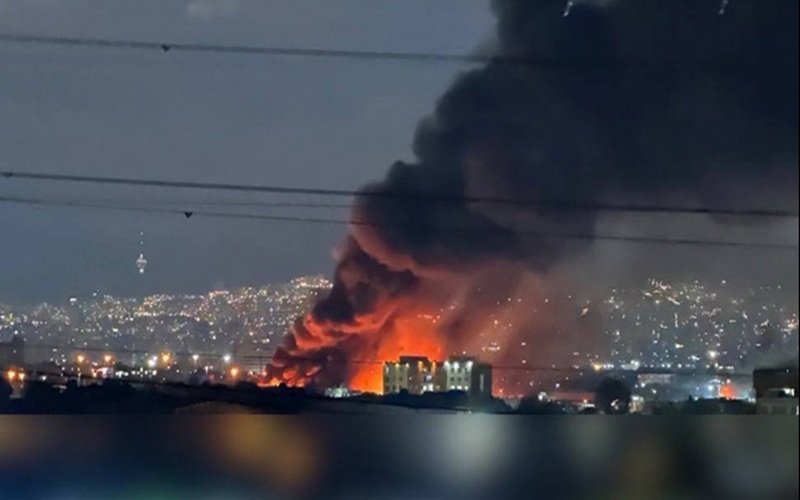

A systematic campaign of fabricated reporting in Iran’s state media reveals how the regime is attempting to project strength, suppress dissent, and manage deepening internal instability.
In times of crisis—particularly under war conditions—state-controlled media often become instruments not of information, but of narrative engineering. In Iran, this phenomenon has evolved into a systematic practice. Over recent years, the fabrication of news has moved from occasional distortion to a central pillar of state media strategy, intensifying alongside both regional tensions and domestic unrest. What emerges is not merely propaganda, but a coordinated effort to shape public perception in the face of mounting instability.
Nowhere is this more evident than in the regime’s reporting on military and security affairs. Official outlets frequently claim high-profile victories—such as the destruction of strategic targets in Israel or the downing of advanced fighter jets like F-35s or F/A-18s. These assertions are routinely published without verifiable evidence and are rarely corroborated by independent international sources. The repetition of such claims suggests a deliberate pattern: the construction of an image of strength where tangible proof is absent.
This approach is not novel. It mirrors classic psychological warfare tactics, where governments exaggerate successes and obscure failures to maintain morale among their base. In Iran’s case, this manifests in a steady stream of reports about the “discovery of espionage networks” or the “arrest of enemy agents.” These narratives serve a dual purpose—projecting vigilance while reinforcing a climate of insecurity.
A recent example illustrates this dynamic. A state-affiliated news outlet reported that the Ministry of Intelligence had uncovered a “large shipment of espionage telecommunications equipment” in West Azerbaijan Province, arresting eight members of alleged separatist terrorist groups and detaining a foreign spy. The announcement, dated March 30, 2026, credited “public reports” and the actions of so-called “unknown soldiers” of the regime. Yet, as is typical in such cases, no verifiable details were provided. The identities of those arrested remain undisclosed, and no independent confirmation has emerged.
This pattern raises fundamental questions about credibility. When arrests are announced without transparency—no names, no evidence, no follow-up—the line between reality and fabrication becomes increasingly blurred. In such an environment, disinformation functions as a tool of social control, manufacturing a sense of omnipresent security while masking operational weakness.
Compounding these concerns are reports regarding the regime’s reliance on proxy forces. The involvement of groups such as Hashd al-Shaabi, Zeynabiyoun, and Fatemiyoun in certain operations points to deeper structural challenges within Iran’s own military apparatus. Internal attrition within the Islamic Revolutionary Guard Corps has been widely noted, suggesting that the regime may be compensating for diminishing internal capacity. Here again, fabricated narratives can serve as a cover, obscuring vulnerabilities behind a façade of operational success.
At the same time, Iranian officials have increasingly emphasized the importance of maintaining control over public spaces. Statements from senior figures—including Mohammad Bagher Ghalibaf and Masoud Pezeshkian—have underscored the necessity of “keeping the streets.” These remarks, widely echoed in state media, come amid rising concerns over potential social unrest.
Similarly, commentary attributed to Ali Larijani and other officials has reinforced the importance of visible public presence during times of tension. In one instance, a Foreign Ministry spokesperson was quoted as describing public gatherings as a reflection of national unity and awareness. Yet, the insistence on projecting such images reveals an underlying anxiety: the regime’s acute awareness of its fragile grip on public sentiment.
Media analysts warn that while repetitive, unverified reporting may yield short-term gains—bolstering morale or deterring dissent—it carries significant long-term costs. Chief among them is the erosion of public trust. In an era defined by social media, where citizens can rapidly cross-check information, the durability of fabricated narratives is increasingly limited.
Ultimately, the expansion of disinformation within Iran’s state media apparatus reflects more than a communication strategy; it signals a government in crisis. While such tactics may temporarily sustain an illusion of stability, they accelerate a deeper process of trust erosion. Historical precedent is clear: regimes that rely on constructed realities do so not from a position of strength, but from an awareness of their own structural fragility.