The execution of two political prisoners exposes Tehran’s deepening crisis and its futile attempt to suppress a society moving irreversibly toward organized resistance.
As discontent simmers beneath the surface of Iran’s cities and organized resistance networks expand their reach, the regime once again turns to its oldest instrument of survival: execution. Yet this reliance on the gallows no longer signals strength—it reeks of desperation, a regime buying time as the shadow of its downfall looms ever closer.
At dawn on March 30, 2026, Iranian regime authorities executed two political prisoners, Mohammad Taghavi, 59, and Akbar Daneshvar Kar, 60. Both were accused of affiliation with the People’s Mojahedin Organization of Iran (PMOI/MEK) and of engaging in armed resistance. Their deaths mark not just another act of repression, but a calculated message to a restless society the regime can no longer fully control.
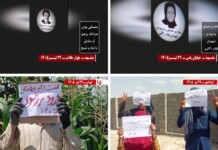
Taghavi, an art graduate and a former political prisoner from the 1980s, and Daneshvar Kar, a civil engineer, were not ordinary detainees. They embodied a generation that has transformed personal conviction into organized defiance. For them, rebuilding their homeland was no longer confined to professions—it became a struggle waged through resistance networks and grassroots defiance.
In a message dated July 29, 2025, Taghavi reaffirmed his unwavering commitment, describing a regime that survives through fear and intimidation. He vowed to stand firm until his final breath, expressing certainty in ultimate victory. Days earlier, Daneshvar Kar had invoked the legacy of Mohammad Hanifnejad, declaring that the banner of resistance had not fallen—it had merely passed into new hands, now carried forward by those willing to pay the ultimate price.
Their words were not symbolic rhetoric; they were declarations of a broader reality. Across Iran, a new generation—hardened by successive uprisings—has moved beyond spontaneous protest toward structured resistance. This evolution represents the regime’s greatest fear: a society that has learned, organized, and refuses to retreat.
The executions come at a time when Iran faces mounting internal crises—economic collapse, social unrest, and increasing international isolation. In response, the authorities have intensified repression at home while escalating tensions abroad, hoping to divert attention from the domestic front. Yet such tactics have only deepened the regime’s crisis, exposing its inability to address the root causes of public anger.
The global reaction was swift. International media outlets, including Associated Press, Reuters, and Agence France-Presse, reported on the executions, highlighting allegations of torture and the charges tied to opposition activity. The coverage underscores how the regime’s internal actions are no longer hidden—they resonate far beyond Iran’s borders.
But beyond headlines and statistics, the names Mohammad Taghavi and Akbar Daneshvar Kar now carry a deeper significance. They are no longer individuals; they have become symbols of a path that stretches from the resistance of the 1980s to today’s organized networks. A path defined by persistence, sacrifice, and an unyielding belief in change.
Today’s executions reveal more than brutality—they reveal fear. A regime that resorts to killing its opponents is a regime that sees its future slipping away. The gallows may silence voices, but they cannot extinguish the will of a people who have already found their direction.
And that is the regime’s greatest dilemma: the future of Iran will not be decided by ropes and repression, but by a society that has crossed a point of no return.