


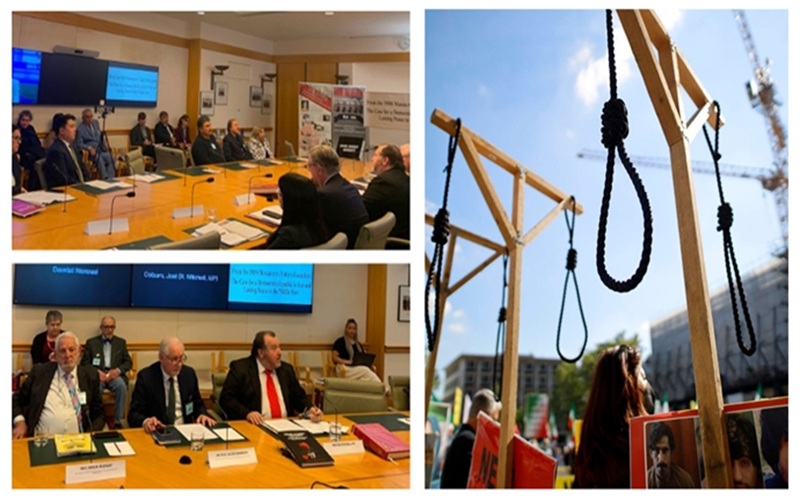

A parliamentary conference in Australia marking the 38th anniversary of Iran’s 1988 massacre highlighted the continuing pattern of executions and repression—and the international demand for accountability.
The bloodshed of Iran’s 1988 massacre has never disappeared from the country’s political memory. Thirty-eight years after thousands of political prisoners were executed on the orders of the regime’s founder, the demand for justice continues to reverberate far beyond Iran’s prisons.
A parliamentary conference held in Australia under the title “From the 1988 Massacre to Executions Today” brought renewed international attention to the connection between the mass executions of 1988 and the regime’s continuing use of the death penalty against political prisoners and protesters.
The conference, attended by members of the Australian Parliament and Senate as well as representatives of Iranian communities, was more than a commemoration of a historic crime. It underscored a continuing pattern: a regime that has repeatedly responded to political opposition and popular uprisings with imprisonment, torture, executions, and systematic repression.
It also demonstrated that the campaign for justice for the victims of the 1988 massacre remains an active international issue.
The 1988 massacre: a crime that refuses to disappear
In her message to the Australian conference, Maryam Rajavi recalled the origins of the massacre.
In July 1988, Ruhollah Khomeini issued a decree ordering the execution of members of the People’s Mojahedin Organization of Iran (PMOI/MEK) who remained committed to their political positions despite years of imprisonment, torture, and abuse.
According to Rajavi’s message, approximately 30,000 political prisoners were executed, around 90 percent of them PMOI members. A book documenting the massacre contains the names of 5,000 PMOI members among those killed.
The executions were carried out through so-called “death commissions,” which subjected prisoners to brief interrogations designed to determine whether they remained committed to their political beliefs. Those deemed unwilling to submit were sent to the gallows.
The massacre was concealed from the public for years. Yet the crime did not disappear.
From the earliest weeks of the killings, the Iranian Resistance began documenting and publicizing what was taking place. Rajavi recalled in her message that Massoud Rajavi sent telegrams to the United Nations secretary-general exposing the secret decree and the campaign of arrests and executions.
That early campaign became part of a decades-long movement seeking recognition, accountability, and justice for the victims.
From 1988 to the executions of today
The significance of the Australian conference lies precisely in the continuity between 1988 and the present.
The massacre was not an isolated episode. The same political system has repeatedly relied on executions and violent repression whenever it has faced serious challenges from Iranian society.
Rajavi noted that the regime has maintained what she described as the “pattern of the 1988 massacre” throughout the past 38 years, brutally suppressing successive waves of protest and resistance.
The current wave of executions has once again placed this pattern under international scrutiny.
According to Rajavi’s message, nine PMOI members have been executed in recent months, while dozens of other young people who participated in the uprising have also been hanged. Some of those sentenced to death openly declared in court that they had risen against the regime. Others used their final moments in prison to affirm their commitment to freedom.
One such case was Mehdi Khanaki, a 26-year-old law graduate and PMOI member who was executed on July 22.
In his final letter, Khanaki wrote:
“As a Resistance Unit from our captive homeland, Iran, I pledge to remain faithful to the freedom, justice, and liberation of Iran.”
His words illustrate why the regime continues to view organized resistance as a threat. The younger generation confronting the regime is not simply demanding limited administrative reforms. Many are openly challenging the foundations of the ruling system.
War as a cover for repression
Rajavi also addressed the regime’s exploitation of war conditions.
She argued that the ruling establishment has welcomed the prolonged wartime environment because it provides an opportunity to confront what it considers its principal internal enemy: the Iranian people and their organized resistance.
“The regime welcomes war conditions that have lasted for about 15 months, using the situation as cover to confront its main enemy: the Iranian people and Resistance.”
The argument points to a broader political dynamic. Governments facing deep internal legitimacy crises can use external confrontation to justify emergency measures, intensify security controls, and divert public attention from domestic failures.
But war cannot permanently conceal structural weakness.
Rajavi pointed to deep divisions at the highest levels of the ruling establishment as evidence of what she described as the regime’s “deadly impasse.” Its displays of military strength, she argued, should not be mistaken for political stability.
The continued executions, meanwhile, expose the regime’s reliance on coercion at precisely the moment when its relationship with society is under increasing strain.
No return to the past
Rajavi’s message also placed the current crisis within a broader political choice facing Iran.
She argued that the Iranian people reject both the existing dictatorship and a return to the former monarchy. In her assessment, those advocating for the continuation of dictatorship include both the current ruling establishment and elements seeking to restore the previous monarchical system.
She specifically criticized calls associated with monarchist circles for restoring institutions such as SAVAK, the shah’s intelligence and security organization, which was notorious for the torture and imprisonment of political opponents.
The larger point is that Iran’s future cannot be reduced to a choice between two authoritarian systems.
A society that has paid such a heavy price for freedom cannot simply be asked to exchange one dictatorship for another.
The National Council of Resistance of Iran (NCRI), Rajavi noted, has instead promoted a political alternative based on a democratic republic, separation of religion and state, and free elections.
Whatever political disputes surround Iran’s opposition landscape, the principle at stake is straightforward: the Iranian people must have the right to determine their own political future without hereditary rule, religious dictatorship, or foreign-imposed political arrangements.
The international community must move from condemnation to accountability
The Australian conference also highlighted an important development in the international recognition of the 1988 massacre.
In 2024, Professor Javaid Rehman, then UN Special Rapporteur on the situation of human rights in Iran, issued a landmark report describing the 1988 massacre as crimes against humanity and genocide. The issue of the massacre was subsequently raised in a UN General Assembly resolution for the first time.
These developments demonstrate that decades of documentation and advocacy can gradually overcome the wall of impunity surrounding crimes committed by authoritarian governments.
But recognition alone is insufficient.
The victims and their families have waited decades for accountability. Meanwhile, executions continue.
Rajavi therefore called on the international community, particularly the Australian Parliament and government, to take concrete measures. Her demands included prosecution of Iranian officials responsible for serious crimes under universal jurisdiction; referral of the case of the 1988 massacre and other major crimes to the UN Security Council; and making an end to executions in Iran a central demand in any future international agreement with the regime.
These demands point toward a broader principle of international policy: engagement with an authoritarian government should not come at the expense of the people suffering under its repression.
The flame of justice remains lit
The Australian parliamentary conference demonstrated that the 1988 massacre is not merely a chapter in Iran’s past.
Its victims remain connected to the political struggles of subsequent generations. The same demand for freedom that led thousands of prisoners to refuse submission in 1988 continues to appear in the words and actions of young Iranians today.
The Resistance Units, according to Rajavi, carried out 200 anti-repression operations across Iran’s provinces in the previous month. Whether confronting the regime’s security apparatus, organizing acts of resistance, or carrying messages of defiance, these activities illustrate the persistence of organized opposition despite the regime’s campaign of executions.
The case of Mehdi Khanaki captures that continuity. A young man executed in 2026 invoked the same principles for which prisoners were killed in 1988: freedom, justice, and the liberation of Iran.
That is why the international pursuit of justice matters.
The passage of 38 years has not erased the crime. Nor has the regime’s continued use of executions succeeded in extinguishing the demand for freedom.
The conference in Australia sent a message that authoritarian governments cannot indefinitely bury their crimes behind secrecy, war, propaganda, or political maneuvering.
The names of the victims remain.
Their families continue to seek justice.
And as executions continue in Iran, the world faces a choice: allow another generation of crimes to accumulate behind the same wall of impunity, or take meaningful steps toward accountability.
The pursuit of justice for the victims of 1988 is therefore inseparable from the struggle to stop executions today.