


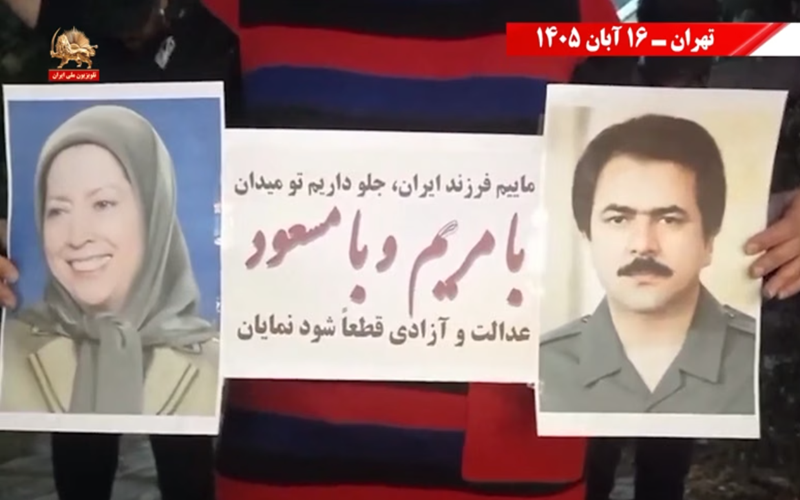

Activities across dozens of cities combine calls for a democratic republic, opposition to both monarchy and clerical rule, and a nationwide campaign against executions and political repression.
Iran’s Resistance Units and supporters of the Iranian Resistance carried out approximately 60 revolutionary activities during the third week of November 2026, marking the anniversary of the November 2019 uprising and expanding calls for renewed protests against the ruling regime. The activities included slogans, wall writings, leaflet distributions, photo campaigns, and audio messages across Tehran, Karaj, Shiraz, Isfahan, Qazvin, Kermanshah, Mashhad, and numerous other cities.
The campaign linked the memory of the November uprising to the struggle for a democratic republic, rejecting both the former monarchy and the current clerical dictatorship. Its central message was that Iran’s future must be determined by its people, free from both forms of authoritarian rule.
Among the slogans displayed across the country were “Death to the oppressor, whether Shah or Supreme Leader,” “Neither Shah nor Mullahs,” and “The Iranian people are awake and reject both Shah and Mullahs.”
In Tehran, activists called on the population to prepare for an uprising, declaring: “We are Resistance Units, ready for an uprising.” Other messages invoked the victims of repression and called for the establishment of a democratic republic in Iran.
Activities in Shiraz included wall writings stating that the November uprising had demonstrated that resistance was the answer to repression. Other slogans emphasized that neither monarchy nor clerical rule represented a future for Iran. In Karaj and Qazvin, messages attributed to Maryam and Massoud Rajavi called for resistance against dictatorship and the overthrow of the ruling establishment.
In Isfahan, activists highlighted the NCRI President-elect Maryam Rajavi’s Ten-Point Plan as a framework for guaranteeing a free Iran. In Kermanshah, slogans declared that those fighting for freedom would bring about victory.
The activities also extended to Rasht, Rudsar, Rafsanjan, Saveh, Anzali, Kurdku, Nahavand, and Noorabad, where activists displayed banners, distributed leaflets, and produced photo campaigns carrying messages of resistance and support for the Iranian Resistance.
The repeated rejection of both the Shah and the Supreme Leader underscored the campaign’s insistence that replacing one form of dictatorship with another is not the answer to Iran’s political crisis.
Nationwide campaign against executions and political repression
Alongside the November uprising activities, supporters of the Iranian Resistance launched a coordinated campaign against executions and in support of political prisoners on November 10, 2026 (19 Aban 1405).
The campaign included photo campaigns, leaflet distributions, and audio messages in Tehran, Isfahan, Zanjan, Hamedan, Semnan, Lahijan, Rasht, and Kerman. Activists condemned recent executions and demanded the cancellation of death sentences, the release of political prisoners, and an end to the regime’s use of capital punishment as an instrument of intimidation.
In Tehran, campaign materials specifically highlighted the cases of political prisoners Zahra Tabari, Arghavan Fallahi, and Manouchehr Fallah, demanding the cancellation of their death sentences and warning about the danger facing those threatened with execution.
Messages displayed in the capital included:
- “Every execution sentence is a wound inflicted on freedom.”
- “Political prisoners must be released.”
- “Executing people will ignite an uprising.”
- “The answer to executions is the rising flame of revolt.”
Other messages called for the release of prisoners arrested during the 2022 uprising and the December 2025–January 2026 protests.
In Isfahan, activists condemned the executions of Amirhossein Maleki and Amirhossein Ebrahimi, displaying messages demanding an end to executions in Iran. Their cases were also highlighted in Zanjan, where photo campaigns declared: “From the red blood of our comrades, a thousand storms will rise.”
The campaign in Zanjan also carried a broader human rights message: “No human being deserves execution.” In Hamedan, activists called for an Iran without executions and demanded the release of political prisoners, declaring that repression and executions could no longer silence society.
Audio campaigns amplify calls for an end to executions
Audio messages and public slogans extended the campaign beyond written materials, bringing its anti-execution message to several cities.
In Semnan, activists declared that freedom could not be killed by a hangman’s rope. Audio messages expressed support for the No to Execution Tuesdays campaign and called on the international community to take effective action against the growing wave of executions in Iran.
One message described executions as an instrument the regime uses to prolong its survival, calling on Iranians to unite against capital punishment and support freedom.
In Lahijan, audio messages emphasized that those facing execution would not surrender to intimidation. One declared: “We may give our lives, but we will never bow our heads.”
In Rasht, activists issued messages of defiance, including: “No more mourning, no more submission. We will return to the streets, this time stronger.”
Other messages stressed that the determination of resistance fighters could not be extinguished through executions and would instead spread among the population.
In Kerman, activists reiterated their support for No to Execution Tuesdays, describing the campaign as a voice of resistance and defiance against the regime’s execution apparatus.
Resistance continues despite escalating repression
The activities of the third week of November demonstrate how the Iranian Resistance’s grassroots network is combining political mobilization with opposition to executions and the imprisonment of activists.
The November uprising anniversary has provided an opportunity to renew calls for popular resistance, while the anti-execution campaign has connected the struggle for political freedom with the immediate defense of prisoners facing death sentences.
By carrying these messages into public spaces across the country, Resistance Units and supporters of the Iranian Resistance are challenging the regime’s efforts to impose silence through executions, intimidation, and repression.
Their message remains unequivocal: neither the Shah nor the Mullahs, but a democratic republic based on the sovereignty of the Iranian people.