


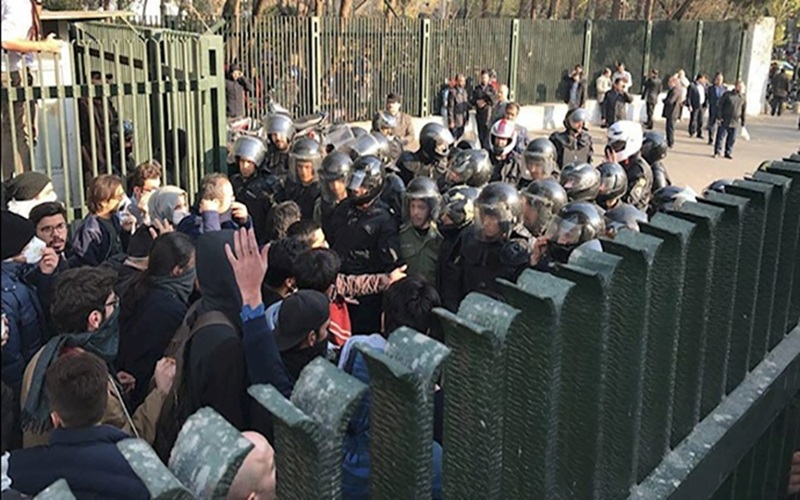

Mass disciplinary summonses, expulsions, and ideological interrogations reveal growing fears within the Iranian regime over student activism and rising social unrest.
As Iran grapples with deepening political, economic, and social crises, increasing attention has focused on the regime’s treatment of university students. While public discourse is often dominated by discussions of war, regional tensions, and diplomatic negotiations, recent developments inside Iranian universities suggest that authorities remain primarily concerned about growing domestic discontent and the possibility of renewed social unrest.
Reports from multiple universities indicate a sharp increase in disciplinary actions against students, including summonses, suspensions, and expulsions. According to accounts published in the Iranian newspaper Tose’e Irani, disciplinary committees have expanded their activities across campuses, targeting students involved in protests, activism, or expressions of dissent.
Universities Under the Shadow of Disciplinary Committees
Students and observers describe a growing atmosphere of intimidation inside Iran’s universities. The regime has increasingly relied on disciplinary committees as a tool to suppress student demands and limit political expression.
Critics argue that these measures directly undermine the core mission of universities as spaces for free thought, debate, and academic inquiry. Rather than addressing legitimate student concerns, authorities appear to be responding with punitive measures designed to discourage activism and silence criticism.
A report published on June 8 highlighted what it described as the “heavy shadow” of disciplinary committees across Iranian campuses. According to the report, the number of student summonses has risen dramatically, reflecting a widening gap between the student body and university administrators.
Allegations of Due Process Violations
Students have also reported significant procedural irregularities during disciplinary proceedings. According to testimonies cited in the report, severe penalties are being issued without proper adherence to established regulations.
Many students describe disciplinary hearings as opaque and arbitrary. One graduate student from Shahid Beheshti University reportedly stated that committee members appeared unfamiliar with the very regulations they were responsible for enforcing and refused to identify themselves during proceedings.
These allegations have fueled concerns that disciplinary committees are functioning less as administrative bodies and more as instruments of political control.
A Longstanding Conflict Between Students and Authoritarian Rule
The tensions unfolding today reflect a much deeper historical conflict between Iran’s student movement and the ruling establishment. Universities have long served as centers of political activism and demands for democratic reform.
Many students view the current crackdown as part of a broader effort to suppress independent thought and prevent universities from becoming catalysts for wider social mobilization.
One student from Iran University of Science and Technology reportedly described the disciplinary campaign as a product of a “deep bureaucratic crisis,” arguing that decision-makers are increasingly influenced by outdated and authoritarian ideological frameworks.
Ideological Interrogations and Collective Blame
Perhaps most troubling are reports describing ideological questioning and attempts to associate students with national tragedies and security-related incidents.
Students from several universities have alleged that disciplinary officials questioned them about their views on individuals killed during recent conflicts and attempted to portray student activism as contributing to national instability.
According to testimonies cited in the report, some students were asked whether they considered themselves responsible for the deaths of individuals killed during wartime events. Others described being subjected to political and ideological questioning unrelated to any academic or disciplinary matter.
Such practices have raised concerns among students and rights advocates about the increasing politicization of university disciplinary systems.
Female Students Among the Primary Targets
One of the most striking aspects of the recent wave of summonses is the reported profile of those being targeted.
A student from the University of Tehran told Tose’e Irani that between 100 and 150 students had received summonses or phone calls from disciplinary authorities. According to the account, the overwhelming majority of those targeted were undergraduate students, with women reportedly comprising approximately 80 percent of the cases.
The allegations suggest that female students continue to play a prominent role in campus activism and remain a major focus of the regime’s efforts to contain dissent.
Universities Remain a Frontline of Social Tensions
The latest developments highlight the continued importance of Iranian universities as arenas of political and social contestation. Despite extensive security measures and repeated crackdowns, student activism remains a significant source of concern for authorities.
As Iran’s internal crises deepen, the growing pressure on students appears to reflect broader fears within the ruling establishment about public dissatisfaction and the potential emergence of future protest movements.
The expanding use of disciplinary committees, mass summonses, and ideological interrogations suggests that the struggle between a younger generation seeking greater freedoms and a system determined to preserve political control remains far from resolved.