


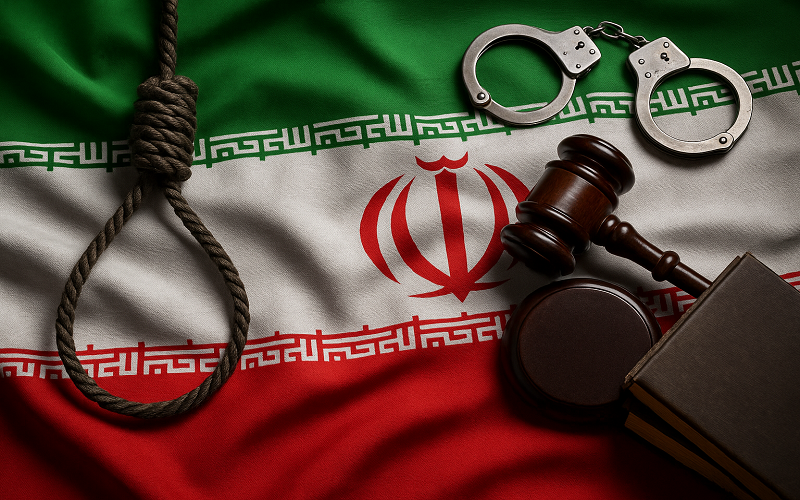

The Iranian regime continues to escalate its use of the death penalty, with a recent wave of executions raising alarms among human rights organizations. On Monday, June 2, authorities executed three prisoners at Qezel Hesar Prison in Karaj. All three had been convicted on drug-related charges by the Revolutionary Court.
A day earlier, on Sunday, June 1, a prisoner was executed in Kerman Prison, also on drug-related charges. That same day, two other inmates were reportedly executed in Bam Prison for similar offenses.
In Isfahan’s Dastgerd Prison, another prisoner was executed on charges of “war crimes” through armed robbery. Separately, an inmate convicted of premeditated murder has been transferred to solitary confinement in preparation for his imminent execution.
Use of Moharebeh and Politicized Charges
The charge of moharebeh (“enmity against God”), often used to justify the death penalty, remains a broadly applied legal tool in Iran’s judicial system. It has been used against members of Kurdish opposition groups, religious minorities, and individuals accused of economic corruption—often without transparent legal processes or internationally recognized standards of justice.
None of the recent executions have been officially confirmed by Iranian state media or regime sources. However, human rights monitors report that more than 10 individuals were executed in just two days last week.
Record-Breaking Execution Rates
According to human rights data, at least 930 executions took place in Iran in 2024—the highest annual figure in over a decade. Of these, at least 419 were carried out under Qesas (retribution) laws, primarily for murder charges.
This represents a steep rise from previous years: 282 executions in 2023, 288 in 2022, and 183 in 2021. The 2024 figure marks the highest number of Qesas executions since 2010.
Drug-related executions have surged dramatically, with at least 503 such executions in 2024 alone. This reflects a 6.6% increase over the 471 drug-related executions in 2023—and nearly 20 times the number reported in 2020. The steady rise over the past five years highlights a significant shift in the regime’s penal policy.
In just one month—the Iranian month of Ordibehesht (April-May 2025)—at least 170 executions were recorded, underscoring the accelerating pace.
Resistance Behind Bars: The “Tuesdays No to Executions” Campaign
In response to the execution surge, political prisoners in Iran have launched a growing campaign known as No to Execution Tuesday, now in its second year. The campaign involves weekly hunger strikes every Tuesday in prisons across the country. As of June 2025, the protest movement has spread to at least 40 prisons and garnered support from numerous human rights and political activists both inside and outside Iran.
The campaign symbolizes resistance to the state’s use of capital punishment as a tool of repression and control. While the Iranian government continues to ramp up executions, the campaign represents a growing domestic and international challenge to its policies.
Conclusion
Iran regime’s accelerating use of the death penalty—particularly for drug-related offenses and under vague or politicized charges—reflects a broader pattern of repression under the current regime.
With execution numbers reaching historic highs, and with mounting resistance both inside prisons and across civil society, Iran’s use of capital punishment is likely to remain a focal point of global human rights concern in the months to come.