Tehran’s address to the UN Human Rights Council revives official narratives that clash sharply with historical records and documented patterns of repression.
On February 24, Iran’s state-run News Network broadcast remarks by Kazem Gharibabadi, Deputy Foreign Minister for International Affairs, delivered at the United Nations Human Rights Council. He opened his speech with a sweeping assertion: “The Islamic Republic of Iran is a responsible and accountable country in the field of human rights.”
Diplomatic in tone, the statement was framed as an official defense of Tehran’s record. Yet in substance, it appeared less as a reflection of on-the-ground realities and more as a carefully constructed political narrative. For many Iranians and international observers, the claim stands in stark contrast to both historical memory and extensive documentation of systemic abuses.
A Record of Repeated Condemnation
Over the past 44 years, Iran’s regime has been condemned 76 times by the UN Human Rights Commission and its successor bodies for “gross violations of fundamental human rights.” Such a volume of resolutions is not episodic or incidental; it signals a persistent and structural pattern of abuse.
Equally significant is the regime’s consistent refusal to meaningfully respond to or implement the recommendations contained in those resolutions. The absence of accountability mechanisms, transparency, or judicial redress has reinforced the perception that the rhetoric of “responsibility” is detached from institutional practice. Non-compliance has, in effect, served as tacit confirmation of the very violations cited in the condemnations.
Rewriting the Iran-Iraq War Narrative
In another part of his speech, Gharibabadi stated that more than 830,000 people were killed during what he described as the “eight-year imposed war.” The reference was to the Iran-Iraq War.
However, historical records indicate that from May 1982 onward—after Iranian forces had recaptured much of their occupied territory—it was the decision of Ruhollah Khomeini to prolong the war. His declared objective of advancing “until the liberation of Quds (Jerusalem)” transformed the conflict from a defensive campaign into a prolonged and expansionist strategy.
From that juncture, responsibility for the continued human toll rested squarely with Tehran’s leadership. Characterizing the entire eight-year conflict as purely “imposed” obscures the political decision to extend hostilities well beyond the point at which a negotiated end was feasible. The human cost borne by both Iranian and Iraqi civilians was, in large part, the result of that choice.
The January 2026 Uprising and Official Contradictions
Gharibabadi also addressed the January 2026 uprising, but his account omitted any acknowledgment of state responsibility for the bloodshed. Instead, he attributed the violence to what he termed “rioters” and “terrorists,” repeating a familiar official narrative that reframes protesters as instigators of chaos.
He declared: “The unrest caused by rioters and terrorists led to the martyrdom of 2,427 innocent people and guardians of order and security out of a total of 3,117 fatalities in these incidents.”
Yet this official statistic raises fundamental questions. If 3,117 people died and 2,427 are categorized as “innocent people and security defenders,” who, then, is responsible for the remaining 690 deaths? Even by the regime’s own numbers, a significant portion of the casualties remains unexplained.
The pattern is consistent with previous episodes of unrest: alter the narrative, shift blame onto demonstrators, and avoid transparent investigation. Victims are recast as perpetrators, and systemic accountability is replaced by rhetorical inversion.
A Structural Pattern of Suppression
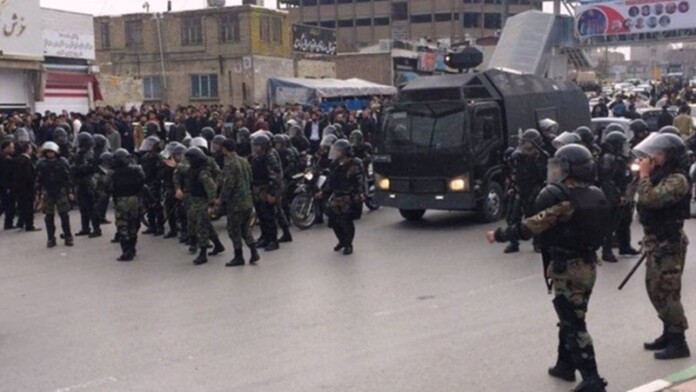
What emerges from both the UN speech and decades of domestic experience is a durable behavioral model: suppression, denial, and narrative manipulation in response to public dissent. Whenever protests have erupted across Iran, the state’s reaction has relied overwhelmingly on coercive force, followed by information control and historical revisionism.
This approach has deepened the divide between society and the ruling establishment. The accumulation of unresolved grievances—political, social, and economic—has transformed human rights accountability from a diplomatic talking point into a central national demand.
Human Rights as a National Imperative
The past 47 years provide ample evidence that calls for systemic change in Iran are inseparable from demands for justice. For many Iranians, the pursuit of accountability is not merely a political objective but a moral and historical necessity.
The insistence on redress for victims of state violence, from the Iran-Iraq War to the January 2026 uprising, reflects a broader conviction: that sustainable stability and legitimacy cannot exist without transparency and responsibility.
As Tehran continues to present itself internationally as “accountable,” the weight of documented history suggests otherwise. Until are regime change, the demand for human rights accountability in Iran will not be realized.