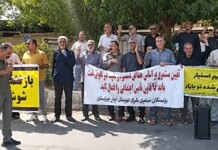
In a bold act of defiance, prisoners across Iran have launched a hunger strike to protest the regime’s escalating use of executions. This strike coincides with the fifty-seventh week of the “No to Executions Tuesdays” campaign, a growing movement against capital punishment in the country.
Nationwide Prisoner Protest
In an unprecedented move, prisoners in 37 Iranian prisons have joined the hunger strike to oppose the alarming rise in executions. A group of prisoners from Qazvin’s Chobindar Prison announced their participation, emphasizing their determination to resist the unjust death sentences imposed on both political and non-political detainees. Their statement declared that, starting Tuesday, February 25, they would refuse food in solidarity with the broader campaign, continuing their strike until the regime halts its execution spree.
Escalation of Executions
The prisoners’ statement highlights a disturbing trend: following the conclusion of the regime’s ceremonies in Bahman (January 20 – February 18), the Iranian judiciary has intensified its execution rate. On just February 19 and 20, 17 inmates were executed, with 10 of them hanged in Ghezel Hesar Prison alone. This sharp increase in capital punishment has raised widespread concern among human rights activists and organizations.
Systematic Negligence and “Murder by Deprivation”
Beyond official executions, prisoners warn of another form of state-sanctioned killing—deliberate medical neglect. Within just the past week, three inmates perished in the prisons of Urmia, Iranshahr’s Lajevardi Prison, and Dehdasht due to a lack of medical attention.
“This situation threatens the lives of many other prisoners,” their statement reads. “The death of sick prisoners due to lack of timely medical care is nothing but ‘systematic murder.’”
Imminent Execution Threats
The prisoners also raised alarms about the fates of political detainees Mehdi Hassani and Behrouz Ehsani, whose requests for retrial were rejected by the Supreme Court, placing them at immediate risk of execution. Similar threats loom over other prisoners, including Pakhshan Azizi and Verisha Moradi in Evin Prison and Sharifeh Mohammadi in Lakan Rasht Prison. Their cases exemplify the regime’s continued efforts to silence dissent through judicial repression.
Political Manipulation of the Judiciary
The “No to Executions Tuesdays” campaign had previously warned that the appointment of Jafar Montazeri, the former Attorney General, as the head of the Supreme Court would lead to the politicization of judicial rulings. Given Montazeri’s history of prioritizing security policies over judicial independence, campaign organizers anticipated an acceleration of executions and the confirmation of Revolutionary Court rulings through special branches of the Supreme Court.
“This appointment fully demonstrated the inefficiency of this body in providing fair trial,” the prisoners’ statement asserts.
A Call to Action
The campaign unequivocally condemns all death sentences, irrespective of the charges against the convicts. It has vowed to continue its efforts to abolish the death penalty in Iran.
“We call on all human rights defenders, political, civil, and trade union activists, and all conscientious individuals in Iran and around the world to unite in the fight to abolish executions and to be the voice of prisoners sentenced to death,” the statement urges.
Participating Prisons
The hunger strike has garnered participation from inmates in the following prisons:
- Tehran & Alborz Provinces: Evin Prison (women’s ward, wards 4 and 8), Ghezel Hesar Prison (units 3 and 4), Karaj Central Prison, Greater Tehran Prison
- Isfahan Province: Arak Prison, Asadabad Prison, Dastgerd Prison
- Khuzestan Province: Sheiban Prison, Sepidar Prison, Ramhormoz Prison
- Fars Province: Nezam Prison in Shiraz, Adelabad Prison (men’s and women’s wards)
- Khorasan & Kerman Provinces: Bam Prison, Kahnuj Prison, Mashhad Prison
- Northern & Western Provinces: Qaemshahr Prison, Lakan Prison in Rasht (men’s and women’s wards), Ardabil Prison, Tabriz Prison, Urmia Prison, Salmas Prison, Khoy Prison, Naqadeh Prison, Saqqez Prison, Baneh Prison, Marivan Prison, Kamyaran Prison, Tabas Prison, Khorin Prison in Varamin, Rudsar Prison, Talesh Prison
- Other Regions: Borazjan Prison, Gonbad-e Kavus Prison, Dizel Abad Prison in Kermanshah, Joveyn Prison, Chobindar Prison in Qazvin
This nationwide action highlights the growing opposition to Iran’s execution policies, with prisoners risking their lives to demand justice. As international outcry mounts, human rights organizations continue to call for global pressure on the Iranian regime to end its reliance on capital punishment as a tool of oppression.