


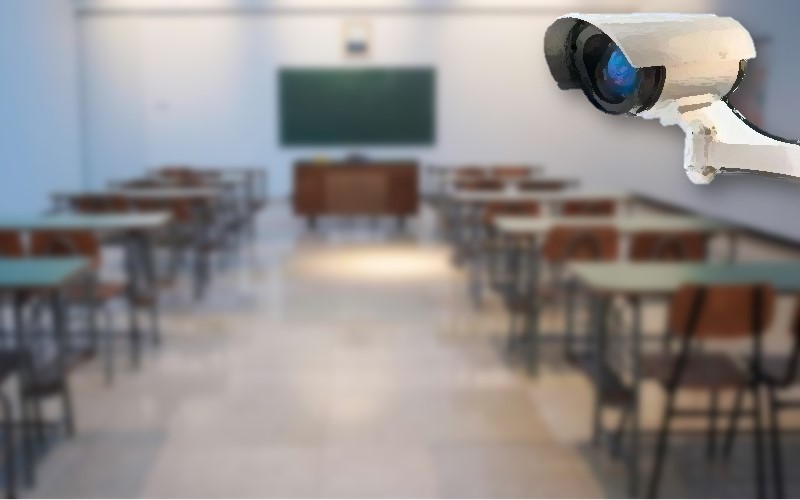

The Iranian regime’s Revolutionary Guards-affiliated Tasnim news agency has reported growing discussions within the Ministry of Education about the installation of surveillance cameras in school classrooms. This proposal has sparked significant controversy among ministry officials, teachers, and civil society activists, many of whom had previously warned about the implications of increased surveillance in schools.
A Contentious Debate
In a report titled “Installing Cameras in School Classrooms: Yes or No?”, published on Monday, March 24, Tasnim highlighted that while most schools in Iran are already equipped with security cameras in hallways and courtyards, classrooms have largely remained exempt from such surveillance.
The report noted that the issue has been debated for over a decade, but education officials have consistently refrained from implementing it due to various concerns, including resistance from teachers’ unions. Some officials argue that classrooms serve as a “private space” for teachers and that constant surveillance could hinder their ability to teach freely.
Government Justifications and Concerns
Despite longstanding opposition, security institutions affiliated with the regime are pushing for classroom surveillance, particularly as concerns about declining educational quality grow. In a recent interview with the state-run IRNA news agency, Ali Farhadi, spokesperson for the Ministry of Education, cited the negative impact of frequent school closures on student learning as a justification for increased monitoring.
Mohammad Salimi, Director General of Performance Evaluation and Complaints Response at the Ministry of Education, also weighed in on the debate. Speaking to Tasnim, he acknowledged that while the classroom is “under the teacher’s control,” the presence of cameras could impose restrictions on educators. He further suggested that making classrooms more transparent—such as replacing walls with glass—could enhance oversight but admitted that such measures would negatively affect teaching quality.
Comparisons with Other Countries
Tasnim’s report attempted to justify the proposed surveillance by citing China’s extensive use of classroom cameras to “improve educational standards and monitor teachers’ performance.” However, the outlet also acknowledged resistance in Western countries such as Germany and France, where critics argue that such surveillance violates teachers’ privacy and creates an oppressive classroom environment.
Broader Implications of Increased Surveillance
The push to install classroom cameras is seen by many as part of the Iranian regime’s broader efforts to tighten control over schools, particularly in the wake of widespread protests. Since the 2022 uprising, in which teachers and students played a crucial role, authorities have intensified efforts to suppress dissent within educational institutions.
Over the past two decades, the regime has employed various repressive measures against students, teachers, and union activists, particularly in the aftermath of anti-regime protests. These have included:
- Chemical attacks on girls’ schools
- Threats of expulsion and suspension of students
- The dismissal and imprisonment of teachers and union activists
One notable incident occurred in October 2024, when the administration of Farzanegan-1 Girls’ High School in Tehran was abruptly changed. This led to protests from parents outside the local Education and Training Center. One parent alleged that “the new administration has stopped working with male teachers and installed cameras in every part of the school, even in the bathrooms.”
In another case, Zahra Lori, principal of Rezvaninejad School in Kerman, was dismissed from her position in 2022 after refusing to hand over the names of protesting students and camera footage to authorities. She died shortly after her dismissal, raising suspicions about the circumstances of her death.
Conclusion
The proposal to install surveillance cameras in classrooms represents yet another attempt by the Iranian regime to extend its control over the education system. While officials frame it as a measure to improve educational oversight, many see it as a means of further repressing students and teachers who dare to challenge the regime’s policies.
With continued opposition from educators, parents, and civil society activists, the debate over classroom surveillance is likely to remain a flashpoint in Iran’s ongoing struggle for academic freedom and civil liberties.