


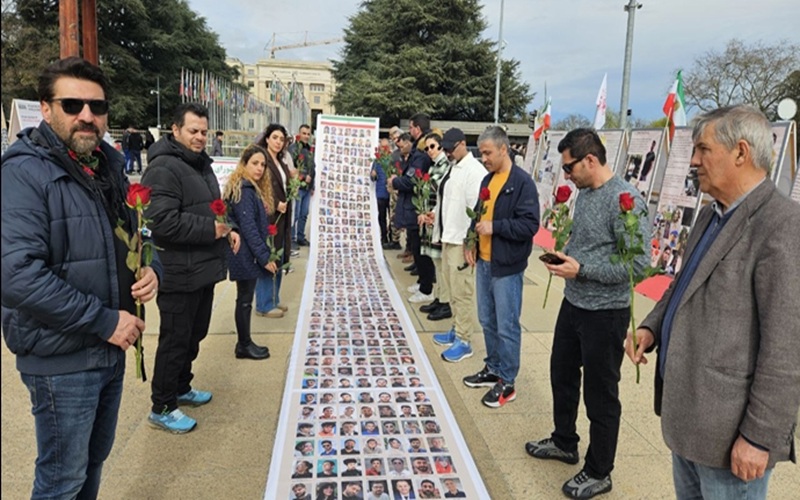

A review of human rights violations reveals a sharp escalation in executions, mass arrests, and lethal crackdowns during Iran’s Year 1404
A Year Defined by Escalating Repression
The human rights record of Iran during the Persian year 1404 (March 21, 2025 – March 20, 2026) stands among the darkest in recent history. Facing an acute crisis of survival, the ruling establishment intensified its reliance on repression, resulting in a dramatic surge in executions, arrests, and systemic violence. From the outset of the year, the rate of executions increased significantly and continued to rise in an exponential pattern over subsequent months.
This escalation coincided with mounting social unrest and culminated in a nationwide uprising on December 28, 2025. In response, regime authorities imposed internet shutdowns and ordered a vast crackdown, further amplifying the scale of human rights violations.
Executions: A Record Surge
At least 2,657 executions were recorded during the year, more than doubling the 1,155 executions documented in 2024. Given the prevalence of secret executions and limited transparency—especially during periods of conflict—the actual figure is likely higher.
The monthly distribution reflects a sharp concentration of executions toward the end of the year, with December 2025 recording at least 376 executions, while March 2026 saw the lowest monthly figure at 65.
Of the total executions, 2,548 men were executed in prisons compared to 1,110 in the previous year, while 13 individuals were executed publicly, nearly doubling the seven recorded in 2024. Public executions took place across multiple cities between May 2025 and March 2026, including cases such as a 23-year-old executed on May 27, 2025 in Nurabad, and several others in locations including Bukan, Damghan, Lar, Kordkuy, Yasuj, Bastam, Semnan, and Borazjan. On March 19, 2026, three individuals arrested during the January 2026 uprising were executed publicly in Qom.
The data also indicates the execution of eight juvenile offenders, up from seven in the previous year. These executions occurred between April and October 2025 in prisons across the country, including Gonbad-e Kavus, Karaj, Arak, Malayer, Shiraz, and Zahedan.
Political Executions
A total of 22 political prisoners were executed during the year, including 19 inside prisons and three in public. These executions targeted individuals from diverse ethnic and religious backgrounds, including Sunni and Baluch minorities.
Among the earliest cases were five prisoners executed on April 8, 2025 in Mashhad on charges related to alleged membership in Salafi groups. Additional executions followed throughout the year, including individuals accused of national security offenses, participation in protests, or affiliation with opposition groups.
Notably, on October 4, 2025, six political prisoners were executed in Ahvaz, while another prisoner was executed the same day after serving 16 years in detention. The pattern of executions indicates a systematic use of capital punishment as a tool of political control.
Mass Killings During the December Uprising
A major turning point occurred during the nationwide protests that escalated from December 28, 2025. According to a detailed investigation by Human Rights Watch, security forces carried out a coordinated and large-scale use of lethal force against unarmed civilians beginning December 8, 2025.
The report, based on eyewitness testimony, verified videos, and field evidence, suggests that thousands of people were killed across multiple provinces, including Tehran, Alborz, Kermanshah, Razavi Khorasan, Gilan, Mazandaran, Markazi, and Kohgiluyeh and Boyer-Ahmad. In some documented footage from forensic facilities in southern Tehran, at least 400 bodies were visible in a single set of videos, indicating a far higher total death toll.
Security forces reportedly used military-grade firearms, with many victims shot in the head or upper body. Even official sources indirectly acknowledged that the number of fatalities reached several thousand.
The investigation also highlights systematic efforts to conceal evidence, including withholding bodies, conducting secret burials, and threatening victims’ families. Interviews conducted between January 12 and January 14, 2026 with at least 21 witnesses and the verification of 51 images and videos further substantiate the scale of the crackdown.
Mass Arrests: Over 27,000 Detained
During the same period, at least 27,752 individuals were arrested. Arrests peaked in January 2026 with 23,710 cases, while the lowest number, 319, was recorded in April 2025.
The overwhelming majority—26,677 cases—were politically motivated, targeting protesters, activists, lawyers, athletes, and individuals expressing dissent online or participating in gatherings. Many arrests were linked directly to the December uprising and its aftermath.
An additional 902 arrests were categorized as arbitrary detentions, often carried out under vague pretexts such as online activity, alleged moral violations, or economic survival activities such as fuel carrying and cross-border labor. Another 150 arrests targeted religious minorities, including followers of the Baha’i and Christian faiths, while 23 cases were classified as social arrests.
Extrajudicial Killings and Deaths in Custody
Beyond executions, at least 161 individuals lost their lives in incidents classified as extrajudicial killings. These include 14 cross-border laborers (kolbars), 37 fuel carriers, and 101 civilians killed by direct gunfire in public spaces. Additionally, nine prisoners died under torture while in custody.
These figures do not include deaths resulting from torture during the December uprising, for which reliable statistics remain unavailable.
Torture and Physical Punishment
Documented cases of torture remain limited due to severe restrictions on reporting. However, at least 14 cases of physical torture, five cases of flogging, and five cases of limb amputation were recorded during the year. These figures likely represent only a fraction of actual incidents, particularly given the lack of transparency surrounding post-uprising repression.
Conclusion
The statistical record of Iran’s 1404 year reveals a systematic escalation of state violence across multiple dimensions, including executions, mass killings, arbitrary arrests, and torture. The sharp increase in executions—exceeding 2,600 cases—combined with tens of thousands of arrests and evidence of large-scale killings during protests, underscores a strategy centered on deterrence through extreme repression.
Taken together, these figures illustrate not isolated violations but a coordinated pattern of human rights abuses at a national scale, raising urgent concerns about accountability and the continued trajectory of governance in Iran.