


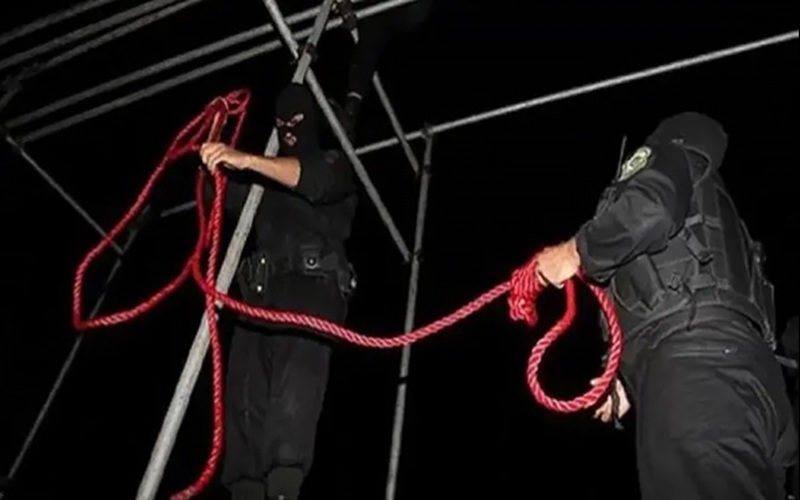

As poverty, inflation, and economic deprivation deepen, Iran’s regime is intensifying executions to suppress dissent and prevent another nationwide uprising.
Poverty and soaring prices are devastating Iranian households. Economic misery is reaching unprecedented levels, inflation is spiraling out of control, retirees are demanding the basic right to live with dignity, and rent-seeking has become a defining feature of Iran’s political and economic vocabulary.
Yet beneath all these crises lies an even more urgent reality: the regime’s escalating use of executions in response to persistent social unrest and its fear of another nationwide uprising.
Iran’s economic and social crises cannot be separated from the regime’s political crisis. The structural causes of economic instability are rooted in a political system whose overriding priority is self-preservation through repression and economic oligarchy. National revenues and resources are diverted toward maintaining the regime and its coercive apparatus, with devastating political and economic consequences.
The result is a cycle in which political repression produces deeper economic dysfunction, while economic deprivation fuels further public discontent—and, in turn, prompts even harsher repression.
Executions: The Front Line of the Regime’s Repression
The most visible front line of the regime’s dictatorship is the gallows.
Executions are not merely a judicial or legal issue in Iran. They have become a central instrument of political repression, designed to intimidate society, silence protesters, and deter future uprisings. This is why the execution crisis increasingly overshadows every other political and economic issue in the country.
A regime presiding over one of the world’s highest execution rates is also presiding over an economy characterized by deep structural dysfunction, widespread poverty, corruption, inflation, and declining purchasing power.
The connection is not accidental. Resources that could address the country’s economic and social needs are instead consumed by the machinery of repression and the broader apparatus required to preserve the regime.
European Union Documents Highlight Systematic Abuses
The international consequences of Iran’s execution policy have increasingly drawn attention.
On August 11, 2026, the European External Action Service (EEAS), in its country report on Iran as part of its Human Rights and Democracy in the World 2025 report, documented serious cases of repression linked to Iranian state bodies.
The report noted:
“On 15 July 2025, reacting to serious cases of transnational repression by Iran, the EU imposed restrictive measures on eight individuals and one entity responsible for committing serious human rights violations and abuses on behalf of the Iranian state bodies outside of Iran, in particular extrajudicial, summary and arbitrary executions and killings as well as enforced disappearances of persons deemed to be opponents or critical of the actions or policies of the Islamic Republic of Iran.”
The report also described EU sanctions imposed on April 14 against seven individuals and two entities involved in serious human rights violations inside Iran. Among the sanctioned entities were Shiraz Central Prison, also known as Adel Abad Prison, and the First Branch of the Revolutionary Court of Shiraz.
According to the EEAS, detainees—including political opponents, ethnic and religious minorities, and unlawfully detained European citizens—faced arbitrary detention, the denial of fair trials, and executions.
The report further highlighted the role of senior officials in Iran’s judicial and prison systems in maintaining convictions based on forced confessions, systematically denying fair-trial rights, and facilitating repression and violence against dissidents and minority groups.
EU Condemns Executions of Iranian Protesters
The pace of executions has also triggered repeated condemnation from European officials.
In an April 28, 2026 statement titled “Iran: Statement by the Spokesperson on executions,” the EEAS declared:
“The current pace of executions in Iran is appalling. The EU has a firm and principled opposition to the use of capital punishment in all cases and in all circumstances. The death penalty is incompatible with the inalienable right to life and the absolute prohibition of cruel, inhuman or degrading punishment. It fails to act as deterrent to crime and makes miscarriages of justice irreversible.”
The statement called on the Iranian authorities to pursue a consistent policy toward the complete abolition of the death penalty.
It also specifically condemned the use of executions as a tool against dissent:
“We condemn in particular the use of capital punishment as a response to domestic dissent.”
The EU urged the Iranian authorities to immediately stop imposing and carrying out death sentences against protesters and called for the release of people unjustly arrested for exercising freedom of expression.
The statement further reminded Tehran of its obligations under international law, including the International Covenant on Civil and Political Rights, to which Iran is a party.
The “No to Execution” Movement Challenges the Regime
Against this backdrop, Iran’s growing “No to Execution” movement has emerged as a direct challenge to the regime’s strategy of intimidation.
Political prisoners have continued the “No to Execution Tuesdays” campaign into its third year, refusing to accept executions as an inevitable feature of life under the regime. The campaign has expanded across Iran’s prisons and has increasingly become a symbol of resistance to the death penalty and political repression.
The significance of this movement extends beyond prison walls.
By challenging executions, prisoners are challenging one of the regime’s principal mechanisms for controlling society. Their resistance exposes the political nature of executions and links the fate of political prisoners to the broader struggle of Iranian society against repression, poverty, corruption, and economic deprivation.
The regime’s reliance on executions reveals its fundamental weakness: rather than addressing the economic and social grievances driving public discontent, it responds with intimidation and force.
A Regime Trapped Between Economic Crisis and Social Unrest
Iran’s overlapping crises are therefore part of a single political equation.
Inflation and poverty erode living standards. Economic corruption and rent-seeking deepen inequality. Retirees and workers protest for basic economic rights. Young people face an increasingly uncertain future. And persistent social unrest demonstrates that public anger has not been extinguished.
The regime’s answer is repression.
Executions are the most extreme expression of this strategy. They are intended not only to punish individuals but also to send a warning to an entire society: dissent will carry the highest possible price.
But the persistence and expansion of the “No to Execution” movement demonstrate the limits of this strategy.
The more the regime relies on executions to preserve itself, the more clearly it exposes the political nature of the death penalty. And the more society resists, the harder it becomes for executions to serve as an effective instrument of intimidation.
The struggle against executions is therefore inseparable from the broader struggle against the regime’s political and economic system. As long as the regime continues to rely on repression as its principal means of survival, the gallows will remain a central feature of its rule.
But the growing resistance to executions points in the opposite direction: toward a society determined to break the cycle of repression and reclaim its fundamental rights.
The “No to Execution” movement is expanding that challenge. Its message is increasingly reaching beyond Iran’s prisons and borders—and it may ultimately deprive the regime of the very instrument it relies upon to keep society silent.