


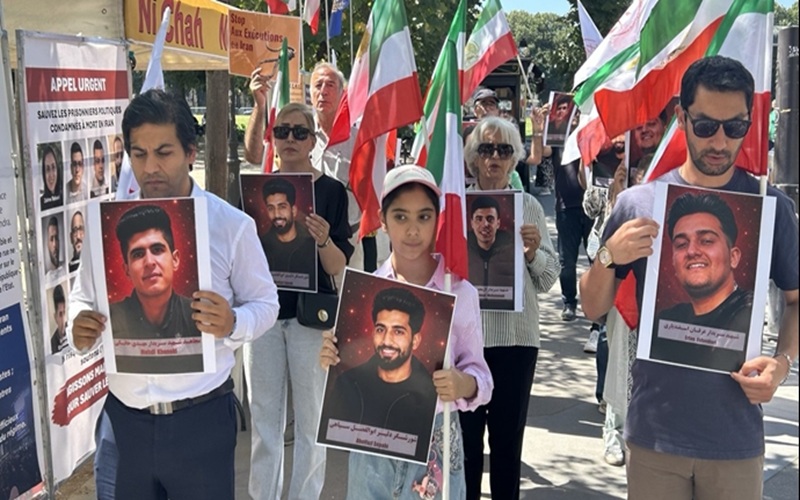

The public hanging of two January 2026 protesters in Isfahan underscores an escalating execution campaign as human rights groups warn that hundreds of political prisoners face death.
The Iranian regime publicly hanged two young protesters in Isfahan on Tuesday, marking another step in what human rights organizations describe as an accelerating campaign of executions aimed at crushing political dissent and intimidating the public.
Abolfazl Sepahi Badjani, 24, and Amirhossein Safari Hosseinabadi, 27, were executed in Alikhani Square after being convicted in connection with the January 2026 nationwide uprising. Authorities accused them of moharebeh (“waging war against God”), setting fire to a police station, possessing weapons and Molotov cocktails, and involvement in the deaths of four security personnel.
The executions were carried out publicly despite repeated international appeals to halt them and growing warnings that dozens of other political prisoners face the same fate.
A Growing Number of Political Prisoners Face Execution
The Isfahan executions are only the latest in a rapidly expanding wave of capital punishment targeting protesters and political prisoners.
According to human rights organizations, hundreds of political prisoners and protesters currently face charges that carry the death penalty, while around 100 death sentences have already been issued. One of the most alarming cases involves approximately 70 prisoners in Dastgerd Prison in Isfahan, where dozens remain under sentence of death.
The two executed protesters belonged to the Alikhani Square case, in which twelve defendants arrested during the January uprising received death sentences. Four have now been executed, leaving eight young prisoners still awaiting execution.
Human rights organizations have repeatedly urged governments to place the regime’s expanding execution campaign at the center of any diplomatic engagement with Tehran, warning that silence will only encourage further killings.
Public Executions and Secret Death Sentences
Rights groups say the authorities are relying not only on public executions to spread fear but also on opaque judicial procedures that deny defendants and their families even the most basic legal protections.
One recent example is Vahid Baniamerian, a 34-year-old physics lecturer sentenced to death alongside five others after being accused of membership in the People’s Mojahedin Organization of Iran (PMOI/MEK).
According to relatives, the family learned about his death sentence only after reading reports published by state-controlled media indicating that the Supreme Court was reviewing the case.
“They gave us no warning. Even his lawyer knew nothing,” one relative said. “It was completely illegal, even under their own repressive laws.”
Human rights organizations say Baniamerian was one of dozens of political prisoners executed since the outbreak of the recent war.
Public Anger Meets Heavy Security
Authorities surrounded the execution site in Isfahan with a heavy security presence, deploying forces on nearby streets and rooftops in anticipation of public protests.
Despite the intimidation, witnesses reported that members of the crowd shouted “Shameless! Shameless!” as the executions were carried out.
Security forces responded by deploying riot police, firing warning shots, and using tear gas and stun devices to disperse the gathering.
The public hanging appears intended to reinforce the regime’s campaign of intimidation at a time of growing political uncertainty and social unrest.
Maryam Rajavi Urges Immediate International Action
Following the executions, Maryam Rajavi, President-elect of the National Council of Resistance of Iran, called on the United Nations, the European Union, and international human rights organizations to intervene immediately to stop the regime’s execution campaign.
She specifically appealed for urgent action to save the lives of the eight remaining prisoners in the Alikhani Square case:
- Alireza Sepahi, 24
- Qaem Hosseini, 20
- Shervin Bagherian, 18
- Amirhossein Ebrahimi, 19
- Amirhossein Maleki, 19
- Ali Dashti, 19
- Abolfazl Ebrahimi, 18
- Alireza Raeisi, 21
Rajavi warned that the regime was using executions to prevent renewed nationwide protests and argued that continued international inaction amounts to a green light for further killings. She called for the regime’s crimes to be referred to the United Nations Security Council and for its leaders to be held accountable for crimes against humanity.