


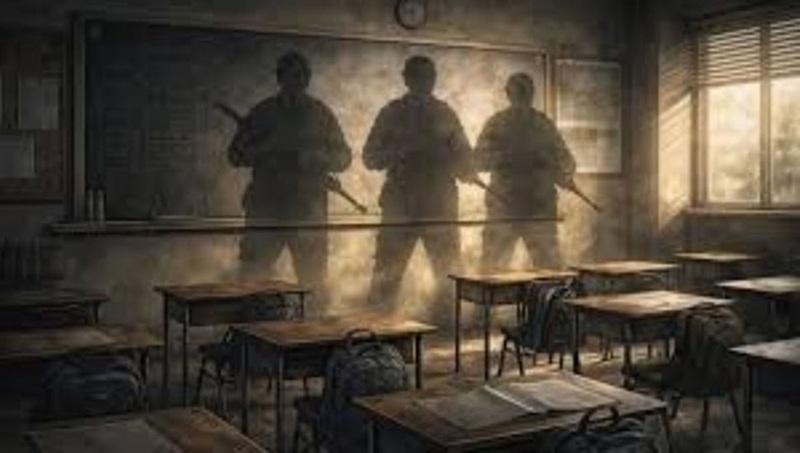

Teachers’ union warns of systematic security infiltration of schools as authorities attempt to contain post-uprising anger.
In the aftermath of the bloody January uprising, Iran’s clerical regime—fully aware of the political and social consequences of its violent crackdown—has turned to maximum intimidation to contain mounting public anger.
According to a report published on Thursday, February 12, 2026, by the Coordinating Council of Teachers’ Trade Associations of Iran, authorities have initiated what it describes as a “silent expansion of repression in schools following the nationwide January uprising.”
The report outlines what it calls a systematic national pattern. Schools, it warns, have increasingly become extensions of the state’s repressive apparatus. Individuals operating under the labels of Basij forces, religious propagandists, and plainclothes agents have entered educational institutions across the country.
Schools Turned into Security Zones
Since its establishment, the regime has regarded the younger generation—students and university youth alike—as an existential threat. The January uprising once again demonstrated the central role of youth in nationwide protests.
Having already subjected many students to lethal violence during the uprising, regime authorities now appear determined to transform schools from supportive institutions into mechanisms of surveillance and fear. According to the teachers’ council, schools risk becoming “a source of threat rather than support,” where students no longer see themselves as valued members of a learning community, but instead as security subjects under suspicion.
The consequences are already visible. The report notes increased cases of school avoidance and declining academic motivation among students exposed to the prevailing atmosphere of intimidation.
A Pattern of Gross Human Rights Violation
The regime’s response to dissent has long included measures that constitute gross human rights violation, from violent suppression of protests to systematic surveillance in educational institutions. The post-uprising strategy described in the teachers’ report adds a new layer: institutionalized psychological pressure targeting minors.
Religious-political totalitarianism under Velayat-e Faqih has a documented history of fracturing families and eroding social trust. For years, morality patrols operated in public spaces, while ideological-security organs monitored schools, universities, factories, and offices. These mechanisms cultivated suspicion not only between citizens and the state but also within families themselves.
Now, following the January crackdown, authorities appear to be advancing what the teachers’ council describes as a policy aimed at dismantling trust between educators and students.
In the report’s concluding section, the council warns:
“The police-like atmosphere has led some students to perceive teachers as ‘monitors’ or ‘informants.’ This environment targets the emotional capital of the classroom and deepens adolescents’ mistrust toward adults, including parents and school staff.”
Governing Through Fear
The cumulative picture presented by the teachers’ associations is stark. It suggests a governing system that has lost the capacity for conventional governance and increasingly relies on massacre, intimidation, and the psychological dismantling of its own society to maintain control.
Rather than stabilizing the situation, however, such measures risk accelerating the regime’s political erosion. In the volatile aftermath of the January massacre, the equation between the Iranian majority and the ruling establishment has become increasingly binary: repression versus resistance.
History suggests that intensifying gross human rights violation does not extinguish dissent—it hardens resolve. The attempt to control the next generation through fear may ultimately strengthen their determination to bring an end to clerical authoritarian rule.
As the teachers’ report makes clear, today’s schools have become a frontline in Iran’s broader struggle—one where the battle is not only over political power, but over trust, dignity, and the future of an entire generation.