


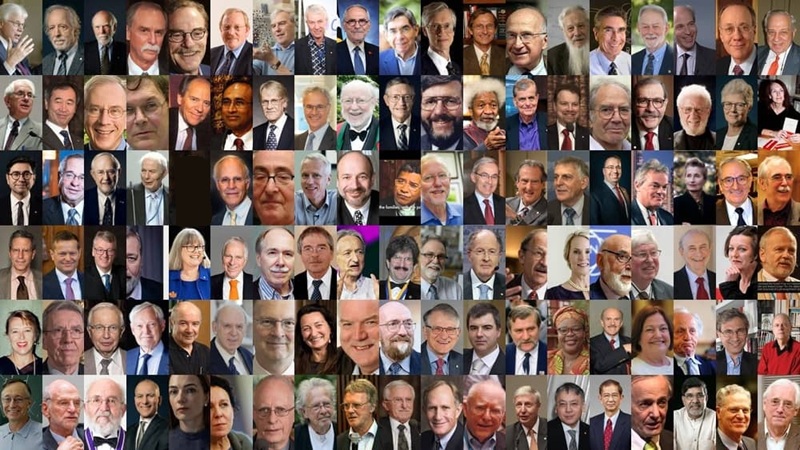

Unprecedented joint statement by global scientific, literary, and political figures backs Iranian protesters and rejects all forms of dictatorship—monarchical or religious.
When protest voices in Iran’s streets are answered with bullets and demonstrators continue to stand firm, the conscience of the world inevitably speaks. That moral voice has now taken a historic and unmistakable form: a joint statement signed by 114 Nobel Prize laureates from across disciplines and continents, expressing unequivocal support for the Iranian people’s uprising.
This declaration is not a routine gesture of solidarity. It represents a rare global consensus among some of the most distinguished figures in science, literature, medicine, economics, and peace advocacy. The signatories condemn the Iranian regime’s repression and gross human rights violations while endorsing the people’s demand for freedom, social justice, and the establishment of a democratic republic.
A Global Moral and Intellectual Consensus
Among the signatories is José Ramos-Horta, Nobel Peace Prize laureate and current President of East Timor, a nation that itself endured occupation and dictatorship before achieving independence. His presence at the forefront of the list underscores the historical resonance of Iran’s struggle.
He is joined by Lech Wałęsa, the iconic leader of Poland’s Solidarity movement and former President of Poland, whose leadership helped dismantle communist authoritarianism in Eastern Europe. Also among the political figures is Óscar Arias, Nobel Peace Prize laureate and former President of Costa Rica.
Yet this statement is not merely the voice of former statesmen. It carries the authority of cultural and scientific pioneers. Nine Nobel laureates in literature—including Annie Ernaux, Kazuo Ishiguro, Orhan Pamuk, and Wole Soyinka—affirm that the Iranian people have rejected “any form of dictatorship, whether monarchical or religious,” framing the uprising not merely as a political revolt but as a profound cultural and civilizational demand.
The Weight of Science Behind the Statement
The scientific authority behind the declaration is striking. Dozens of Nobel laureates in physics, chemistry, medicine, and economics—individuals who have shaped humanity’s understanding of disease, matter, markets, and the cosmos—have lent their names in support.
Among them are Daron Acemoglu, Nobel laureate in economics, whose work on institutions and democracy has profoundly influenced modern political economy; Pierre Agostini, Nobel laureate in physics; Frances Arnold, Nobel laureate in chemistry; and Geoffrey Hinton, a 2024 Nobel laureate in physics recognized for foundational contributions to artificial intelligence.
Their message is explicit: a system that, according to the statement, has executed more than 2,200 people in 2025 alone in an attempt to quell dissent cannot claim moral or political legitimacy.
The declaration emphasizes that despite “brutal and shameless repression,” the regime has failed to extinguish the uprising. It asserts that the Iranian people “deserve the strong and unwavering support of the free world.”
A Call to Democratic Nations
Beyond moral condemnation, the statement includes a direct appeal to leaders of democratic countries. The laureates urge them to support the Iranian people’s struggle for change, freedom, and social justice, and to assist Iran in joining the community of democratic nations.
The breadth of the signatories—spanning peace activists, economists, physicists, physicians, and literary figures—signals that Iran’s uprising is no longer perceived as an isolated domestic disturbance. It is recognized as a pivotal struggle with global moral implications.
When Nobel Prize winners—from politics and literature to medicine and economics—speak in unison to reject both monarchy and theocracy and to endorse a democratic republic, the message is unmistakable:
The Iranian uprising is no longer solely the voice of the streets. It is the voice of the world’s awakened conscience.
Signatories: 114 Nobel Prize Laureates Supporting the Iranian People
- José Ramos-Horta – Nobel Peace Prize (1996), East Timor
- Lech Wałęsa – Nobel Peace Prize (1983), Poland
- Óscar Arias – Nobel Peace Prize (1987), Costa Rica
- Daron Acemoglu – Nobel Prize in Economics (2024), Turkey–USA
- Pierre Agostini – Nobel Prize in Physics (2023), France
- Peter Agre – Nobel Prize in Chemistry (2003), USA
- Harvey J. Alter – Nobel Prize in Medicine (2020), USA
- Victor Ambros – Nobel Prize in Medicine (2024), USA
- Frances Arnold – Nobel Prize in Chemistry (2018), USA
- Alain Aspect – Nobel Prize in Physics (2022), France
- Robert Aumann – Nobel Prize in Economics (2005), USA–Israel
- Barry Barish – Nobel Prize in Physics (2017), USA
- Moungi Bawendi – Nobel Prize in Chemistry (2023), USA–France–Tunisia
- Georg Bednorz – Nobel Prize in Physics (1987), Germany
- Carlos Filipe Ximenes Belo – Nobel Peace Prize (1996), East Timor
- Bruce Beutler – Nobel Prize in Medicine (2011), USA
- William C. Campbell – Nobel Prize in Medicine (2015), Ireland–USA
- Mario Capecchi – Nobel Prize in Medicine (2007), Italy–USA
- Thomas Cech – Nobel Prize in Chemistry (1989), USA
- Aaron Ciechanover – Nobel Prize in Chemistry (2004), Israel
- Elias James Corey – Nobel Prize in Chemistry (1990), USA
- Mairead Corrigan Maguire – Nobel Peace Prize (1976), Northern Ireland
- Johann Deisenhofer – Nobel Prize in Chemistry (1988), USA
- François Englert – Nobel Prize in Physics (2013), Belgium
- Annie Ernaux – Nobel Prize in Literature (2022), France
- Gerhard Ertl – Nobel Prize in Chemistry (2007), Germany
- Adolfo Pérez Esquivel – Nobel Peace Prize (1980), Argentina
- Joachim Frank – Nobel Prize in Chemistry (2017), USA
- Jerome Friedman – Nobel Prize in Physics (1990), USA
- Leymah Gbowee – Nobel Peace Prize (2011), Liberia
- Reinhard Genzel – Nobel Prize in Physics (2020), Germany
- Sheldon Glashow – Nobel Prize in Physics (1979), USA
- David Gross – Nobel Prize in Physics (2004), USA
- John Lewis Hall – Nobel Prize in Physics (2005), USA
- Peter Handke – Nobel Prize in Literature (2019), Austria
- Oliver Hart – Nobel Prize in Economics (2016), USA
- Alan Heeger – Nobel Prize in Chemistry (2000), USA
- Richard Henderson – Nobel Prize in Chemistry (2017), United Kingdom
- Avram Hershko – Nobel Prize in Chemistry (2004), Israel
- Geoffrey Hinton – Nobel Prize in Physics (2024), Canada
- Jules Hoffmann – Nobel Prize in Medicine (2011), France
- Roald Hoffmann – Nobel Prize in Chemistry (1981), USA
- Bengt Holmström – Nobel Prize in Economics (2016), Finland
- Gerard ‘t Hooft – Nobel Prize in Physics (1999), Netherlands
- Michael Houghton – Nobel Prize in Medicine (2020), United Kingdom
- Anne L’Huillier – Nobel Prize in Physics (2023), Sweden
- Tim Hunt – Nobel Prize in Medicine (2001), United Kingdom
- Louis Ignarro – Nobel Prize in Medicine (1998), USA
- Kazuo Ishiguro – Nobel Prize in Literature (2017), United Kingdom
- Elfriede Jelinek – Nobel Prize in Literature (2004), Austria
- Brian Josephson – Nobel Prize in Physics (1973), United Kingdom
- Takaaki Kajita – Nobel Prize in Physics (2015), Japan
- Brian Kobilka – Nobel Prize in Chemistry (2012), USA
- Roger Kornberg – Nobel Prize in Chemistry (2006), USA
- Ferenc Krausz – Nobel Prize in Physics (2023), Austria–Hungary
- Leon M. Lederman – Nobel Prize in Physics (1988), USA
- Robert Lefkowitz – Nobel Prize in Chemistry (2012), USA
- Jean-Marie Lehn – Nobel Prize in Chemistry (1987), France
- Rudolph A. Marcus – Nobel Prize in Chemistry (1992), USA
- Eric Maskin – Nobel Prize in Economics (2007), USA
- John C. Mather – Nobel Prize in Physics (2006), USA
- Oleksandra Matviichuk – Nobel Peace Prize (2022), Ukraine
- Michel Mayor – Nobel Prize in Physics (2019), Switzerland
- Arthur B. McDonald – Nobel Prize in Physics (2015), Canada
- David MacMillan – Nobel Prize in Chemistry (2021), United Kingdom
- Craig Mello – Nobel Prize in Medicine (2006), USA
- Hartmut Michel – Nobel Prize in Chemistry (1988), Germany
- Paul Milgrom – Nobel Prize in Economics (2020), USA
- Patrick Modiano – Nobel Prize in Literature (2014), France
- Paul Modrich – Nobel Prize in Chemistry (2015), USA
- William Moerner – Nobel Prize in Chemistry (2014), USA
- Edvard Moser – Nobel Prize in Medicine (2014), Norway
- May-Britt Moser – Nobel Prize in Medicine (2014), Norway
- Herta Müller – Nobel Prize in Literature (2009), Germany
- Dmitry Muratov – Nobel Peace Prize (2021), Russia
- Roger Myerson – Nobel Prize in Economics (2007), USA
- Konstantin Novoselov – Nobel Prize in Physics (2010), United Kingdom
- Orhan Pamuk – Nobel Prize in Literature (2006), Turkey
- Ardem Patapoutian – Nobel Prize in Medicine (2021), USA
- Edmund Phelps – Nobel Prize in Economics (2006), USA
- William D. Phillips – Nobel Prize in Physics (1997), USA
- Christopher Pissarides – Nobel Prize in Economics (2010), United Kingdom
- John Polanyi – Nobel Prize in Chemistry (1986), Canada
- Venkatraman Ramakrishnan – Nobel Prize in Chemistry (2009), USA
- Peter Ratcliffe – Nobel Prize in Medicine (2019), United Kingdom
- Charles M. Rice – Nobel Prize in Medicine (2020), USA
- Adam Riess – Nobel Prize in Physics (2011), USA
- Richard J. Roberts – Nobel Prize in Medicine (1993), USA
- Michael Rosbash – Nobel Prize in Medicine (2017), USA
- Gary Ruvkun – Nobel Prize in Medicine (2024), USA
- Gregory Winter – Nobel Prize in Chemistry (2018), United Kingdom
- Kailash Satyarthi – Nobel Peace Prize (2014), India
- Jean-Pierre Sauvage – Nobel Prize in Chemistry (2016), France
- Randy Schekman – Nobel Prize in Medicine (2013), USA
- Richard Schrock – Nobel Prize in Chemistry (2005), USA
- Gregg Semenza – Nobel Prize in Medicine (2019), USA
- Dan Shechtman – Nobel Prize in Chemistry (2011), Israel
- Vernon L. Smith – Nobel Prize in Economics (2002), USA
- Wole Soyinka – Nobel Prize in Literature (1986), Nigeria
- Donna Strickland – Nobel Prize in Physics (2018), Canada
- Jack Szostak – Nobel Prize in Medicine (2009), USA
- Joseph H. Taylor Jr. – Nobel Prize in Physics (1993), USA
- Kip Thorne – Nobel Prize in Physics (2017), USA
- Olga Tokarczuk – Nobel Prize in Literature (2018), Poland
- Harold Varmus – Nobel Prize in Medicine (1989), USA
- Klaus von Klitzing – Nobel Prize in Physics (1985), Germany
- John E. Walker – Nobel Prize in Chemistry (1997), United Kingdom
- Arieh Warshel – Nobel Prize in Chemistry (2013), USA–Israel
- Torsten Wiesel – Nobel Prize in Medicine (1981), Sweden
- Eric Wieschaus – Nobel Prize in Medicine (1995), USA
- Jody Williams – Nobel Peace Prize (1997), USA
- Robert Woodrow Wilson – Nobel Prize in Physics (1978), USA
- David J. Wineland – Nobel Prize in Physics (2012), USA