


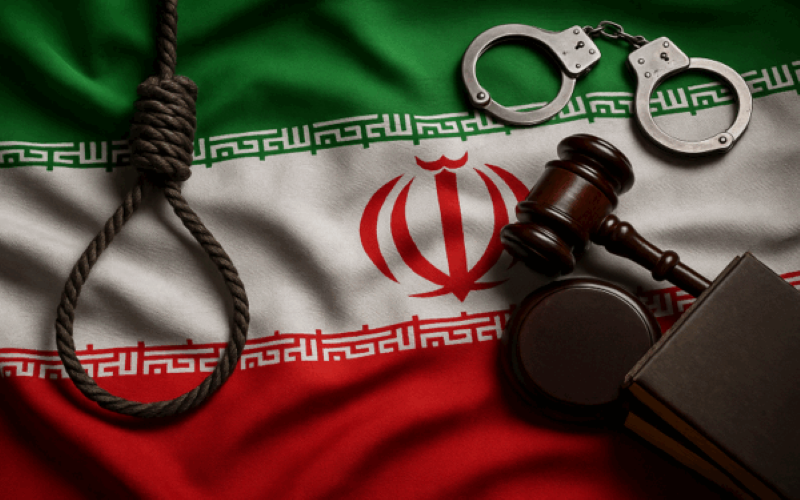

With more than 1,700 executions in 2025, the Iranian regime is using capital punishment as a calculated mechanism of repression, fear, and ideological control
Executions in the Iranian regime of Iran have long stood at the center of international concern over human rights violations. In 2025, however, this practice has reached unprecedented and alarming dimensions. Reports by human rights organizations indicate that more than 1,400 executions were carried out from the beginning of the year through mid-November, with supplementary data suggesting the number has exceeded 1,700, making 2025 one of the bloodiest years of the past four decades.
This is not merely a matter of criminal justice. From the perspectives of critical criminology, international human rights law, and the study of authoritarian governance, Iran’s execution policy constitutes a systematic and organized structure of repression, in which the death penalty is deliberately deployed to enforce social control, ensure political survival, and reproduce the regime’s official ideology.
Execution as a Calculated Instrument of Fear
In today’s Iran, executions increasingly function as a calculated state mechanism designed to instill fear, suppress resistance, and discipline society. Many executions carried out under ostensibly “security-related” charges—such as moharebeh (enmity against God) or efsad fel-arz (corruption on earth)—are, in reality, manifestations of political repression.
These charges stem from the Iranian regime’s criminal code, which enables ideological criminalization and allows political dissent to be punished by death. In recent years, death sentences targeting ethnic minorities, particularly Kurds and Baluchis, have increased sharply. During the latest period of heightened tensions—especially following the escalation surrounding the so-called twelve-day war—a significant portion of executions has been justified under accusations of “treason,” “espionage,” or vaguely defined national security offenses.
From a criminological standpoint, execution in Iran serves not as a proportional response to crime, but as a state strategy to reproduce the authority of the Supreme Leader and secure regime continuity.
A Legal Framework Designed for Death
Under the Islamic Penal Code of the regime, a vast array of crimes is punishable by death. These include hudud offenses (such as adultery and same-sex relations), qisas (intentional murder), ta’zir offenses in certain cases, and broadly defined political-economic crimes such as efsad fel-arz. Drug-related offenses under Iran’s anti-narcotics laws also carry the death penalty.
Recent legal amendments have further expanded this scope. According to human rights organizations, changes to anti-drug legislation have lowered the thresholds required for issuing death sentences, widening the net of capital punishment. This expansive criminalization reflects a system in which “religiously embedded” laws are instrumentalized to consolidate power—particularly through discretionary punishments and drug-related offenses.
Such legal structures, enforced without transparent oversight, without guarantees of fair trial, without effective legal defense, and often based on forced confessions, inevitably lead to arbitrary executions.
Violations of International Law
International human rights law—especially the International Covenant on Civil and Political Rights (ICCPR), to which Iran is a party—strictly limits the use of the death penalty to the “most serious crimes,” generally understood as intentional killing. By this standard, the vast majority of executions in Iran—particularly for drug offenses or vaguely defined political crimes—are unjustifiable under international law.
UN human rights experts and the Human Rights Council have repeatedly emphasized this incompatibility. Moreover, extensive documentation shows that many executions in Iran are accompanied by gross violations of due process, including denial of access to legal counsel, unfair trials, torture, and coerced confessions.
Toward Crimes Against Humanity
Given the scale—over a thousand executions in a single year—several human rights organizations now assess Iran regime’s execution policy as systematic, raising the possibility that it may constitute crimes against humanity. For example, IHRNGO has urged the United Nations to initiate serious investigations into the regime’s execution practices.
From the perspective of international criminal law, the use of executions as a tool of political repression—rather than as punishment for genuine criminal acts—can trigger international accountability mechanisms, including UN resolutions, fact-finding missions, and sustained diplomatic and legal pressure.
Structural Poverty, Drugs, and State Violence
Structural criminology highlights that crimes such as drug trafficking often originate in economic and social conditions. Iran today faces widespread poverty, unemployment, inequality, and social marginalization—conditions exacerbated by the regime’s nuclear, missile, and regional proxy policies.
Instead of adopting harm-reduction strategies, social care, or restorative justice, the state responds with extreme punitive violence, disproportionately targeting vulnerable populations. This creates a vicious cycle: poverty and inequality fuel informal and illegal economies; the regime responds with executions; fear spreads; and authoritarian control is reinforced.
Ethnic discrimination further deepens this cycle. Independent reports, including those by Hengaw, show that ethnic minorities—Kurds, Baluchis, Turks, and others—are disproportionately represented among the executed, demonstrating that the death penalty also functions as an instrument of ethnic repression.
Ideology, Secrecy, and Absolute Power
Within the system of absolute clerical rule (velayat-e faqih), criminal law derives its legitimacy from religious authority. Execution, therefore, is not merely a material tool of repression but a symbol of ideological power, framed as divine justice.
Yet the secrecy surrounding many executions—hidden cases, underreported figures, and lack of transparency—exposes a stark contradiction between claims of “divine justice” and the reality of systemic injustice, inequality, and terror.
A Regime That Cannot Reform Itself
An examination of executions in 2025, alongside patterns from the past 47 years, makes one conclusion unavoidable: Iran regime’s mass executions cannot be understood as isolated legal practices. They are embedded within a political, legal, and ideological structure that treats the death penalty as a central mechanism of governance.
Vague criminalization, denial of fair trials, structural discrimination against minorities, and the political use of capital punishment are not anomalies—they are defining features of the system.
From an international legal perspective, many of these executions qualify as arbitrary and constitute organized repression. And four decades of experience demonstrate that fundamental reform is impossible within the existing framework. The ideology of absolute clerical rule, the securitized judiciary, and the fusion of religion and power form the pillars of this machinery of violence.
The Only Way Out
The criminological and legal conclusion is clear:
Only a complete regime change can enable fundamental changes—in criminal law, judicial justice, human dignity, and the abolition of the death penalty.
As long as this ideological-political structure remains intact, mass, discriminatory, and political executions will continue to be reproduced—under new pretexts, but with the same brutal purpose.