
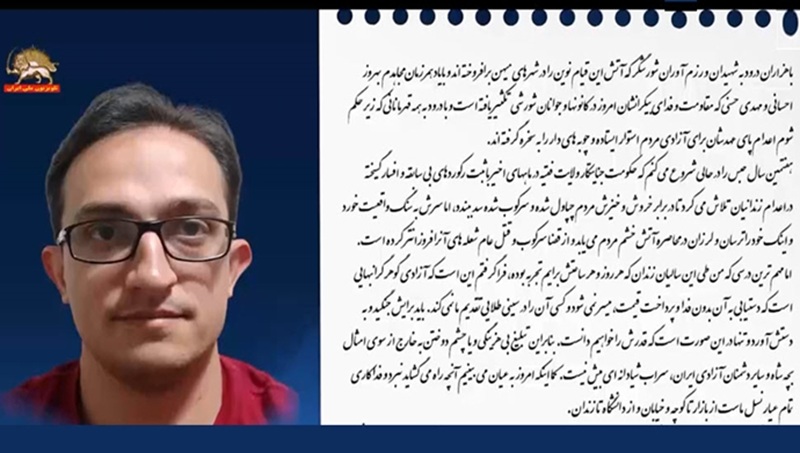

From Qezel Hesar Prison, a jailed activist marks his seventh year of imprisonment with a defiant message on executions, uprising, and the cost of freedom in Iran.
On the occasion of the seventh year of his imprisonment, political prisoner Sepehr Emamjomeh has issued a powerful and uncompromising statement from Qezel Hesar Prison, directly addressing the ongoing nationwide uprising, the regime’s escalation of executions, and the price of freedom in Iran.
Opening his message with homage to those who have paid the ultimate price, Emamjomeh explicitly links today’s protests to decades of resistance. He salutes both fallen protesters and imprisoned dissidents, writing:
“With thousands of salutations to the martyrs and insurgent fighters who have ignited the fire of this new uprising in the cities of our homeland, and in memory of my Mojahed comrades Behrouz Ehsani and Mehdi Hassani, whose boundless resistance and sacrifice are today being replicated in the resistance units and among insurgent youth.”
He further honors political prisoners facing execution, emphasizing their steadfastness:
“I send my salutations to all those heroes who, under the ominous verdict of execution, stand firm on their pledge to free the people and mock the gallows.”
Reflecting on the broader political context, Emamjomeh situates his seventh year of imprisonment amid what he describes as an unprecedented wave of state violence. He directly accuses the ruling system of attempting to halt the uprising through mass executions:
“I begin my seventh year of imprisonment while the criminal regime of the rule of the Supreme Leader, in recent months, has attempted—by setting unprecedented and unrestrained records of executions—to erect a barrier against the roar and uprising of the plundered and repressed people.”
However, he argues that this strategy has failed and instead intensified public anger:
“But it crashed headfirst into the rock of reality, and now finds itself fearful and trembling, surrounded by the fire of the people’s wrath; and paradoxically, repression and massacre have only made those flames burn brighter.”
Drawing on his years behind bars, Emamjomeh presents what he calls the most important lesson of imprisonment: that freedom is neither free nor granted. In one of the statement’s most direct passages, he writes:
“Freedom is a precious jewel that cannot be attained without sacrifice and paying its price. No one will present it to us on a golden plate.”
Rejecting narratives that promote cost-free change or external saviors, he adds:
“The promotion of ‘no-cost’ paths or fixing one’s gaze on foreign powers—by figures such as the ‘Shah’s son’ and other enemies of Iran’s freedom—is nothing but a deceptive mirage.”
Instead, he insists that real change comes only through collective struggle across society:
“Today it is plainly visible that what opens the path forward is the all-out struggle and sacrifice of our generation—from the bazaar to the alleyways and streets, and from the universities to the prisons.”
Looking ahead, Emamjomeh frames the current uprising as a historic turning point, contingent on organization and sustained resistance:
“It is hoped that this uprising, through fire, organization, and the efforts of the resistance units, will herald the end of more than one hundred years of darkness and decay under the despotism of both Mullahs and Shah.”
He concludes with a vision of liberation and democratic transformation:
“With the hope for the dawn of the sun of liberation and freedom, and the victory of the new democratic revolution of the people of Iran.”
The statement, issued from one of Iran’s most notorious prisons, underscores a central theme echoed by many imprisoned activists: that repression has not extinguished dissent, and that the demand for freedom continues to grow—inside prison walls and far beyond them.