From the Shah to the Supreme Leader, how Iran’s rulers have weaponized propaganda to destroy real alternatives and block democratic change
Political warfare—and especially political demonization—is one of the oldest and most effective survival tools used by dictatorships. In Iran, this strategy did not begin with the current mullahs regime. It was systematically practiced under the Pahlavi regime and later perfected under the clerical regime.
Despite their ideological differences, the Shah and the Supreme Leader share a fundamental method: destroying resistance, distorting reality, and engineering public perception to prevent the emergence of a genuine democratic alternative—an absence that has long plagued Iran’s political history.
Unlike conventional warfare, political warfare is silent but deeply destructive. No bullets are fired, yet truth itself becomes the primary target. At the center of this war lies political demonization: the deliberate effort to strip legitimacy from any force capable of producing real change.
Political warfare refers to a coordinated set of non-military actions designed to control, weaken, or eliminate political opponents. These actions include organized propaganda, psychological operations, censorship, disinformation, media pressure, infiltration of opposition movements, and systematic character assassination. The objective is not debate, but political neutralization.
Under both the Shah’s monarchy and the clerical dictatorship, political demonization has served as the backbone of this strategy. These anti-popular regimes have consistently sought to discredit revolutionary forces in order to keep society away from the option of real transformation. The ultimate message is always the same: there is no alternative.
One defining feature of this strategy is its concealment. Political warfare rarely presents itself as repression. It appears instead as “analysis,” “expert commentary,” journalism, or even internal criticism. Its second defining feature is its direct targeting of public opinion. Undermining the legitimacy of organized revolutionary resistance is its central mission.
A third characteristic is the extensive use of media and digital platforms. Fabricated narratives, rumor campaigns, and the deliberate amplification of internal disagreements are the primary tools used to fracture opposition forces and confuse society.
In both the Pahlavi era and under the doctrine of Velayat-e Faqih (clerical rule), the systematic destruction of real resistance—namely, an organized, revolutionary alternative—has remained a top priority. In both periods, forces aligned with power, often supported by external interests, attempted to replace genuine resistance with artificial, controllable substitutes. This substitution strategy forms a central pillar of political demonization.
Under the Shah, revolutionaries were branded as “saboteurs,” “foreign agents,” or “traitors.” Today, the same logic is recycled by the clerical regime, albeit with updated terminology. The labels have changed; the objective has not.
From its inception, the Iranian regime has faced a structural threat: organized resistance. Unlike many opposition currents that have fragmented or faded over time, the National Council of Resistance of Iran (NCRI) has maintained organizational cohesion, a clear political strategy, and firm ideological boundaries. This continuity is precisely what makes it dangerous to the regime.
As a result, political demonization has been systematically concentrated against this democratic alternative. Khamenei’s regime understands that the legitimacy of an organized resistance does not merely challenge policies—it shakes the very foundations of clerical rule.
One of the regime’s primary tools is character assassination. Smearing resistance leaders is an inseparable component of political demonization. The goal is to implant a distorted, negative, and false image in the public consciousness.
The second tool is accusation. Allegations of foreign dependency, terrorism, or extremism are deployed to erase political credibility. These tactics mirror those used under the Shah, who accused revolutionaries of being foreign-backed or disloyal in order to justify repression.
Today, alongside direct repression, Khamenei’s regime relies on currents that present themselves as “opposition” while objectively contributing to regime survival. These political performers play a crucial role in political demonization by diverting attention, fragmenting dissent, and attacking organized resistance from within the opposition space.
The circle surrounding Reza Pahlavi and his supporters exemplifies this phenomenon. Using superficially pro-freedom rhetoric, they push political discourse toward polarization and hostility. Instead of focusing on dismantling the clerical dictatorship, they deepen social divisions and neutralize collective action.
This current, with a history of proximity to power, now rebrands itself as an agent of change. Yet its objective is neither revolution nor regime overthrow. It is the preservation of the existing framework—repackaged with new faces and power-sharing ambitions.
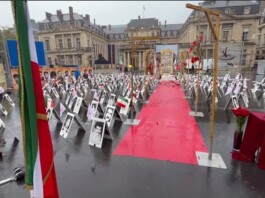
One of the most dangerous forms of political demonization is historical distortion. From denying or minimizing the 1988 prison massacre to erasing the role of organized resistance in nationwide uprisings, fabricated narratives are deliberately substituted for documented facts. This distortion is systematic, intentional, and coordinated.
State media, affiliated outlets, and even some foreign media platforms promote the notion that Iranian society is “tired of change.” This narrative is designed to push society toward paralysis and disengagement. The destruction of hope is the final link in the chain of political demonization.
The political war against resistance is not temporary. Demonization is a permanent survival strategy of the regime. Yet the reality of a deeply rooted resistance—with steel-like organization and decades of struggle against both monarchical and clerical dictatorship—remains alive. Exposing this hidden war is not optional; it is an essential component of the struggle for freedom and the Iranian people’s right to self-determination.