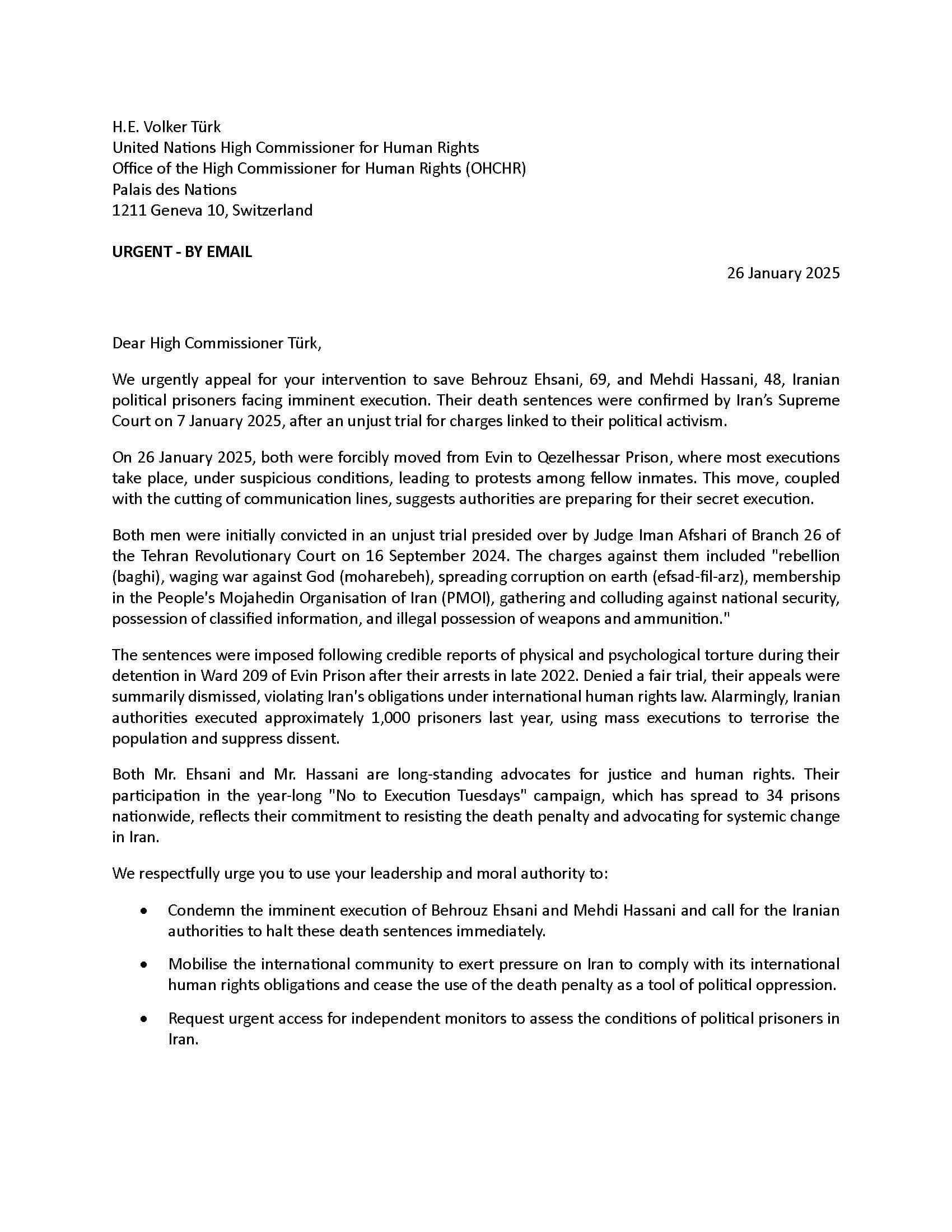
In a powerful letter addressed to United Nations High Commissioner for Human Rights Volker Türk, 16 Members of the European Parliament (MEPs) have made an urgent plea to prevent the execution of Behrouz Ehsani, 69, and Mehdi Hassani, 48, two Iranian political prisoners. The appeal highlights the imminent danger these men face following the confirmation of their death sentences on January 7, 2025, by Iran’s Supreme Court.
Both men were convicted in a highly controversial trial led by Judge Iman Afshari of Branch 26 of the Tehran Revolutionary Court in September 2024. They were charged with crimes including “rebellion (baghi),” “waging war against God (moharebeh),” and “spreading corruption on earth (efsad-fil-arz)”—charges frequently used by Iranian authorities against political dissidents. Their prosecution also cited alleged membership in the People’s Mojahedin Organisation of Iran (PMOI), possession of classified information, and illegal possession of weapons.
Credible Allegations of Torture and Denial of a Fair Trial
The letter from MEPs underscores that both men were subjected to severe physical and psychological torture during their detention in Ward 209 of Evin Prison, following their arrests in late 2022. The trial lacked basic safeguards for fairness, and their appeals were dismissed in what has been described as a summary and arbitrary process. These violations stand in direct contravention of Iran’s international human rights obligations.
Adding to the urgency, Ehsani and Hassani were forcibly transferred from Evin Prison to Qezelhessar Prison on January 26, 2025. This facility is notorious for executions, and the sudden transfer—accompanied by the cutting of communication lines—raises fears that their executions are imminent.
Political Suppression Through Executions
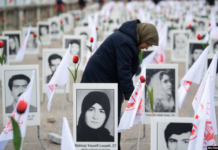
The appeal from the MEPs also situates these cases within a broader pattern of repression by the Iranian regime, which executed approximately 1,000 prisoners in 2024. Many of these executions targeted political dissidents and activists, serving as a grim tool to stifle dissent and spread fear across the nation.
Ehsani and Hassani’s involvement in the “No to Execution Tuesdays” campaign—a grassroots initiative against capital punishment that has gained traction in 34 prisons—further highlights their commitment to justice and human rights.
The Call to Action
The MEPs’ letter urges High Commissioner Türk to take decisive action to prevent the execution of Ehsani and Hassani. Specifically, they call for:
A public condemnation of the imminent executions and a demand for the Iranian authorities to halt these death sentences immediately.
Mobilisation of the international community to pressure Iran into complying with international human rights standards and ceasing the use of the death penalty as a political tool.
Granting independent monitors urgent access to assess the conditions of political prisoners in Iran.
International Responsibility
The MEPs stress that silence in the face of such blatant human rights violations is not an option. Their letter highlights the need for the international community to act swiftly and decisively to save Ehsani and Hassani from execution.
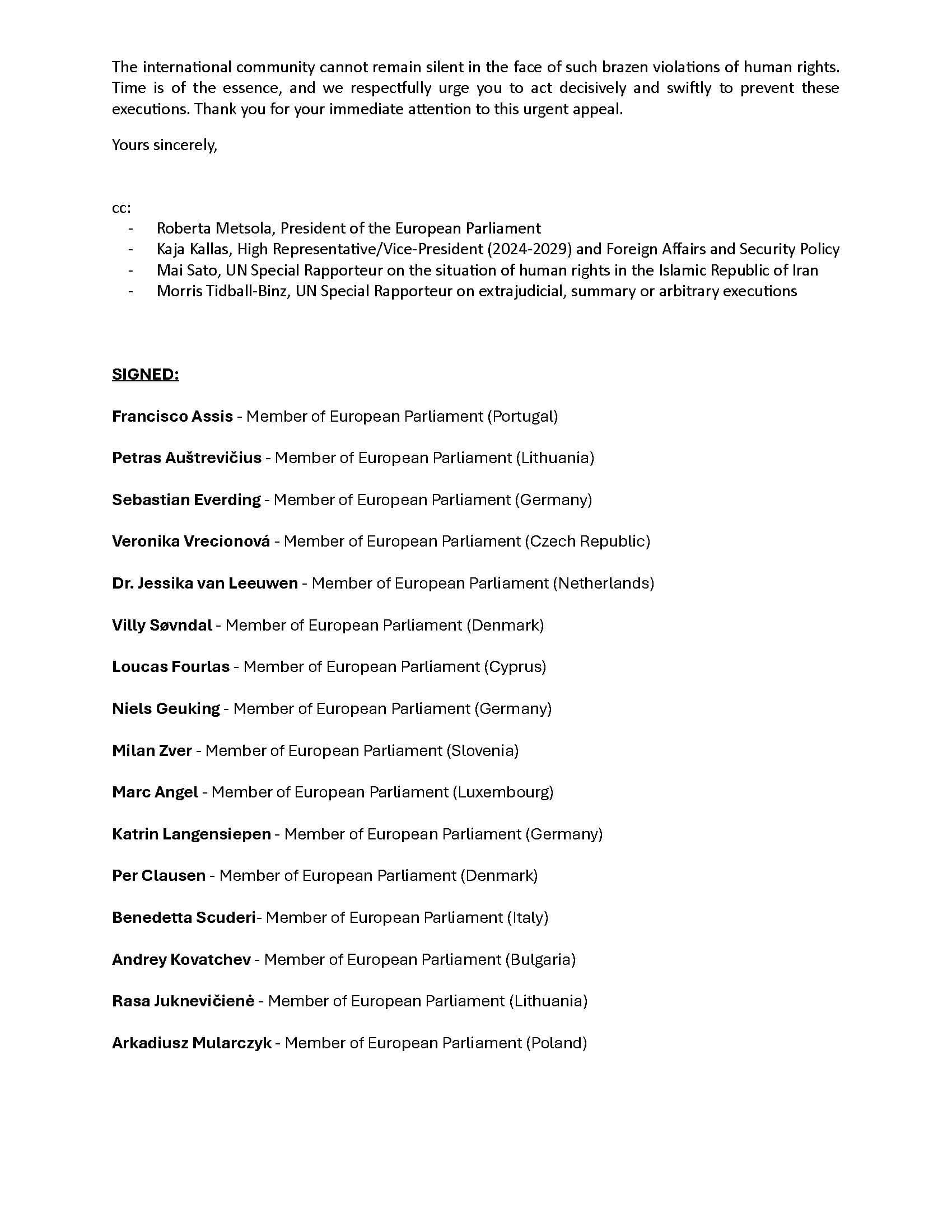
The letter is signed by prominent MEPs from across Europe, including Francisco Assis (Portugal), Petras Auštrevičius (Lithuania), Benedetta Scuderi (Italy), and Marc Angel (Luxembourg), among others.
Broader Implications
The case of Behrouz Ehsani and Mehdi Hassani serves as a stark reminder of the ongoing human rights crisis in Iran. Their plight underscores the need for sustained international attention and coordinated efforts to hold the Iranian regime accountable for its systematic use of repression and violence against political dissent.
With time running out, the fate of Ehsani and Hassani rests in the hands of international actors willing to confront Iran’s human rights abuses head-on.