


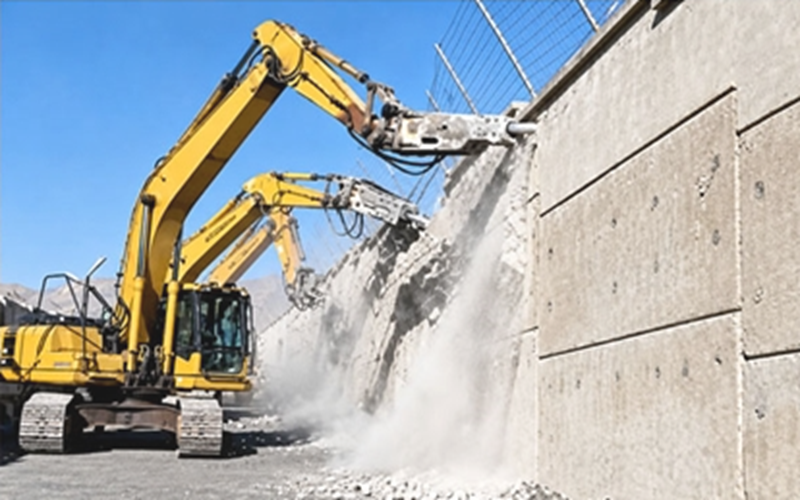

The demolition of Gohardasht Prison raises renewed questions about the preservation of evidence from decades of political repression, including the 1988 massacre of political prisoners.
The demolition of Gohardasht Prison in Karaj has revived a fundamental question about Iran’s history of political repression: what happens when the physical sites where crimes were committed are deliberately altered or destroyed?
On September 13, 2026, Iran’s prison authorities announced that the demolition of the prison’s walls had begun. The announcement followed earlier decisions to empty the facility, transfer its prisoners, and ultimately change the site’s use.
For former political prisoners and survivors, however, Gohardasht is not simply an obsolete prison complex. It is a site associated with some of the darkest episodes in Iran’s modern history, including the mass execution of political prisoners in 1988.
Mahmud Royaei, a former Gohardasht prisoner and witness to the 1988 massacre, argues that the destruction of the prison should be viewed in the context of a broader effort to erase physical evidence of political crimes. Whether every element of that interpretation can be independently established, the destruction of a major site associated with documented human-rights abuses raises serious questions about the preservation of evidence and historical memory.
From Prison Closure to Demolition
The current project did not begin with the announcement that the walls were being demolished.
According to Royaei, the first major public indication came on April 7, 2023, when Judiciary Chief Gholam-Hossein Mohseni Ejei said during a visit to Alborz Province that the prisoners at Gohardasht would be transferred and the facility closed.
On August 5, 2023, the judiciary announced that the prison had been emptied. Political prisoners held there were subsequently transferred to Qezel Hesar Prison.
Plans to close or demolish Gohardasht—and, at various points, other major prisons such as Evin—had reportedly circulated for years without being fully implemented. The process nevertheless moved forward after the prison was emptied.
Royaei says that approximately seven months ago, on February 26, Ejei announced that Gohardasht would undergo a change of use. The September announcement concerning the demolition of its walls represents another stage in that process.
The sequence is significant because it separates two issues that are often conflated: closing a prison and physically erasing it are not the same thing.
A closed prison can remain a historical site and a potential source of documentary and forensic evidence. Once buildings, corridors, cells, and other structures are demolished or substantially altered, preserving that evidence becomes considerably more difficult.
A Prison Built Around Isolation
Gohardasht’s history predates the 1979 revolution.
According to Royaei, the prison was constructed during the 1970s under the Shah and became known as the “Thousand Cells” prison. Its design placed unusual emphasis on solitary confinement and the isolation of prisoners.
The complex consisted of 11 blocks, including three administrative buildings and eight three-story blocks containing prison wards. Royaei describes 21 wards in the latter buildings, most of them consisting primarily of solitary cells.
Each ward contained approximately 40 cells, with cells measuring roughly 1.8 by 2.5 meters. According to this account, the complex contained 798 solitary cells, in addition to other areas including dark cells and auxiliary sections.
The architectural design is important because the prison later became a major site of political imprisonment under the regime that came to power after the Shah was overthrown.
A facility designed for isolation became, under a different government, a major center of political detention and repression.
From Solitary Confinement to the “Death Corridor”
Gohardasht Prison formally opened under the new regime in the autumn of 1982, during a period of intensified political repression.
Royaei recalls that authorities deliberately used solitary confinement as a means of breaking political prisoners psychologically and forcing them to abandon their political convictions.
The strategy, according to his testimony, was based on the assumption that prisoners who were separated from one another would eventually become isolated, demoralized, and submissive.
But the outcome was reportedly different.
Political prisoners spent prolonged periods in solitary confinement, yet the attempt to break their resistance did not produce the result authorities expected. Royaei describes the reopening of the solitary cells after roughly two and a half to three years as an indication that the policy had failed to achieve its intended objective.
Gohardasht would later become associated with an even more consequential chapter in Iran’s history: the mass execution of political prisoners in 1988.
During that period, prisoners were summoned before commissions that asked questions determining whether they would be spared or sent to their deaths. Survivors have described the corridor through which prisoners were taken as the “death corridor.”
Royaei says that prisoners were brought there in groups beginning on August 1, 1988, and that many understood that the proceedings were not genuine clemency hearings but could lead directly to execution.
Despite that knowledge, he recalls instances in which prisoners refused to abandon their political positions.
He also describes prisoners being given paper on which to write their wills before being taken away. According to his testimony, even this final opportunity did not lead many to renounce their beliefs.
The importance of such testimony extends beyond individual recollections. The 1988 executions remain one of the most consequential unresolved episodes of Iran’s political history, and survivors’ accounts constitute an important part of the available record.
Why the Physical Site Matters
The destruction of Gohardasht therefore raises a question that goes beyond architecture.
Historical crimes are documented through testimony, official records, photographs, forensic evidence, physical locations, and the accumulated memories of survivors and witnesses. Removing a crime scene can make future investigation more difficult even when other evidence survives.
This is why the preservation of sites associated with mass atrocities has become an important element of transitional justice and historical accountability in many countries.
The concern is particularly relevant in Iran because survivors and human-rights organizations have repeatedly called for accountability over executions and other abuses committed by state authorities.
The issue also extends beyond Gohardasht.
Royaei points to the destruction or alteration of locations associated with victims of political repression, including sections of Tehran’s Behesht-e Zahra cemetery and mass-grave sites associated with the 1988 executions.
From the perspective of critics of the Iranian regime, these actions form part of a broader pattern intended to make the physical evidence of past crimes increasingly difficult to locate and investigate.
The Iranian authorities have not publicly accepted that interpretation. The official explanation for the redevelopment and change of use of Gohardasht should therefore be distinguished from the allegations made by survivors and opposition groups concerning the preservation of evidence.
That distinction does not eliminate the underlying concern.
If a site has major historical and evidentiary significance, demolition should raise legitimate questions about whether records, structures, and other material evidence are being adequately preserved before irreversible changes take place.
The Battle Over Memory
The significance of Gohardasht extends beyond what happened inside its walls.
For survivors, families of victims, and human-rights advocates, physical locations can serve as anchors for collective memory. Destroying such locations cannot erase testimony, names, documents, or memories, but it can remove tangible points of reference for future generations.
This is particularly important in the case of the 1988 massacre, for which accountability remains a central demand among victims’ families and Iranian human-rights activists.
Royaei connects the demolition directly to what he describes as the growing movement for accountability, arguing that the authorities are increasingly concerned about the preservation of evidence as demands for justice gain momentum.
The argument reflects a broader political reality: the passage of time does not necessarily eliminate demands for accountability.
On the contrary, archives, survivor testimony, documentation by human-rights organizations, and international investigations can allow cases to remain part of the public record decades after the crimes occurred.
Destroying a building therefore does not destroy the historical record. It may, however, destroy part of the physical evidence through which that record can be reconstructed.
Gohardasht Is More Than a Prison
The planned disappearance of Gohardasht should consequently be viewed through two lenses.
The first is practical: what will happen to the site after the prison is demolished, and what records and physical evidence will be preserved?
The second is historical: what does the destruction of a place associated with political imprisonment and mass executions mean for Iran’s ongoing struggle over memory and accountability?
The answers matter not only to former prisoners and victims’ families but to anyone concerned with documenting Iran’s contemporary history.
Buildings can be demolished. Walls can disappear. Prison blocks can be replaced by new structures.
But the testimony of survivors, the names of victims, documentary evidence, and the historical record cannot simply be demolished along with them.
For that reason, the destruction of Gohardasht should prompt renewed international attention to the preservation of evidence concerning political repression in Iran. Any physical site associated with alleged mass atrocities should be documented and preserved wherever possible before irreversible demolition takes place.
Gohardasht’s walls may not survive.
The question is whether the evidence of what happened behind those walls will be allowed to survive with them.