


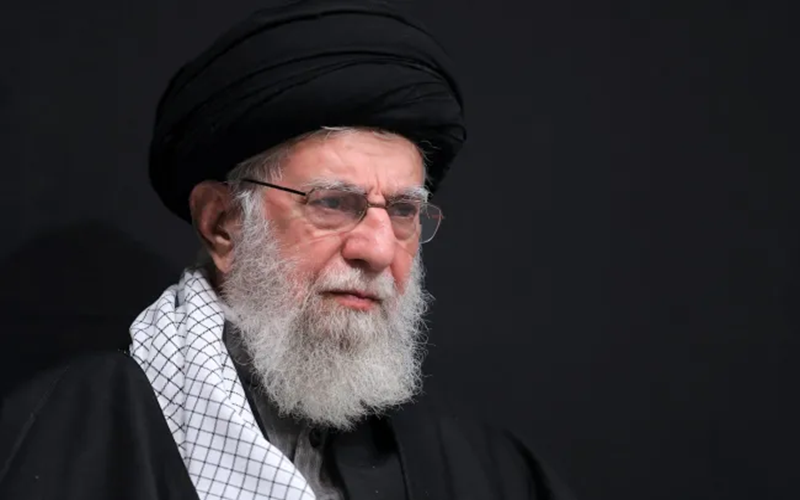

From consolidating absolute rule after 1989 to presiding over decades of repression, economic plunder, and human rights abuses, Ali Khamenei’s era ended amid war, leaving the Iranian regime under the leadership of his son, Mojtaba Khamenei.
For nearly 37 years, from June 1989 until his death in February 2026, Ali Khamenei stood at the apex of Iran’s clerical dictatorship, transforming the office of Supreme Leader into the center of an extensive system of political repression, economic domination, and institutionalized impunity.
His rule shaped nearly every aspect of the Iranian regime’s domestic and foreign policies. Under his leadership, the country witnessed repeated massacres of protesters, widespread executions, systematic human rights abuses, economic decline, and growing international isolation. His death during the 2026 war created the most serious leadership crisis in the history of the doctrine of Velayat-e Faqih, with his son, Mojtaba Khamenei, assuming control of the regime amid deepening political instability.
From Revolutionary Cleric to Absolute Ruler
Ali Khamenei rose through the ranks of the revolutionary establishment following the 1979 anti-monarchical revolution. Although he lacked the senior religious credentials traditionally associated with the position of Supreme Leader, he steadily accumulated influence through key appointments.
He served as a senior figure within the Revolutionary Council, supervised the newly established IRGC during its formative years, became president between 1981 and 1989, chaired the Supreme Council of the Cultural Revolution, and cultivated close ties with the regime’s security apparatus.
Following the death of Ruhollah Khomeini in June 1989, Khamenei was elevated to Supreme Leader through a process heavily influenced by then-President Akbar Hashemi Rafsanjani. The appointment was controversial from the outset, with prominent clerics—including Hussein-Ali Montazeri—questioning Khamenei’s religious qualifications to assume the position.
Nevertheless, once installed, Khamenei transformed the office into the unquestioned center of political authority.
Building an Unaccountable System of Absolute Power
Throughout his rule, Khamenei expanded his authority far beyond the constitutional powers formally granted under Article 110 of the regime’s constitution.
He consolidated control over virtually every major institution by:
- Appointing members of the Guardian Council responsible for vetting all electoral candidates.
- Exercising direct authority over the judiciary, whose chiefs oversaw thousands of executions and politically motivated prosecutions.
- Installing representatives of the Supreme Leader throughout ministries, universities, the armed forces, and major state institutions.
- Expanding parallel intelligence organizations, including the IRGC Intelligence Organization and the intelligence office attached directly to the Supreme Leader’s office.
- Maintaining ultimate authority over state broadcasting, military policy, and the country’s security establishment.
These mechanisms effectively eliminated institutional oversight and concentrated unprecedented power in the office of the Supreme Leader.
An Economic Empire Beyond Public Accountability
Khamenei’s rule also saw the emergence of one of the largest opaque financial empires in the Middle East.
A vast network of foundations and conglomerates operated outside parliamentary oversight and independent auditing while enjoying extensive legal protections and tax exemptions.
Among the most significant institutions were:
- Execution of Imam Khomeini’s Order (Setad): Estimated by Reuters in 2013 to control assets worth approximately $95 billion through an extensive network of companies and holdings.
- Astan Quds Razavi: One of Iran’s largest economic foundations, controlling vast real estate holdings and major commercial enterprises.
- Mostazafan Foundation: A conglomerate managing hundreds of businesses across sectors including energy, construction, finance, manufacturing, and tourism.
Critics have long argued that these institutions enabled the concentration of enormous wealth within the ruling elite while much of the Iranian population faced rising poverty, inflation, and unemployment.
Reports over the years also alleged that members of Khamenei’s family accumulated extensive wealth through privileged access to state-controlled economic networks. Mojtaba Khamenei, widely viewed for years as the most influential figure within his father’s inner circle, emerged as the de facto manager of the Supreme Leader’s office long before formally succeeding his father.
Decades of Repression and Human Rights Violations
Khamenei’s leadership was marked by some of the bloodiest episodes in modern Iranian history.
The 1988 Massacre
As president, Khamenei publicly defended the mass execution of more than 30,000 political prisoners during the summer of 1988, the overwhelming majority of whom were affiliated with the PMOI/MEK. The massacre remains one of the gravest crimes against humanity in Iran’s contemporary history.
Assassinations at Home and Abroad
During the 1990s, the regime carried out a campaign of assassinations targeting political opponents and dissidents both inside Iran and overseas.
The 1997 Mykonos Trial in Germany concluded that the highest levels of the Iranian leadership were responsible for ordering the assassination of Kurdish opposition leaders in Berlin, placing international attention on the regime’s policy of transnational repression.
Crushing Popular Uprisings
Khamenei repeatedly relied on lethal force to suppress nationwide protests.
His tenure included:
- The violent suppression of the 2009 Protests.
- The nationwide protests of 2017–2018.
- The November 2019 uprising, during which more than 1,500 protesters were reportedly killed.
- The 2022 nationwide protests following the death of Mahsa Amini, during which hundreds were killed and many others suffered permanent injuries, including blinding caused by security forces.
These crackdowns were accompanied by mass arrests, torture, forced confessions, and an escalating use of executions against political prisoners.
Nuclear Ambitions and Economic Consequences
Khamenei consistently insisted on advancing the regime’s nuclear and ballistic missile programs despite mounting international pressure.
Successive rounds of sanctions, combined with systemic corruption and economic mismanagement, contributed to worsening inflation, currency collapse, declining living standards, and widespread social unrest.
While the regime portrayed these programs as symbols of national strength, critics argued that ordinary Iranians bore the economic costs while the ruling establishment continued to expand its security apparatus.
The January 2026 Uprising and the End of an Era
The final chapter of Khamenei’s rule unfolded during the nationwide January 2026 uprising.
As protests spread across Iran, security forces launched one of the most severe crackdowns in recent history. According to opposition reports, thousands of protesters were killed or injured during the first days of the uprising after authorities reportedly ordered security forces to use lethal force against demonstrators.
Weeks later, on February 28, 2026, Ali Khamenei was killed during the conflict involving the Iranian regime and the United States. His death created an unprecedented leadership vacuum within the regime and intensified already deep political divisions.
The succession of Mojtaba Khamenei as Supreme Leader has not resolved those tensions. Instead, it has reinforced criticism that the doctrine of Velayat-e Faqih has evolved into a hereditary system in which power remains concentrated within a single ruling family rather than resting on any popular mandate.
A Legacy Defined by Repression
Ali Khamenei’s nearly four decades in power left behind a legacy characterized by systematic political repression, widespread human rights abuses, entrenched corruption, and economic decline.
His rule transformed the office of the Supreme Leader into an institution exercising unchecked authority over every branch of the state while shielding the ruling elite from accountability. Although his death marked the end of his personal rule, the succession of Mojtaba Khamenei has underscored the regime’s determination to preserve the same governing structure despite mounting internal crises and growing public opposition.
As Iran enters a new and uncertain chapter under Mojtaba Khamenei, the political system built by his father continues to face profound challenges from a society increasingly demanding democratic change, accountability, and an end to decades of authoritarian rule.