


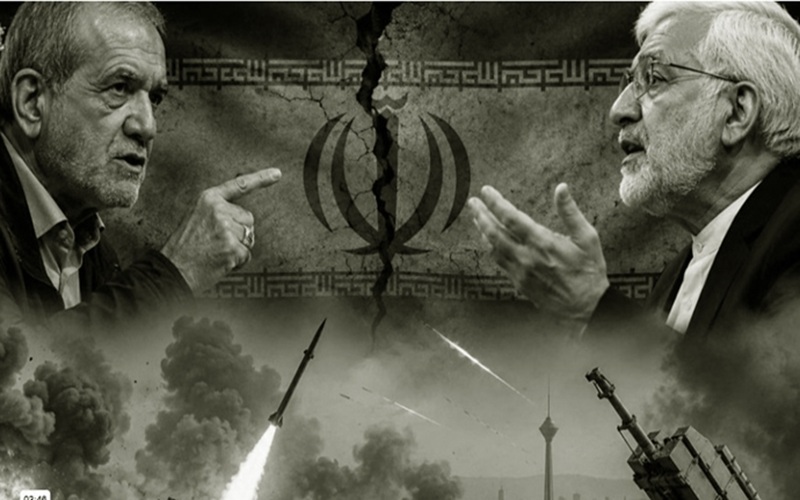

As factional infighting intensifies over negotiations with the United States, Iran’s ruling establishment reveals a deeper reality: a regime so fragile that even diplomacy is portrayed as surrender, while threats of wider war and nuclear catastrophe become instruments of internal political warfare.
The Iranian regime’s growing internal conflict over possible negotiations with the United States has once again exposed the deep strategic paralysis consuming the ruling establishment. What appears on the surface as a dispute over diplomacy is, in reality, a struggle over survival itself — a regime trapped between mounting international pressure, economic collapse, military vulnerability, and fear of domestic unrest.
As tensions between rival factions intensify, media outlets affiliated with the camp of Saeed Jalili have launched a fresh wave of attacks against President Masoud Pezeshkian, portraying any form of negotiation with Washington as an act of surrender that would inevitably lead to renewed war and further retreat by the regime.
At the same time, the Islamic Revolutionary Guard Corps (IRGC) issued threats warning that any future attack on Iran would expand the war beyond the region. Meanwhile, members of the regime’s parliamentary security apparatus escalated rhetoric even further by claiming that any concession during negotiations — particularly regarding enriched uranium — could invite a nuclear strike against Iran.
Negotiation as “Weakness”
The ferocity of the attacks against Pezeshkian reflects more than a policy disagreement. It reveals the extent to which sections of the regime now view diplomacy itself as politically dangerous.
Rajanews, a media outlet closely aligned with Saeed Jalili’s faction, accused Pezeshkian of reviving what it called the “failed project” of dialogue with the West. Mocking the president’s question — “If we do not negotiate, then what should we do?” — the outlet described him as a mouthpiece for pro-Western currents within the regime.
According to the publication, previous negotiations only emboldened Iran’s adversaries and ultimately resulted in military attacks against the regime. The outlet framed diplomacy not as a tool for de-escalation, but as a cycle inevitably leading from “negotiation to war.”
This narrative reflects an increasingly dominant mindset within hardline circles: that compromise signals weakness, and that weakness threatens the regime’s survival more than confrontation itself.
The argument is deeply revealing. Hardliners no longer claim negotiations can strengthen the regime internationally; instead, they openly fear that any retreat — however limited — could trigger a chain reaction of strategic and domestic vulnerability.
The Politics of Permanent Crisis
The regime’s rhetoric also demonstrates how external confrontation has become essential to maintaining internal cohesion.
The IRGC’s warning that future conflict would spread beyond the Middle East was not merely directed at foreign adversaries. It also served as a message to internal rivals: that the security establishment remains committed to escalation and rejects any path perceived as conciliatory.
Similarly, remarks from parliamentary security commission member Ali Khezrian exposed the regime’s broader logic of perpetual confrontation. In a televised interview, he argued that even the slightest concession in negotiations with the United States would send a “signal of weakness” to enemies.
Khezrian went even further, claiming that removing enriched uranium from Iran could increase the likelihood of an enemy nuclear strike, including the possible use of a “tactical” nuclear weapon. Such statements reveal not only the regime’s siege mentality but also its reliance on fear as a political instrument.
He additionally warned that reopening the Strait of Hormuz and reducing strategic tensions would merely pave the way for an even larger future war. According to his logic, maintaining confrontation is necessary to preserve deterrence and prevent perceived humiliation.
This worldview effectively transforms permanent crisis into state doctrine.
Fear of Collapse Behind the Rhetoric
What emerges from these escalating internal disputes is a picture of a regime profoundly insecure about its future.
The hardline faction’s hostility toward negotiations stems from a deeper fear: that any compromise abroad could weaken the ideological foundations of the system at home. Economic concessions could raise public expectations. Diplomatic flexibility could expose years of propaganda. Any sign of retreat could encourage broader social demands for accountability and change.
The regime’s political structure has long depended on the cultivation of external enemies to justify repression, militarization, and economic sacrifice. In that context, normalization carries risks that parts of the establishment now appear unwilling to accept.
The contradictions are increasingly stark. On one hand, the regime faces enormous economic pressure, diplomatic isolation, and public dissatisfaction that make some form of negotiation strategically necessary. On the other, hardliners fear that negotiations themselves could accelerate the erosion of the regime’s authority.
This explains why the debate inside Tehran has become so explosive. It is not fundamentally about uranium enrichment, diplomacy, or military tactics. It is about whether the regime can preserve its political identity without continuous confrontation.
A Regime Consumed by Its Own Contradictions
The current infighting reveals a ruling establishment trapped inside the logic it created over decades. The regime’s survival strategy has always relied on projecting strength, resisting compromise, and framing all dissent — domestic or international — as existential threats.
But this strategy now collides with mounting realities: economic deterioration, social unrest, regional instability, and declining internal legitimacy.
Hardliners increasingly argue that even limited concessions could trigger wider collapse. Reformist-aligned factions, meanwhile, seek tactical engagement with the outside world to relieve pressure and buy time.
Neither faction offers a genuine solution to the underlying crisis because both remain committed to preserving the same authoritarian structure.
As a result, Iran’s leadership appears caught between two fears: the fear that confrontation may destroy the regime, and the fear that compromise may destroy it faster.