



Conflicting statements by officials and institutional paralysis point to deepening instability inside the Iran regime
Recent statements by officials within the Iran regime, amplified even by state-affiliated media, offer an unusually clear window into the extent of internal disorder at the highest levels of power. What emerges is not merely routine political disagreements, but a pattern of contradiction, fragmentation, and institutional weakness that reflects a deeper structural crisis.
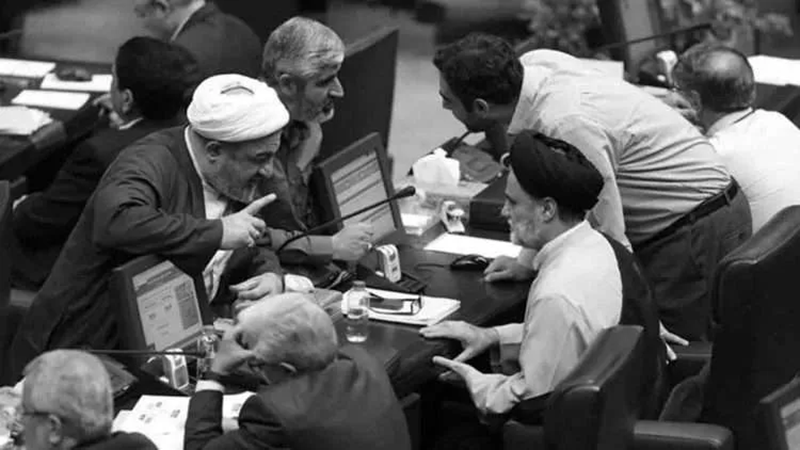
A report published on April 28, 2026, by the regime-affiliated outlet Khabar Online openly questioned the role of parliament, asking whether representatives have become “loudspeakers for hardliners” rather than functioning as a legislative body. The article highlighted how members of parliament, whether inside the chamber or appearing in media, have increasingly become sources of controversy rather than stability—an admission that underscores the erosion of institutional coherence.
Such observations, coming from within the regime’s own media ecosystem, are significant. They point to a reality in which formal governing bodies are no longer able to contain internal disagreements, and instead serve as platforms for their public show.
Parliament Without Function: From Chamber to Cyberspace
According to the same report, since the onset of the recent conflict—referred to domestically as the “Ramadan war”—the parliament has effectively ceased formal legislative activity. No official sessions have been held, and the institution’s role has been informally transferred to media appearances and social platforms.
This shift is more than procedural; it signals a breakdown in governance. In place of structured debate and policy-making, what has emerged is a decentralized and often contradictory current of statements, particularly from hardline factions. Rather than mitigating tensions, these interventions frequently intensify them.
As the report notes, “some representatives, through their statements, add fuel to the fire of disagreements.” This dynamic illustrates how political messaging within the regime has become increasingly uncoordinated, reflecting competing agendas rather than a unified strategy.
Escalatory Rhetoric and Strategic Incoherence
Examples cited in the report further highlight this fragmentation. Ebrahim Rezaei, spokesperson for the National Security Commission, rejected negotiations and ceasefire efforts while proposing maximalist conditions for ending the conflict—including permanent membership in the UN Security Council with veto power and recognition of Iran’s control over the Strait of Hormuz.
Such positions, detached from prevailing geopolitical realities, drew criticism even from figures close to the regime. Political commentator Mohammad Mohajeri questioned the basis of these claims, asking from which authority such conditions were derived and warning against uninformed commentary on matters of war and security.
Similarly, another official, Ebrahim Azizi, reportedly invoked Article 51 of the UN Charter to declare the entirety of Ukraine a legitimate target—an assertion that carries significant international implications and reflects a striking lack of strategic discipline.
Taken together, these statements illustrate not strength, but incoherence. They suggest a system in which messaging is no longer centrally controlled, and where individual actors advance positions that may contradict or undermine broader policy objectives.
“National Unity” as Narrative Cover
Amid this disorder, calls for “national unity” have become more frequent. Yet, as the same report indicates, such appeals often function as rhetorical cover rather than substantive policy. Statements by officials—including speculative remarks about leadership succession—have, in practice, widened internal fissures rather than narrowed them.
The prominent presence of officials on filtered social media platforms and in state media has further amplified this effect. Instead of reinforcing cohesion, these channels have become arenas for competing narratives and public disagreements, exacerbating perceptions of instability.
Exclusion and Information Gaps
Another revealing dimension of this crisis is the apparent lack of knowledge among key institutions. Some parliamentarians have openly complained about being excluded from sensitive negotiations, including those involving the United States. Reports suggest that only a limited circle of officials has been directly involved, leaving others to speculate or issue contradictory statements.
This informational asymmetry contributes to the broader pattern of confusion. When representatives lack access to verified details, public discourse becomes vulnerable to rumor, exaggeration, and political positioning.
An audio recording attributed to a member of the negotiation team further underscores these tensions. In it, the inclusion of the nuclear issue in talks is described as a strategic mistake—one that, in his view, encouraged additional demands from opposing parties. Such internal critiques, when aired publicly, reinforce the image of a divided leadership struggling to align on fundamental issues.
A System Under Strain
In its conclusion, even the regime-affiliated report acknowledges that the heightened presence of hardline representatives in media spaces has, under current conditions, contributed more to controversy than cohesion. The closure of formal parliamentary sessions and the transfer of activity to informal platforms are presented not as tactical adjustments, but as symptoms of dysfunction.
What is unfolding within the Iran regime is not merely a series of isolated missteps. It is indicative of a deeper crisis in governance—one in which institutional roles are blurred, decision-making is fragmented, and strategic clarity is increasingly absent.
As this current continues, the gap between formal structures and actual power dynamics is likely to widen further. The result is a political system that appears increasingly disjointed at the top, with consequences that extend beyond internal politics to its broader regional and international posture.