



Why the Cycle of Shah and Mullah Must End — and What Must Replace It
For more than a century, Iran has lived in a state of unfinished revolution. From the Constitutional era to the present, the central question has remained unchanged: who holds sovereignty — the people or an unelected absolute authority?
In the late 1980s, as he approached ninety, Ruhollah Khomeini issued the decree that led to the mass execution of political prisoners, many of them members or supporters of the People’s Mojahedin Organization of Iran (PMOI/MEK). It was a calculated attempt to extinguish an organized democratic opposition at its roots.
Nearly four decades later, at age eighty-seven, Ali Khamenei presided over another defining episode: the brutal suppression of the January uprising. The regime’s own televised images — black body bags displayed as a warning — were meant to intimidate. Instead, they exposed a continuity of cruelty embedded in the doctrine of Velayat-e Faqih — the “absolute guardianship of the jurist,” a term Khomeini himself described as “absolute rule.”
History’s cruelty, however, is not measured solely by repression. It is measured by endurance.
A 120-Year Struggle for Sovereignty
For 120 years, Iranians have pursued constitutionalism, national independence, and political liberty. The names form a lineage of resistance: Sattar Khan, Bagher Khan, Mirza Kuchik Khan, Mohammad Mossadegh, Hossein Fatemi, Mahmoud Taleghani, Mohammad Hanifnejad, Sheikh Mohammad Khiyabani, Ashraf Rajavi. Alongside them stand figures from diverse ideological traditions — Taghi Arani, Khosrow Roozbeh, Amir Parviz Pouyan, Massoud Ahmadzadeh, Bijan Jazani, Kazem Paknejad — each representing a chapter in the same unfinished narrative.
This historical arc reveals a persistent structural conflict: the Iranian people versus concentrated, unaccountable power — whether monarchical or theocratic.
For six decades of that 120-year span, the PMOI/MEK has maintained uninterrupted opposition activity — through the Shah’s prisons, the revolution of 1979, the purges of the 1980s, and the repression of recent uprisings. Whether one agrees with its ideology or not, the organization’s longevity reflects an undeniable fact: Iran’s democratic impulse has not been extinguished.
The “War of Wars”
When some describe the present moment as the “war of wars,” they are not speaking solely of armed confrontation. They refer to a total political, social, ideological, and historical confrontation — a culmination of a century-long contest between regression and progress.
This is not simply a clash of factions. It is a struggle between past and future. Between inherited authority and popular sovereignty. Between what may be termed religious absolutism and civic republicanism.
Every historical rupture serves as a test — not only of regimes but of societies. The Constitutional Revolution was tested. The nationalization movement was tested. The 1979 revolution was tested — and arguably diverted. The present moment is another such test.
History will judge where political actors stand in relation to what many consider a century-long cycle of authoritarian relapse — from monarchy to clerical rule, from crown to turban. The question is whether Iran will again circle within that binary, or break from it.
The Illusion of External Salvation
Another enduring illusion must be addressed: that foreign governments will deliver democratic change. International actors rarely embrace independent alternatives unless compelled by geopolitical necessity. Stability, not liberty, often guides policy.
Propaganda, historical distortion, and selective narratives complicate this reality. Digital manipulation, selective memory, and revisionist framing seek to normalize a return to past structures under new packaging. The suggestion that Iran’s future lies in a recycled model of monarchy or in cosmetic reform within the theocracy reflects this pattern.
The deeper danger is that Iran remains trapped in a closed orbit — oscillating between Mullah and Shah — while genuine republican sovereignty remains deferred.
Breaking the Cycle
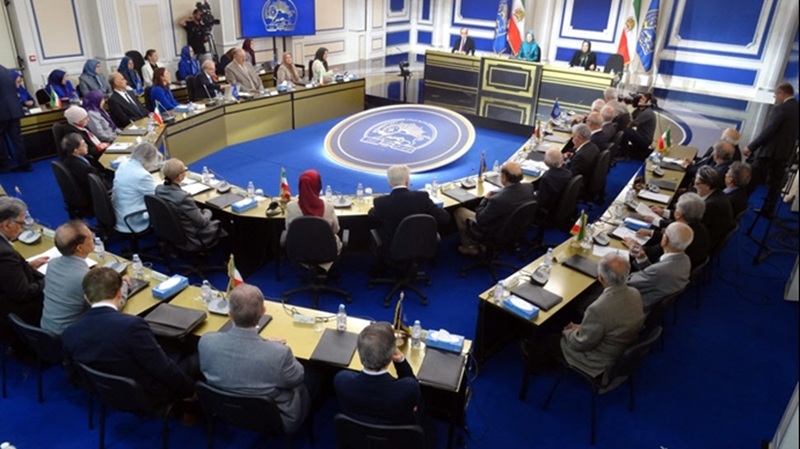
If the twentieth century exposed the fragility of revolutions without institutional safeguards, the twenty-first demands structured transition. This is where the proposal advanced by the National Council of Resistance of Iran (NCRI) enters the debate: the establishment of a provisional government tasked solely with transferring sovereignty to the electorate.
Iranian exile group forms provisional government as U.S.-Israeli military operation continues
This concept is not recent. The Resistance first articulated it more than four decades ago. Its core premise is straightforward: dismantle authoritarian structures, establish a temporary authority with a defined mandate, and organize free elections for a constituent assembly that drafts a new constitution.
The principle at stake is not partisan dominance. It is procedural legitimacy.
A provisional government with a limited timeline and clearly circumscribed authority aims to prevent two historical failures: revolutionary chaos and authoritarian substitution. The objective is neither vengeance nor restoration, but institutional rebirth.
A Historical Verdict in the Making
Iran today stands at what many perceive as a decisive juncture — a convergence of accumulated sacrifice and structural exhaustion. The emotional weight of decades — from the mass executions of the 1980s to the body bags of recent uprisings — underscores the cost of authoritarian continuity.
Yet historical transformation is not driven by grief alone. It requires organization, clarity of end-state, and political courage.
The central question remains unchanged after 120 years: Will Iran continue its oscillation between variants of absolutism, or will it establish a durable democratic republic grounded in popular sovereignty?
To break the cycle demands more than resistance; it demands replacement. Not the return of a crown, not the perpetuation of clerical guardianship, but the institutionalization of citizen rule.
The verdict of history is not predetermined. It will be written by the choices made in this decisive hour — choices that determine whether Iran remains bound to its past or finally claims its republican future.