


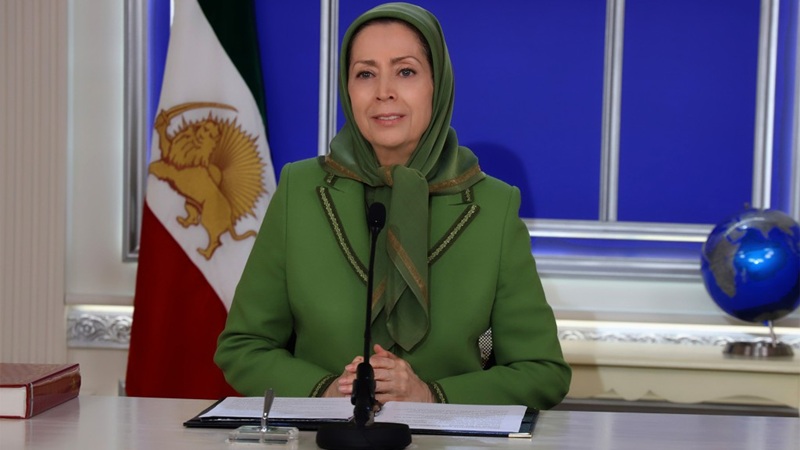

NCRI President-Elect Calls for Provisional Government and Transfer of Sovereignty to the Iranian People
In a landmark message issued on February 28, 2026, Maryam Rajavi, President-elect of the National Council of Resistance of Iran (NCRI) for the transitional period, declared that the death of Ali Khamenei marks the collapse of the ideological foundation of the ruling system in Iran.
The Death of Khamenei Is the Death of Religious Despotism and the End of the Velayat-e Faqih Regime
“The death of Khamenei is the death of religious tyranny and the end of the regime of Velayat-e Faqih,” she stated. “Now is the time to establish freedom and the sovereignty of the people of Iran.”
Her message frames the moment not as a mere leadership transition, but as a structural rupture — an opportunity to dismantle the doctrine of absolute clerical rule and replace it with a democratic republic grounded in popular sovereignty.
Announcement of a Provisional Government
Rajavi announced that, “Based on the Ten-Point Plan for transferring sovereignty to the people of Iran, the National Council of Resistance of Iran (NCRI) has announced the formation of a provisional government.” She noted that the precedent for such a move dates back to October 1981, underscoring the continuity of the Resistance’s institutional strategy.
The provisional government, she explained, is not an end in itself but a transitional mechanism to organize free elections and hand authority permanently to the people.
“I emphasize once again that the NCRI and the Provisional Government are not seeking power, but rather the transfer of power to the sovereignty of the Iranian people,” Rajavi declared.
Rejection of Both Theocracy and Monarchy
Referring to the January uprising, Rajavi stressed that the Iranian people reject both the current clerical dictatorship and any return to monarchical rule.
“As the Iranian people demonstrated during the January uprising, they seek a future founded on a democratic republic and reject both the tyrannical mullahs and the dictatorial Shah.”
In doing so, she directly addressed what many observers describe as competing post-regime scenarios — warning against efforts to “steal the democratic revolution and the product of 47 years of suffering and sacrifice.”
No Foreign Intervention
Rajavi also delivered a pointed message to the international community.
“I declare to the international community that only the people of Iran have the legitimacy to determine their country’s political future.”
She reiterated a longstanding position of the Resistance: “We have consistently said that the Iranian people write their destiny with the blood of their valiant sons and daughters and that there is no need for foreign intervention. We have consistently said that we do not seek money or the presence of foreign forces on Iranian soil.”
This assertion seeks to preempt narratives that frame regime change as externally engineered. Rajavi’s emphasis is on national agency and domestic legitimacy.
Call for Unity and Military Neutrality
Rajavi called for solidarity among all political forces committed to overthrowing religious despotism and establishing a secular democratic republic.
She referenced the NCRI’s National Solidarity Front plan, presented 24 years ago, as a framework for unity “despite differences” at what she described as a sensitive historical juncture.
Addressing the armed forces directly, she urged patriotic elements within the military to align with the population: “Here, I call upon the patriotic personnel of the army to stand alongside the people of Iran. The Revolutionary Guard and all other forces that preserve the regime must lay down their arms and surrender to the people.”
Six-Month Roadmap to Elections
According to Rajavi, once established on Iranian territory, the provisional government will be legally bound to hold “free and fair elections within six months for a National Legislative and Constituent Assembly.”
She outlined the responsibilities of that assembly: drafting a new constitution, determining the republican system of governance, legislating for interim administration, and designating a government that will assume responsibility under the new constitutional framework.
The six-month timeline is presented as a safeguard against transitional stagnation or power entrenchment — a structured bridge from authoritarian rule to institutionalized democracy.
A Defining Moment
Rajavi concluded her message with a direct appeal to national unity and democratic aspiration:
“Now is the time for solidarity and unity against the remnants of religious dictatorship and monarchical fascism.”
“Hail to the people of Iran. Victory to the democratic revolution of Iran. Long live the democratic republic.”
Her statement positions the current moment as a decisive turning point. Whether Iran’s political future moves toward pluralistic democracy, renewed authoritarianism, or instability will depend not only on the collapse of an individual leader, but on the ability of organized forces to translate rupture into constitutional order.
For the NCRI and its president-elect, the path forward is clear: a provisional government, rapid elections, and the irreversible transfer of sovereignty to the Iranian people.