


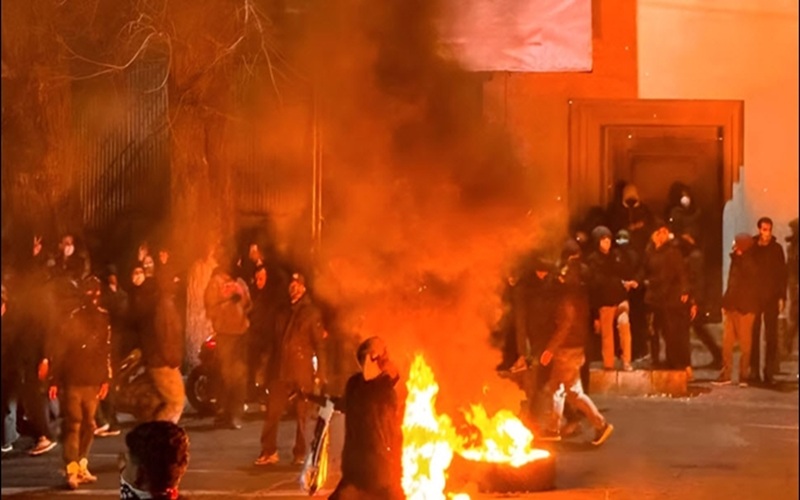

After decades of repression and repeated uprisings, Iranian society is no longer choosing between reformists and hardliners. The central question has become fundamental political change.
For 47 years, the Iranian people have lived under a system of clerical rule that has survived by moving from one crisis to another. Whenever political, economic, or social pressures have threatened its stability, the regime has relied on repression, emergency measures, legal manipulation, and promises of limited adjustment.
But after decades of experience—and six major nationwide uprisings—the relationship between Iranian society and the ruling establishment has fundamentally changed.
The question facing Iran is no longer whether the regime should be governed by “reformists” or “hardliners.” Increasingly, the question is whether a system that has produced decades of repression, executions, corruption, economic deprivation, and political exclusion can continue at all.
The end of the reformist promise
For years, the reformist-versus-hardliner dichotomy was presented as the central political choice available to Iranians. Reformists promised moderation, gradual change, dialogue, and greater openness, while hardliners defended a more uncompromising version of the same political structure.
Yet both currents operated within the same system of clerical rule.
The repeated uprisings of the past three decades have demonstrated how far Iranian society has moved beyond this artificial choice. Protesters have repeatedly challenged the entire political establishment rather than demanding a change of personnel within it.
Against this backdrop, attempts to revive reformism as the solution to Iran’s crisis increasingly appear disconnected from the political reality on the ground.
The fundamental issue is not simply that people are dissatisfied with economic conditions. Nor is the problem merely psychological pressure or inadequate social services. The deeper crisis is political: a society demanding fundamental rights is confronting a ruling structure that denies those rights and suppresses those who demand them.
Reducing a political crisis to “social pressure”
A recent article published by Arman Melli illustrates the problem.
The article acknowledges that Iranian society has faced severe “economic, social and psychological” pressures but argues that dissatisfaction does not necessarily mean society is moving toward radicalism. It advocates moderation and presents dialogue, reform, gradualism, and stability as preferable alternatives to rupture and upheaval.
At first glance, such language may appear reasonable. But it leaves out the central dimension of the crisis: political repression.
What happens when economic hardship is accompanied by executions, imprisonment, suppression of dissent, restrictions on political activity, and violent responses to protests?
Can the resulting crisis genuinely be described simply as “economic, social and psychological pressure”?
The omission is significant because the relationship between Iranian society and the regime is fundamentally political. The question is not merely how much economic pressure people can tolerate. It is why a society subjected to decades of repression continues to challenge the political system despite the enormous cost.
Reducing this confrontation to a question of social pressure risks obscuring its essential character.
What does “stability” actually mean?
The reformist prescription often revolves around concepts such as moderation, dialogue, gradual change, and stability.
One formulation cited by Arman Melli states:
“Moderation can mean preferring dialogue over elimination, reform over destruction, gradualism over leaps, and stability over instability.”
But stability is not politically neutral when the status quo itself is the source of repression.
If “stability” means preserving a political structure that executes dissidents, suppresses protests, restricts political freedoms, and denies citizens meaningful participation in determining their future, then stability becomes another name for maintaining the existing order.
The same applies to “gradual reform.” Reform can only function as a genuine political alternative when the system permits society to freely determine the direction and limits of change.
If the population cannot freely organize, protest, campaign, or express support for an alternative political system, then claims about what society supposedly wants remain fundamentally unverifiable.
The question reformism cannot answer
This leads to a basic question: If the reformist approach genuinely represents the democratic aspirations of Iranian society, why does it stop short of allowing the people to freely determine the country’s political future?
The question of a genuine referendum is particularly revealing.
A democratic process would allow the population to decide whether it wants to preserve the existing political structure or establish a fundamentally different system. But calls for reform within the existing framework generally avoid confronting that question.
This exposes the limits of reformism within the ruling system.
Its objective is not necessarily to dismantle the political structure but to make it sufficiently adaptable to survive.
In this sense, reformism can become a mechanism for political containment: acknowledge public dissatisfaction, promise limited changes, reduce immediate pressure, and prevent that dissatisfaction from developing into a movement for fundamental transformation.
The fear of a “radicalized” society
The warning that continued economic and psychological pressure could push more people toward “radicalism” is particularly revealing.
It effectively acknowledges that a portion of Iranian society has already moved beyond the boundaries of gradual reform.
But what exactly is the problem with this development?
If “radicalism” means rejecting repression, executions, corruption, authoritarian rule, and the existing political structure, then the solution cannot simply be to reduce economic pressure while leaving the political system intact.
The real test would be to remove the mechanisms that prevent people from expressing their political preferences freely.
End executions and political repression. Release political prisoners. Remove restrictions on political activity. Allow opponents of the regime to organize and speak openly. Then observe what Iranian society chooses.
This is precisely the challenge expressed by Maryam Rajavi when she argued that if the regime truly believed its opponents lacked social support, it should end executions, imprisonment, and killings and allow their supporters to take to the streets freely.
The question, therefore, is not whether Iranian society is “radical” in the abstract. The question is what society would demand if repression no longer prevented it from speaking.
Reformism and hard-line rule: Two approaches within one system
The failure of reformism is ultimately connected to its structural limitation: it operates within the same political framework it claims to modify.
Hardliners seek to preserve the system through coercion and ideological rigidity. Reformists seek to preserve it through adaptation, moderation, and controlled change.
Their methods differ, but their political boundaries remain largely the same.
This is why reformism can sometimes serve the system even when reformists criticize aspects of its operation. By presenting gradual change as the only responsible alternative to instability, reformist discourse can redirect popular anger away from fundamental political change.
In this respect, reformism may become more effective than outright repression at preventing a decisive break with the existing order.
Repression silences dissent.
Reformist rhetoric can attempt to contain it.
Iran’s political question has changed
The experience of the past 47 years has profoundly altered Iranian society.
Repeated economic crises, political repression, executions, corruption, social deprivation, and successive waves of protest have eroded the credibility of promises that the system can gradually reform itself.
The major uprisings of recent decades have reinforced this transformation. Their significance lies not simply in the number of people who participated, but in the political demands and slogans that emerged from them.
They demonstrated that large sections of Iranian society no longer see the reformist-hardliner competition as a meaningful solution to the country’s problems.
The political question has moved beyond:
Who should manage the existing system?
It is increasingly becoming:
What political system should replace it?
That is precisely why attempts to revive the language of reform, moderation, and “stability” deserve scrutiny.
Beyond the illusion of reform
Iranian society does not need another cycle in which the regime alternates between promises of reform and periods of repression.
After nearly five decades, the accumulated experience has created a fundamentally different political reality. The central conflict is between a population seeking freedom and a ruling structure determined to preserve its power.
The attempt to portray this confrontation as merely a struggle over economic pressure, social frustration, or the appropriate degree of moderation misses the fundamental issue.
The people of Iran have repeatedly demonstrated that their grievances are not confined to the price of food, employment, or living standards. These problems are inseparable from a political system that denies them the ability to determine their own future.
That is why the debate over reformism has increasingly become a debate about preserving the status quo.
The decisive question is no longer whether the existing system can be slightly modified.
It is whether the Iranian people will finally be allowed to choose a fundamentally different political future—free from dictatorship, repression, and the cycle of promises that has defined the past 47 years.