


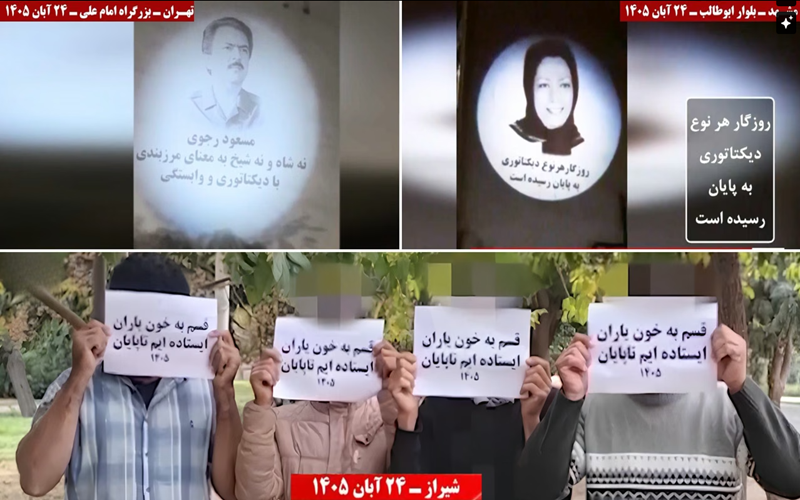

Resistance Units conduct a nationwide campaign of slogans, wall writings, posters, and photo displays in Tehran, Karaj, Mashhad, and other Iranian cities, reaffirming the rejection of both monarchical and clerical dictatorship and calling for a democratic republic.
Iranian Resistance Units have carried out a new wave of activities across the country, marking the anniversary of the November 2019 uprising with slogans, wall writings, posters, and photo displays in public spaces.
The campaign, reported from Tehran, Mashhad, Karaj, Shiraz, Tabriz, Qazvin, Hamedan, Babol, Takab, Iranshahr, Arak, Kermanshah, Zahedan, and Bushehr, centers on the continuing struggle against dictatorship and the demand for a democratic republic.
A prominent message running throughout the activities is “No to Shah, No to Mullahs”—a rejection of both monarchical and clerical dictatorship, as well as political dependence. The slogans explicitly emphasize that Iran’s future must not return to either form of authoritarian rule.
“No to Shah, No to Mullahs” message displayed across cities
In Tehran, Mashhad, and other locations, Resistance Units displayed the slogan:
“No to Shah, No to Mullahs means drawing a clear line against dictatorship and dependence.”
Other messages reinforced the same position, including:
- “Death to the oppressor, whether Shah or Supreme Leader.”
- “Neither crown nor turban—the mullah’s time is up.”
- “Iran is awake and rejects both Shah and Mullah.”
- “One hundred years of crimes under monarchy and theocracy.”
In Zahedan, activists displayed slogans rejecting both the crown and the clerical turban, while messages in Bushehr called for an end to both monarchy and clerical rule.
Another slogan, displayed in Bushehr, stated: “Neither monarchy nor supreme leadership—democracy and equality.”
These messages place the demand for a democratic alternative at the center of the anniversary campaign.
November uprising remembered as a turning point
A substantial part of the activities focused on the November 2019 uprising and its legacy.
In Tehran and Karaj, Resistance Units displayed messages from Massoud Rajavi and Maryam Rajavi recalling the nationwide protests and their significance for the continuing struggle against the regime.
Among the messages attributed to Massoud Rajavi were:
- “The November uprising proved that the only path to liberation is fire answered with fire.”
- “The lessons and experiences of the November 2019 uprising are our guide to action.”
- “The blood of the martyrs, especially the martyrs of November, continues to boil and rise in flames.”
- “On the anniversary of the November uprising, the response of Iran’s children is maximum offensive and a hundredfold battle.”
Messages attributed to Maryam Rajavi highlighted the uprising’s impact on the regime and the continuation of the struggle for democratic change.
One read: “The great November 2019 uprising brought the regime to the brink of overthrow.”
Another stated: “The democratic revolution of the Iranian people will triumph through the surging blood of its martyrs.”
In Arak, a displayed message referred to the more than 1,500 people killed during the November 2019 uprising, describing their sacrifice as a harbinger of Iran’s democratic revolution.
In Iranshahr, another message emphasized that the uprising of rebellious youth continues.
Democratic republic presented as the alternative
The campaign also repeatedly articulated the political objective of the Resistance Units: replacing the existing system with a democratic republic.
In Tehran, one slogan declared:
“We swear by the blood of the martyrs: We will sacrifice everything we have to establish a democratic republic in Iran.”
In Karaj, activists displayed the message that the Iranian people’s democratic revolution would triumph through the sacrifice of its martyrs.
In Shiraz, slogans included:
- “We stand together until the end, sworn by the blood of our comrades.”
- “With Maryam Rajavi’s path to freedom, it is possible—and it must be done.”
Another message attributed to Maryam Rajavi stated that the Iranian people had resolved to overthrow the system of velayat-e faqih (clerical rule) and establish a democratic republic.
Similar messages appeared in Qazvin and Kermanshah, reiterating the objective of ending religious dictatorship and establishing a democratic political system.
In Hamedan, activists expressed their rejection of both historical forms of dictatorship in a slogan declaring that Iran had been ruined under both Shah and Mullah, while calling for a democratic republic.
In Babol, messages referred to the role of the younger generation and the People’s Liberation Army as part of the campaign’s vision for a free Iran.
Wall writings and photo displays extend campaign
Beyond the major slogans and political messages, Resistance Units also carried out wall-writing campaigns, installed posters, and displayed photographs bearing the slogan “Long Live Rajavi.”
These activities were reported from different areas of Tehran, Shahriar, Karaj, and Mashhad.
The geographic spread of the campaign, together with its recurring messages, reflects the Resistance Units’ effort to keep the memory of the November 2019 uprising alive and connect its legacy with the demand for a democratic future.
The central theme remained consistent throughout the activities: rejection of both monarchical and clerical dictatorship, remembrance of those killed during the November uprising, and the establishment of a democratic republic in Iran.