

Rival factions clash over negotiations with Washington, the continuation of the war, and the authority of Mojtaba Khamenei, exposing growing divisions at the heart of the regime.
The internal power struggle within Iran’s regime is becoming increasingly bitter, with rival factions now questioning not only each other’s political loyalty but also their religious credentials. President Masoud Pezeshkian has openly criticized officials who invoke Islamic prayers while insulting opponents, spreading accusations, and undermining one another. His remarks have exposed the hypocrisy of a ruling establishment that uses religious accusations as a political weapon while imposing the harshest punishments on ordinary citizens for questioning its religious authority.
The escalating confrontation reflects a deeper struggle over the regime’s direction, particularly whether to pursue negotiations to end the current state of neither war nor peace or maintain a confrontational course. At its center are competing factions surrounding Pezeshkian, Parliament Speaker Mohammad Bagher Ghalibaf, hardline networks associated with the Paydari faction, and regime security official Mohsen Rezaei. Mojtaba Khamenei, meanwhile, appears to be at the center of the competing power claims.
Pezeshkian’s Religious Rebuke Exposes the Regime’s Hypocrisy
Pezeshkian recently questioned the religious credentials of his opponents, saying that someone who prays daily, invokes the name of God, and then insults, slanders, and labels others should reconsider the meaning of those prayers.
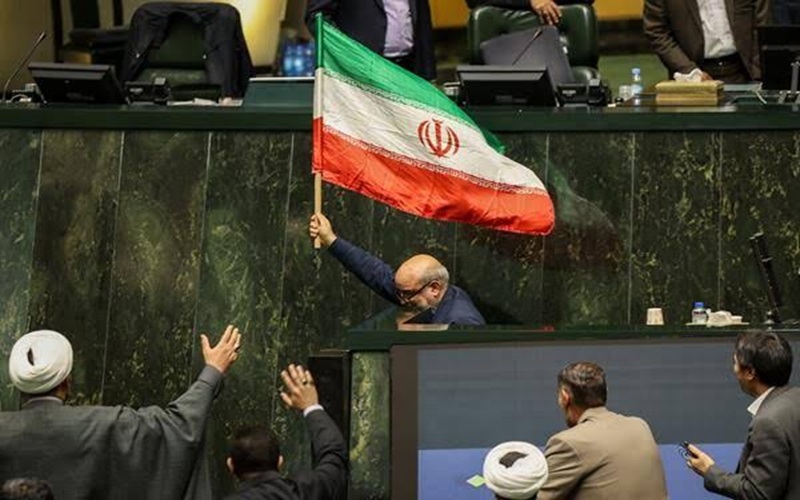
Although he did not initially identify his targets, the remarks were directed at rival hardliners who have themselves questioned Pezeshkian’s religious and political legitimacy. The confrontation has become increasingly public, with members of parliament among those participating in nighttime gatherings against the government and others raising the prospect of impeaching the president.
The accusations are particularly revealing in a system that punishes dissent and religious questioning with extreme severity, including execution. Yet officials who invoke religion to justify their authority now routinely use accusations of religious misconduct against one another.
Pezeshkian’s own political record further complicates his attempt to assume the role of religious arbiter. During the early years after the 1979 revolution, he was involved in enforcing compulsory veiling at Tabriz University of Medical Sciences, using intimidation and accusations against female students. His current invocation of religious conduct does little to obscure his own role in the regime’s ideological repression.
The contradiction is not simply personal. It reflects the broader crisis of a ruling establishment that has made religion an instrument of political control while presiding over repression, executions, corruption, and the destruction of people’s livelihoods.
Paydari Faction and Mohsen Rezaei Lead the Hardline Front
One side of the confrontation is associated with the Paydari faction, which has considerable influence over the regime’s parliament, state broadcasting, and the hardline newspaper Kayhan, run by Hossein Shariatmadari. Its networks are also involved in organizing nighttime gatherings against the government.
This camp is aligned with Mohsen Rezaei, a former IRGC commander and secretary of the regime’s Expediency Council. Its confrontation with Pezeshkian revolves largely around the question of negotiations and the regime’s response to the current military and political crisis.
The central disagreement concerns whether the regime should seek an arrangement to end the present state of neither war nor peace or continue its confrontational strategy. Disputes over the Strait of Hormuz and the conditions under which it should be reopened are also part of this broader struggle.
For the hardliners, negotiations risk forcing the regime to make concessions that could weaken its position. Their opponents, however, see an agreement as a possible way to contain the crisis and relieve the mounting pressure on the ruling establishment.
These disagreements have transformed policy differences into an increasingly personal struggle for political survival.
Pezeshkian and Ghalibaf Invoke the Legacy of Ali Khamenei
On the other side, Pezeshkian is attempting to justify his negotiating position by repeatedly invoking instructions he says he received from former supreme leader Ali Khamenei.
He has argued that Ali Khamenei instructed him to bring an end to the state of neither war nor peace. By invoking the former leader, Pezeshkian is effectively challenging Mojtaba Khamenei to demonstrate that he is continuing his father’s political line.
More recently, Pezeshkian has claimed that Mojtaba Khamenei himself authorized him to pursue an end to the current situation. This assertion suggests that the president is seeking to establish political legitimacy for negotiations by presenting them as an approved course of action from the new leadership.
Parliament Speaker Mohammad Bagher Ghalibaf appears to share this approach. Despite his anti-Western rhetoric, he is aligned with Pezeshkian in seeking to bring the confrontation to an end through negotiations. Both figures appear prepared to accept concessions if necessary to reach an agreement.
This position has made Ghalibaf another target of the hardline camp, which views negotiations as a threat to its political interests and ideological position.
Mojtaba Khamenei at the Center of the Power Struggle
The most revealing aspect of the confrontation is the position of Mojtaba Khamenei. Rather than presenting a unified leadership capable of imposing a clear direction, the competing factions are attempting to use his authority to legitimize their respective positions.
Pezeshkian invokes the instructions of the former supreme leader and now claims to have Mojtaba’s authorization. His opponents, meanwhile, are challenging his authority and pushing their own political agenda through parliament, state media, and organized gatherings.
This leaves Mojtaba Khamenei at the center of a struggle in which neither camp appears willing to accept the other’s authority.
The growing use of religious accusations, impeachment threats, and competing claims of supreme leadership approval illustrates how deeply the divisions have penetrated the regime’s governing structure. The dispute over negotiations is only the immediate expression of a wider crisis: rival factions are fighting over who has the authority to determine the regime’s course at a moment of mounting internal and external pressure.
Rather than resolving its strategic dilemmas, the regime is increasingly consumed by a struggle over its own political future. The public questioning of one another’s religious credentials is another indication of how far the ruling establishment has moved from the image of ideological unity it has spent decades trying to project.