


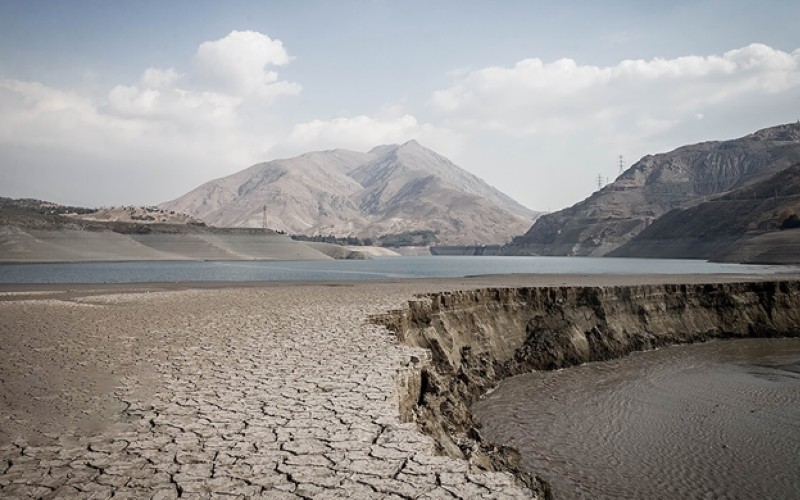

Decades of wrong economic engineering have pushed Iran to the brink of environmental and societal collapse.
The Iranian regime is widely known for exporting terrorism and instability across the Middle East. But its leadership also provides a striking example of how a modern economy should not be managed.
Nowhere is this clearer than in the regime’s decades-long experiment with ideological industrial policy—an experiment that has drained the country’s resources and pushed its society toward a crisis with irreversible consequences.
From the earliest days of the 1979 revolution, the clerical establishment imposed a dogma of economic self-sufficiency. Rejecting what it called “Western ideas” such as globalization and market integration, the regime announced its intention to produce everything domestically, including all food needed for a country of more than 90 million people.
The regime’s founder Ruhollah Khomeini declared that agriculture must be “the foundation of everything.” What he never confronted was the simple reality that water is the foundation of agriculture—and Iran is running out of it.
A nation with Iran’s climate, geography, and limited water resources has little comparative advantage in large-scale farming. Yet the regime attempted to manufacture one through massive state intervention.
It poured subsidies into fertilizers, guaranteed purchase prices, expanded cheap credit to farmers, and nearly doubled the area of irrigated land since 1979.
These policies created millions of agricultural jobs and boosted output, but only by propping up farms that could never survive in a rational market.
Long before the disaster became visible, critics of central planning warned that these policies would inevitably lead to water shortages. Those warnings were ignored.
In an efficient market—where water has a real price—the crisis would have revealed itself much earlier. Rising water costs would have pushed farmers to adopt more efficient methods, switch to less water-intensive crops, or move into different sectors.
Open trade would have allowed Iran to import goods from countries better suited to produce them. But the regime subordinated basic economic principles to ideology: agriculture had to continue “at any cost,” and officials insisted it was necessary for national interest.
The result was predictable. Reservoirs around Tehran have reached dangerously low levels. Water rationing is now a reality. Even the regime’s own president, Masoud Pezeshkian, has admitted that the capital may eventually need to be relocated.
According to the deputy director of the Regional Water Company of Tehran, the combined drinking water reserves of the province’s five major dams have dropped to 170 million cubic meters—less than half of last year’s 380 million.
Another senior official, Rama Habibi, stated that Iran has experienced five consecutive years of drought for the first time in six decades.
Industrial policy can indeed fuel rapid growth and technological progress when it is targeted, flexible, and grounded in realistic economic assessments. But large-scale or ideologically driven state intervention often encounters serious obstacles.
Complex technologies, shifting market dynamics, and global competitive pressures make expansive government-led initiatives highly vulnerable to inefficiencies, escalating costs, and structural distortions.
Without adaptive strategies, transparent governance, and accountability, centralized planning tends to misallocate resources, suppress innovation, and produce industries that cannot compete internationally.
These experiences show that while active state involvement can succeed under specific conditions, excessive or rigid interference frequently leads to setbacks that undermine long-term economic sustainability.
Domestic production as the core of national economic strategy does not always destroy water resources, but it consistently produces unintended consequences that central planners fail to foresee.
If international trade truly impoverished nations and industrial policy enriched them, Iran—one of the most closed economies in the Middle East—would today be among the richest countries in the world.
Instead, it stands as a case study in the catastrophic consequences of ideology-driven economics. The regime’s fixation on self-sufficiency has not delivered stability or prosperity.
It has produced scarcity, environmental exhaustion, and a crisis that threatens the country’s future far more than any foreign adversary.
Iran regime’s leaders set out to defy global economic logic. The result is an economy—and a society—paying the price for that defiance.