


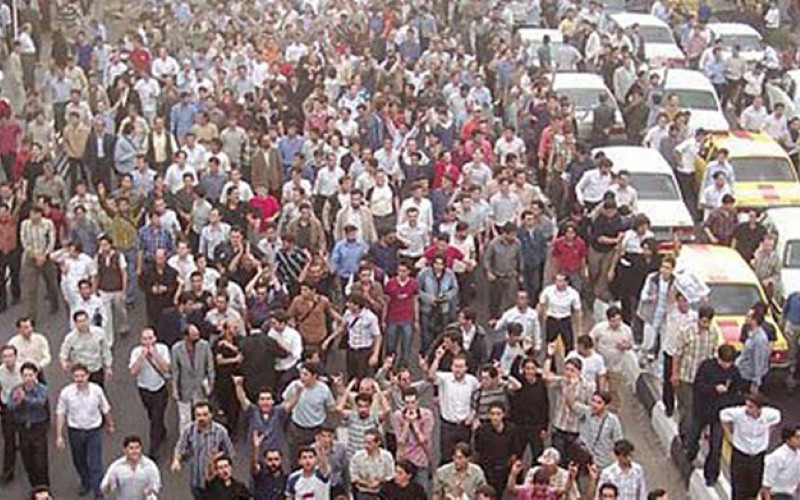

Structural pressures within Iran’s political, economic, and social order have reached a point where collective action is no longer a choice but a survival mechanism.
The next wave of uprisings in Iran is not a matter of conjecture. It is the predictable product of forces that have accumulated for years across every layer of society and now stand at a point of irreversibility.
History shows that when a society enters a revolutionary condition, several dynamics tend to emerge at once. In contemporary Iran, these forces are not only present but have intensified to an unprecedented level, pushing the country toward collective action and large-scale mobilization.
Economic collapse has steadily eroded the foundations of daily life, shrinking the horizon of possibility for millions. Persistent inflation, the free fall of the national currency, the closure of viable paths to employment, and a widening class divide have generated a form of discontent that goes far beyond ordinary economic crisis.
When a society recognizes that daily effort yields no meaningful improvement, people conclude that only collective action can alter their fate. Poverty in today’s Iran has ceased to be an economic hardship; it has become a political indictment of a regime whose legitimacy is already under assault.
The state has convinced itself that executions, mass arrests, and intensified repression will prevent unrest. The past years, however, have demonstrated the opposite. Increasing state violence has diminished fear rather than reinforced it, producing a shared sense of defiance and moral outrage.
Recent waves of executions did not pacify society. They fueled deeper resentment, expanded acts of resistance, and reinforced the perception that silence now carries a higher cost than protest. A society that has reached such a threshold is no longer contained by force.
Senior officials have openly acknowledged the regime’s worsening security crisis and its paralysis in decision-making. Such admissions carry profound meaning for ordinary citizens: the state is signaling its inability to govern effectively.
When this understanding permeates society, change is no longer perceived as an option but a necessity. After years of concluding that the system is neither reformable nor accountable, the public naturally gravitates toward periodic waves of revolt.
The weakening of Iran’s regional apparatus has further eroded the regime’s internal stability. The gradual collapse of its long-standing strategy—built on proxy networks, geopolitical leverage, and external crises—has curtailed the influence of the Supreme Leader and exposed new vulnerabilities within the ruling structure.
As the regime’s external tools falter, domestic pressures intensify, producing deeper fractures among governing elites and accelerating a broader trajectory of decline.
A new generation has emerged that neither believes in reform nor sees its future within existing structures. Localized protests, bold acts of defiance by young people, and the expanding activity of grassroots resistance networks reveal a society that is not retreating but evolving.
This generation is unmoved by superficial state concessions and continues its path with increasing clarity and determination.
No political system collapses in an instant. It unravels through the accumulated weight of crises that gradually reach a breaking point. Today’s Iran sits precisely at that juncture, with economic, political, social, and regional failures converging.
The space for internal repair has vanished, leaving the system with no sustainable path forward.
Future uprisings in Iran are therefore neither a matter of probability nor speculative prediction. They are a structural necessity generated by the current trajectory of the state itself.
The forces shaping Iran’s future—from economic implosion and political ossification to social transformation and regional decline—leave only one logical conclusion: the emergence of a new wave of uprisings, more widespread, more organized, and more deeply rooted than those of the past.
In such conditions, change becomes not a political choice but the natural reaction of a society fighting for dignity, survival, and its right to a future.
The coming uprisings will be a response to the fundamental question of collective existence. They are unavoidable, and they carry the potential to redefine the fate of Iran at its core.
It is therefore incumbent upon those committed to freedom, justice, and a democratic republic to prepare, organize, and guide this moment.
With the backing of a resistance movement seasoned by six decades of struggle, the path forward is clear: to channel this historic turning point toward a liberated and democratic Iran.