


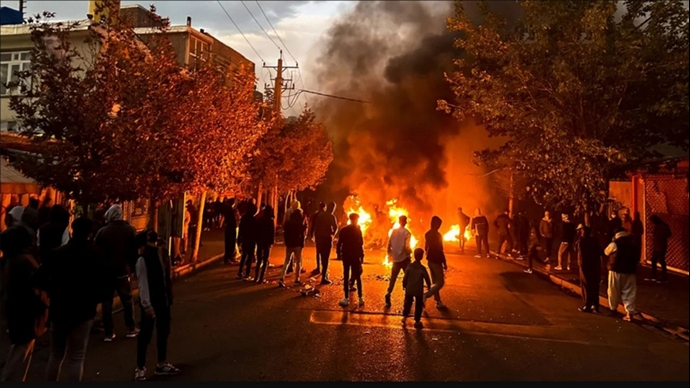

Less than 24 hours after the reactivation of snapback sanctions, regime factions and media reveal deep divisions and anxieties over internal collapse.
It has been less than 48 hours since the reactivation of the snapback sanctions mechanism, yet the Iranian regime’s deepest fears appear to come not from abroad, but from within its own ranks and supporters and a new revolt by the people.
Regime-controlled media have erupted in bitter disputes over the nuclear deal (JCPOA), with factions attacking one another. Some say that the deal was a blessing, while others condemn it as a betrayal. The argument over the impact of snapback sanctions has reached a boiling point inside the regime, exposing divisions that reveal just how fragile its foundations have become.
On September 28, the state-run Khabar Online quoted MP Hassan Samsami, who admitted: “We are more worried about the domestic trigger.”
He went on to explain: “The domestic policy-making model and self-sanctions played a much greater role in creating the current crises than Western sanctions. Instead of being used for development and progress, our country’s foreign exchange resources have become the basis for speculation and for weakening domestic production and industry. The United States did not teach us this, but we chose it ourselves. I am more concerned about the unfulfilled greed of the wealthy than about the three European countries pulling the trigger. The potential for destruction is much greater at home.”
This rare admission laid bare the regime’s own plunder of national wealth by its officials and supporters — corruption and greed that have crippled Iran’s economy more than any external sanctions.
The following day, on September 28, the state-run daily Ham Mihan criticized officials who openly celebrated the snapback activation, calling such attitudes proof that “the root of Iran’s problems is at home and not abroad, not in the Security Council or in interactions with Western countries.” The paper even accused some regime-aligned political factions of “alignment with Israel” by exploiting the end of the JCPOA for political gain.
In these open quarrels between regime insiders, the true sources of Iran’s political, economic, and social crises have been revealed — and they are not foreign sanctions. They stem from decades of corruption, plunder, and incompetence by the ruling elite. Ham Mihan itself admitted: “We can also see this destructive policy in other areas, including the economy, education, healthcare, water, energy, and culture.”
The return of snapback sanctions has amplified the regime’s greatest fear: the domestic consequences. The leadership is more anxious about the eruption of internal unrest than about foreign diplomatic or economic pressure. This explains why the regime reluctantly accepted the reimplementation of sanctions, even while a new war looms on its doorstep — preferring confrontation to stepping back and entering serious negotiations with the West.
Ahmad Zeidabadi, a regime-affiliated analyst, addressed this very fear in a YouTube program on September 28. He warned: “I don’t know any other situation where all the historical crises are suddenly linked to immediate crises, and what emerges from it is not a peaceful revolution or gradual reform, but a violent confrontation. If a protest arises – which is certainly possible on any issue – that confrontation will look bad.”
The truth is clear: the regime’s survival is far more threatened by its own corruption, mismanagement, and the anger of its people than by any foreign sanctions. The snapback mechanism has simply accelerated a process already underway — a regime eaten away from within, increasingly vulnerable to the will of the Iranian people.