



Millions of Iranian Students Are Losing Their Future as the Regime Turns Crisis-Era “Temporary” Online Education Into a Permanent National Failure
For millions of Iranian families, education has become another casualty of war, state incompetence, and systemic collapse. What was once presented as a temporary emergency solution during the COVID-19 pandemic has now evolved into a chronic national disaster: students spending months away from classrooms, trapped inside a dysfunctional online education system incapable of delivering even the most basic learning standards.
As schools across Iran continue to close or operate remotely, growing concerns among parents, teachers, and education experts point to a severe and potentially irreversible decline in student learning. Even the regime’s own Parliamentary Research Center has warned that unless appropriate policies are implemented under the current wartime and ceasefire conditions, the country will face “irreparable consequences for the national education system.”
Under Iran’s 1997 school calendar law, the academic year officially begins in October and ends in May, with June reserved for final examinations. Yet this year, Iranian students have spent nearly half of the school year away from classrooms.
According to Iran’s National Curriculum Document approved in 2011, elementary school students are required to attend 925 hours of classes annually, while lower secondary students need 1,110 hours and upper secondary students 1,295 hours of instruction per academic year. In reality, those standards have become meaningless.
Even before the outbreak of the 39-day war involving the United States, Israel, and Iran on 9 Esfand, students — especially in Tehran — had already lost more than a month of classroom education due to repeated closures caused by air pollution, gas shortages, electricity crises, freezing weather, and government mismanagement of the country’s energy infrastructure.
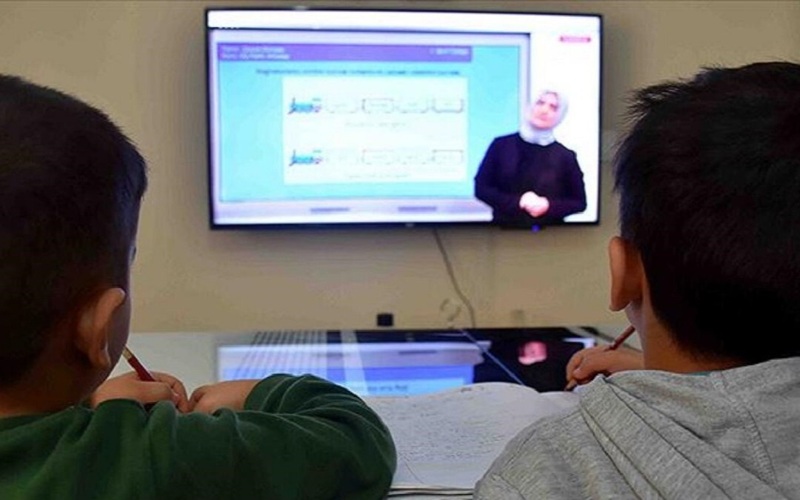
After the war began, schools were shut down again, and the regime’s Ministry of Education shifted the entire country toward virtual learning through the “Shad” platform.
Iran has approximately 16 million students, all expected to rely on the Shad online system. But the platform itself can only support around three million simultaneous users. As a result, students are allocated only two or three hours of online instruction per day depending on their educational level — far below the required learning standards.
A small number of mostly private schools use alternative platforms such as “Maktabkhaneh,” which do not suffer from the same limitations and allow full daily schedules. But for the overwhelming majority of Iranian children, particularly those in public schools, education has been reduced to fragmented and ineffective digital sessions plagued by technical failures.
The Parliamentary Research Center acknowledged in its report, “Review of the Challenges and Issues of Public Education Under Imposed War Conditions,” that the limited two-hour online quotas on Shad have resulted in the loss of approximately 135 hours of instruction at the elementary level and around 180 hours in secondary education.
Experts affiliated with the parliament concluded that these losses, combined with earlier shutdowns caused by pollution, cold weather, and energy shortages, have created “a significant gap between actual educational hours and standard educational requirements,” seriously undermining the implementation of the national curriculum.
The consequences are already visible.
Educational experts warn that prolonged school closures are particularly devastating for elementary school children, who cannot properly develop foundational literacy and writing skills without in-person instruction. Virtual education destroys continuity in learning, weakens concentration, and destabilizes family life.
Parents across Iran describe a daily struggle with broken internet connections, poor audio and video quality, inaccessible class links, and constant disruptions inside the Shad platform. Teachers attempting to upload educational materials or students trying to submit assignments often spend hours dealing with technical failures.
Many parents complain that when teachers call on students during virtual classes, neither side can hear the other because of internet instability and software defects. For digitally literate teenagers raised in the modern technological era, the outdated and poorly designed Shad application has become a source of frustration and ridicule.
The platform itself has barely changed since its launch in 2020 by Iran’s state-affiliated mobile operator Hamrah-e Aval during the COVID pandemic. Although the Ministry of Education reportedly sought additional funding to improve the application, the government eliminated the proposed budget allocation.
What was supposed to be a temporary crisis solution has now become a permanent substitute for functioning schools.
Families are increasingly terrified that this “half-education” will permanently damage their children’s futures. The concern is not exaggerated. Iran’s educational system was already suffering from deep structural weakness long before the current wave of closures.
Official figures show that the national average score on final exams last year stood at only 9.94 out of 20. Yazd province recorded the country’s highest average at 12.04, while Sistan and Baluchestan had the lowest average score at just 7.73.
International assessments paint an even darker picture.
In the TIMSS and PIRLS international education tests, which evaluate mathematics, science, reading ability, and literacy, Iran has consistently ranked below global averages. The international benchmark score in these exams is 500 points, yet Iranian students have never reached that threshold.
In the 2023 TIMSS exams, Iranian students scored only 420 in mathematics, while science results were similarly poor. In the latest PIRLS reading literacy assessment, Iranian students scored 413, placing the country near the bottom among 57 participating nations.
Now, after months of school closures, internet disruptions, war conditions, and chaotic virtual education, the situation is rapidly deteriorating further.
The burden falls disproportionately on poorer regions.
According to the Parliamentary Research Center, at least two million students are effectively excluded from online learning altogether because they lack access to digital devices or stable internet connections. In the most optimistic scenarios, some of these students receive limited educational content through television broadcasts or paper-based correspondence materials.
The report warned that unless serious policy interventions are implemented, this growing inequality in access to education will deepen long-term educational disparities and create severe social consequences for future generations.
For low-income families, school closures are not merely educational disruptions; they are financial catastrophes. Parents are forced to pay for childcare, remedial lessons, private tutoring, and lost workdays simply to compensate for the collapse of public education.
Last year, Ali Farhadi, a deputy education official, estimated that every single day of nationwide school closure costs approximately one trillion tomans. Even that staggering figure did not include the hidden costs imposed on families themselves.
In deprived regions of Iran, the damage is even more severe. Students without internet access or digital devices lose all connection to education entirely, with virtually no mechanism for recovery.
Yet despite the scale of the disaster, the Ministry of Education now appears far less interested in reopening schools than it was before the war.
Following the protests of January 18 and 19 and the subsequent mass killings, Tehran’s schools were shut down for a week. Then came the war, followed by near-total educational paralysis. Nearly three months later, millions of Iranian students remain trapped at home while the regime normalizes educational collapse as part of everyday life.
The Iranian regime is not merely failing to educate a generation; it is actively presiding over the destruction of that generation’s future. A country already facing economic ruin, political repression, brain drain, and social unrest is now adding educational collapse to its expanding list of national crises.
For millions of Iranian children, the classroom has become another lost battlefield.