


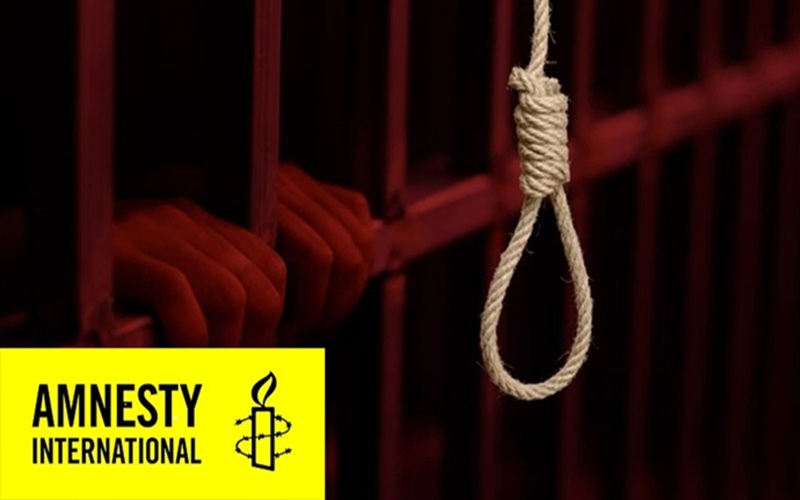

Tehran Uses “Wartime Conditions” to Justify Crackdown on Dissidents, Internet Blackouts, and Executions
Iranian regime authorities have dramatically escalated their crackdown on dissent under the pretext of “wartime conditions,” carrying out thousands of arbitrary arrests, politically motivated executions, internet blackouts, and harsh prison sentences, according to a new report released by Amnesty International on May 28, 2026.
The organization warned that the Islamic Republic is exploiting the aftermath of the February 2026 conflict involving the United States and Israel to deepen repression and silence critics across the country.
According to Amnesty International, more than 6,000 people have been arbitrarily arrested since February 28, including protesters, journalists, lawyers, students, human rights defenders, members of ethnic and religious minorities, and ordinary citizens accused of sharing information online.
The report states that Iranian regime authorities have accelerated judicial proceedings against detainees, including cases involving the death penalty, while widespread concerns persist over torture, enforced disappearances, forced confessions, and sham trials.
Amnesty: Authorities Launch “All-Out Assault” on Iranian Society
Erika Guevara Rosas, Senior Director of Research, Policy, Advocacy and Campaigns at Amnesty International, condemned the crackdown and said Iranian authorities are using the crisis to strengthen their grip on power.
“To maintain their grip on power, the authorities have unleashed an all-out assault on people in Iran,” she said.
She added that anyone criticizing the regime, sharing information about airstrikes, or attempting to bypass internet restrictions has become a target for arrest and prosecution.
Amnesty International also warned that Iranian officials have openly threatened further mass killings against anyone advocating for the downfall of the Islamic Republic.
Longest Internet Shutdown in Iran’s History
One of the central findings of the report concerns the unprecedented nationwide internet blackout imposed after the outbreak of the conflict.
According to Amnesty International, authorities isolated more than 90 million people from the outside world through an 88-day internet shutdown — described as the longest and most suffocating internet blackout ever recorded in Iran.
Although limited internet access was partially restored on May 26 by the administration of Masoud Pezeshkian, significant restrictions remain in place, including censorship, filtering, and surveillance measures.
The report states that Iranian authorities criminalized the use of VPNs, satellite internet systems such as Starlink, and other methods used to bypass censorship. Security agencies reportedly threatened citizens via text messages with arrest, prosecution, confiscation of assets, and even the death penalty under Iran’s Espionage Law.
Amnesty International reviewed multiple warning messages sent by police, intelligence agencies, and the Islamic Revolutionary Guard Corps (IRGC), accusing ordinary internet users of crimes linked to “hostile states” and “the Zionist regime.”
The organization said the blackout not only blocked communication but also obstructed documentation of human rights violations and enabled abuses to occur with impunity.
Thousands Arrested Across Iran
The report details widespread arrests across numerous provinces, including Tehran, Isfahan, Khuzestan, Fars, Gilan, Yazd, West Azerbaijan, and others.
Iranian officials reportedly labeled detainees as “traitors,” “terrorists,” “enemy collaborators,” and “agents of foreign powers.”
Among the accusations used against detainees were:
- Sharing videos or information online
- Supporting airstrikes against regime targets
- Possessing Starlink equipment
- Communicating with foreign media outlets
- Writing anti-government slogans
- Participating in peaceful activism
Amnesty International said the authorities specifically targeted lawyers, journalists, teachers, labor activists, students, ethnic minorities, and families seeking justice for victims of previous crackdowns.
The organization also highlighted growing pressure against legal professionals representing political prisoners.
Enforced Disappearances and Torture
The report documents numerous cases of enforced disappearances, including prominent human rights lawyer Nasrin Sotoudeh, who was reportedly detained for weeks without information about her whereabouts before being released on bail.
Other lawyers and activists, including Maryam Ansari and Elham Zera’atpisheh, remain forcibly disappeared following their arrests.
Amnesty International also expressed alarm over the disappearance of journalist and Christian convert Mary Mohammadi.
The organization documented multiple forms of torture and ill-treatment against detainees, including:
- Mock executions
- Severe beatings
- Solitary confinement
- Suspension from hands and feet
- Denial of medical care and food
State media reportedly broadcast forced confessions extracted under coercion before trials had even taken place.
At Least 39 Political Executions Since February
Amnesty International said Iranian regime authorities have sharply expanded the use of the death penalty as a political weapon.
Since February 28, at least 39 people have reportedly been executed on politically motivated charges following grossly unfair trials tainted by torture and forced confessions.
Those executed reportedly included protesters, dissidents, individuals accused of espionage for the United States or Israel, and others charged with “armed rebellion.”
Iranian regime judiciary chief Gholamhossein Mohseni Ejei was cited in the report as repeatedly calling for rapid prosecutions and severe punishments under “wartime conditions.”
Amnesty International warned that many more detainees remain at imminent risk of execution.
Asset Seizures and Financial Punishment
The report also describes a coordinated campaign to freeze and confiscate the assets of individuals accused of ties to foreign governments or media organizations.
Iranian regime authorities reportedly launched a digital tracking system known as “Saham” to rapidly identify and seize bank accounts, property, and financial holdings belonging to alleged “enemy agents.”
According to the report, the assets of more than 750 people — including journalists living outside Iran — have already been targeted.
Calls for International Action
Amnesty International urged the international community not to allow the Iranian regime to use the conflict as a cover for expanding repression.
“The international community must not allow the Iranian authorities to use the conflict as a smokescreen to deepen their machinery of repression and carry out crimes under international law with impunity,” Erika Guevara Rosas said.
The organization called for urgent diplomatic action, an end to executions, the release of arbitrarily detained prisoners, restoration of unrestricted internet access, and international accountability mechanisms, including possible referral of Iran’s case to the International Criminal Court.