


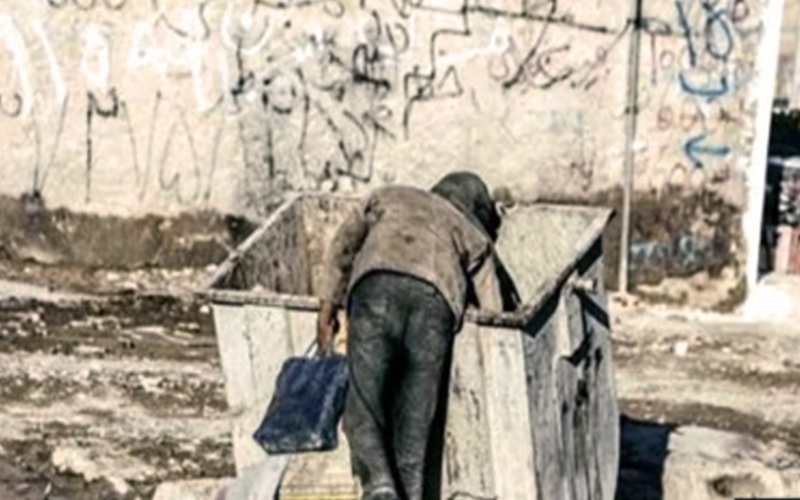

Runaway inflation and the collapse of Iran’s national currency are not unintended consequences of war or sanctions, but part of a deliberate strategy by the ruling establishment to finance repression, offset structural bankruptcy, and delay political collapse at the expense of ordinary citizens.
Iran’s devastating economic crisis and runaway inflation are not accidental developments, nor are they merely the byproduct of regional military tensions. They are the direct outcome of a systematic political strategy aimed at preserving power through the destruction of public livelihoods. While the regime’s propaganda apparatus continually attempts to blame the collapse of the national currency on external factors and foreign conflicts, even economists within Iran increasingly acknowledge that the roots of the catastrophe lie within the regime’s own policies and power structure.
For years, the ruling religious dictatorship in Iran has exploited self-created international crises as cover for implementing some of the harshest anti-public economic measures. In this context, regime economist Hussein Ragfar rejected government claims that recent inflation was primarily caused by war and military confrontation.
According to Ragfar, the economic effects of war do not emerge immediately because damaged facilities and warehouses still maintain reserves, and much of the current inflation stems from psychological expectations and temporary disruptions rather than direct wartime destruction. His remarks amount to an implicit admission that the regime has deliberately intensified inflationary pressures by exploiting wartime fears to shift the burden of its chronic budget deficits and financial failures onto the population.
Shock Therapy as a Tool of Economic Plunder
To finance its military ambitions, ideological apparatus, and security machine, the Iranian regime has increasingly relied on policies commonly described in economic literature as “shock therapy.” Rather than supporting citizens after military tensions subsided, the state accelerated policies that transferred economic pain directly onto society.
Ragfar described these measures as among the most unjust and destructive methods of dealing with the population, warning that such policies have repeatedly produced severe political and social crises throughout the country. He emphasized that the resulting instability has deepened public demands for political and social change.
The most visible manifestation of this strategy was the sudden increase in fuel prices and the sharp rise in foreign exchange rates following the end of military confrontations. Desperate for immediate liquidity, the government pushed the value of the dollar upward through deliberate market manipulation.
Ragfar pointed specifically to post-war increases in gasoline and energy prices, followed by an extreme surge in currency prices that fueled inflation and social discontent. He linked these developments directly to subsequent public protests and unrest.
He further revealed the extent of artificial currency manipulation by noting that the dollar stood at around 92,000 tomans at the start of the twelve-day conflict and fell to approximately 83,000 tomans by the fourth day. Yet afterward, the exchange rate more than doubled. Such dramatic and politically timed fluctuations strongly suggest state-directed intervention rather than natural market dynamics.
The regime’s conduct demonstrates how it profits directly from the collapse of the rial. On one side, authorities keep society trapped in fear and uncertainty through continuous references to war and instability. On the other, they hold the livelihoods of workers, professors, pensioners, and salaried employees hostage through inflation and delayed payments.
Ragfar also criticized what he described as the government’s unethical withholding of university professors’ salaries under the pretext of lacking financial resources. He characterized these measures as classic examples of shock-therapy economics — policies that would provoke major resistance under normal conditions but become easier to impose when society is distracted by war, crisis, or collective trauma.
The Historic Collapse of the Iranian Rial
Iran’s regime has now become one of the most extreme examples of national currency destruction in modern history. The collapse of the rial is not simply the inevitable consequence of sanctions; it increasingly appears to be a conscious mechanism used to conceal structural insolvency and finance government deficits.
Ragfar openly stated that currency pricing remains entirely under government control and argued that no previous administration had imposed currency shocks on the country at the scale seen under the current government. He noted that the administration inherited a dollar exchange rate of approximately 48,000 tomans, while the figure has now approached 190,000 tomans.
Such a rapid collapse in currency value represents a devastating erosion of purchasing power for ordinary Iranians. The destruction of the rial has translated into soaring food prices, collapsing savings, disappearing middle-class stability, and worsening poverty across the country.
This level of deliberate devaluation amounts to an economic assault on society itself. Inflation has become not merely an economic condition but a political instrument used to transfer wealth upward while forcing the population to absorb the costs of the regime’s failures.
Social Disintegration as the Cost of Regime Survival
The consequences of these policies extend far beyond economic indicators and financial statistics. The regime’s approach to financing its deficits and sustaining its ideological-security structure is actively dismantling Iran’s social fabric.
The expansion of absolute poverty, the destruction of the middle class, rising psychological trauma, and growing social despair are all direct outcomes of policies designed to prioritize regime survival over public welfare.
Ragfar linked the long-term collapse of the national currency to broader social crises, including rising prostitution, suicide, depression, and mass migration. He argued that successive governments have repeatedly relied on currency devaluation as the easiest method of compensating for budget deficits, despite its catastrophic human consequences.
He ultimately acknowledged that responsibility for these structural crises lies with the political system as a whole and that the current administration is continuing the same destructive trajectory pursued by previous governments.
Economic Destruction as a Political Survival Strategy
The reality in Iran today is increasingly difficult to obscure: the ruling religious dictatorship has adopted the destruction of public livelihoods as a deliberate survival strategy. By weaponizing inflation, manipulating the currency market, and implementing shock-therapy policies, the regime seeks to postpone its own political collapse while shifting the costs onto society.
The protests and uprisings that have erupted in recent years demonstrate that growing segments of the Iranian population increasingly recognize the true origins of inflation, poverty, and economic collapse. Attempts to blame foreign policy tensions or external conflicts serve primarily as political cover for structural failures rooted inside the regime itself.
As economic conditions continue to deteriorate, the central debate inside Iran is no longer merely about reforming economic policy. Increasingly, it is about whether the political structure responsible for the systematic reproduction of corruption, inflation, and impoverishment can survive at all.