


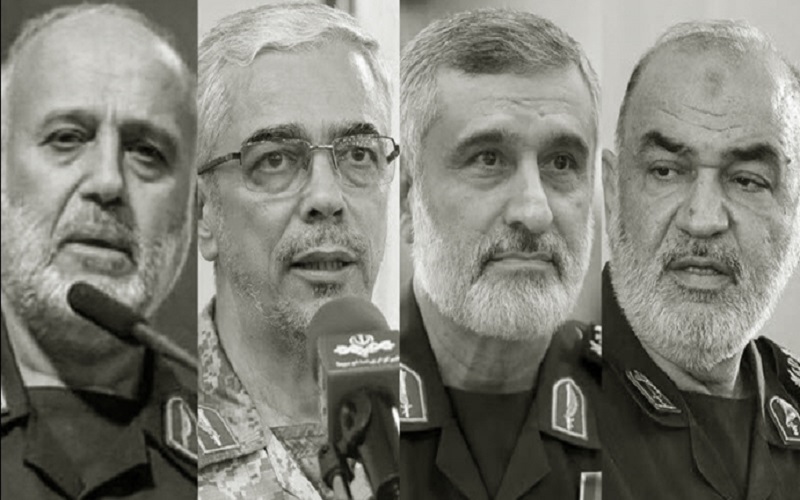

Seventeen days after the ceasefire in the 12-day conflict, Iran regime’s ruling elite remains trapped in a state of heightened alert, with no end in sight. The regime’s leaders, once prominent symbols of authority, now live like fugitives, haunted by fears of targeted assassinations and covert operations by external adversaries.
The cessation of hostilities has not eased the regime’s anxieties. The threat of precision strikes and clandestine operations has forced the regime’s senior officials into a secretive existence. In the 27 days since attacks claimed over 300 senior and mid-level military commanders, Iran regime’s governing institutions have abandoned normal operations. Public meetings, summits, and ceremonies have been canceled or held in secret, unannounced locations under stringent security measures. The regime’s efforts to project normalcy through symbolic gestures are undermined by undeniable realities.
A Leader in the Shadows
The most striking evidence of Iran regime’s precarious state was the long absence of Supreme Leader Ali Khamenei from public view. In the past month, he made only one brief appearance at his Husseiniyeh “Bayt” for a Muharram mourning ceremony, a tightly controlled event with a select audience and no prior announcement. Since then, Khamenei has vanished from public life, delivering no speeches or attending any gatherings.
Sources suggest Khamenei remains confined to a secure underground bunker, emerging only in emergencies under extreme security protocols. On Saturday night, as he left the mourning ceremony, internet access was cut off across Tehran and other cities, with fighter jets reportedly patrolling the capital’s skies to ensure his safety. GPS systems in Tehran remain disrupted, reflecting the regime’s deep-seated fears.
A President Under Threat
Iranian regime President Masoud Pezeshkian, in a Monday interview with American journalist Tucker Carlson, revealed that adversaries had attempted to assassinate him. “They tried. They took some steps, but they failed,” he said, describing an attempt to bomb a meeting he was attending. This was not an isolated claim. On July 9, Ali Larijani, a key advisor to Khamenei, disclosed that hostile forces planned to target a meeting of military leaders before aiming for the leadership itself, an operation thwarted by “divine providence and certain measures.”
These admissions highlight a stark reality: Iran’s top officials live under constant threat, shaping their every decision in a climate of fear.
A Regime on Edge
Abdollah Shahbazi, a historian with ties to Iran regime’s security apparatus, painted a grim picture on X: “Iran’s atmosphere is unrecognizable. The country feels under the grip of a hostile force. Senior officials live like underground guerrillas, changing safe houses nightly and avoiding phones for fear of assassination. Beyond airstrikes and drones, an active network of covert operatives is at work on Iranian soil. How long can this persist?”
Shahbazi’s remarks, coming from a regime insider, underscore the depth of the crisis. Iran regime’s power structure, particularly its security and command echelons, lacks the stability to govern effectively. Officials’ homes, government offices, and meeting venues are no longer considered safe—or are perceived as unsafe. As a result, recent meetings of the Supreme National Security Council, military command, government, and parliament have been held in secret, rotating locations without prior notice.
Reports indicate that high-ranking officials, from Revolutionary Guard members to the “leadership circle,” have overhauled their security details in recent weeks. Foreign Minister Abbas Araghchi recently confirmed that even senior officials face restricted access to Khamenei, signaling tightened internal controls.
A Facade of Stability
While state media projects an image of “returning to stability,” the reality at the regime’s core tells a different story: trust within its security apparatus has collapsed, with officials uncertain of the next threat. The regime’s defensive posture—marked by secrecy and fear—belies its claims of resilience.
Iran regime’s leadership, once emboldened by its rhetoric, now operates under a shadow of fear, even in peacetime. Vulnerable to espionage and terror, the Iranian regime faces an existential challenge: a regime too afraid to govern openly, caught in a cycle of suspicion and survival.