


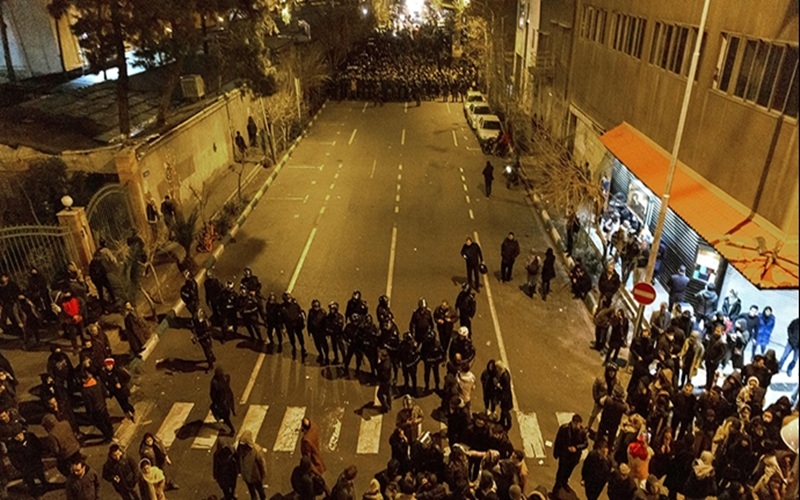

A senior police commander’s stark warning exposes a deeper reality: the Iranian regime increasingly treats protesting citizens as “enemies,” revealing that the regime’s primary confrontation is not external—but internal.
In recent days, Iran’s political landscape has been overshadowed by the dust and anxiety of war across the region. Public discourse is filled with speculation about external threats, military escalation, and the country’s uncertain future. Yet beneath this atmosphere of geopolitical tension, a more fundamental question persists: where is the real conflict unfolding, and between whom?
Is the primary confrontation truly external, as official narratives suggest, or does the central battlefield lie somewhere else entirely?
An answer may lie in a recent report broadcast by Iran’s state television, Islamic Republic of Iran Broadcasting (IRIB). The report inadvertently revealed a deeper truth about the regime’s perception of its own society.
According to the broadcast, Ahmadreza Radan, the commander-in-chief of Iran’s national police, delivered a stark warning during an interview on March 10. He declared:
“If someone takes to the streets at the enemy’s request, we will not see them as a protester or anything else. We will see them as an enemy, and we will treat them the way we treat an enemy. All our forces have their fingers on the trigger and are ready.”
At first glance, the statement appears to be a routine security threat aimed at deterring unrest. Yet embedded within it is a revealing admission. When a government defines a protesting citizen not as a dissenter but as an “enemy,” it effectively redraws the boundaries of war.
Under such a definition, the battlefield is no longer located along national borders. Instead, it lies in the streets of Iran’s own cities—and the opposing side is not a foreign army, but the country’s own people.
Recent developments appear to support this interpretation. Over the past several days, numerous reports have emerged describing a heavy security presence across major urban centers. Members of the Basij militia and plainclothes security agents have reportedly established checkpoints and conducted patrols throughout several cities. Observers say these measures serve less as counterterrorism operations than as instruments of intimidation designed to instill fear among ordinary citizens.
The scenes evoke a militarized environment—one that suggests the authorities fear domestic unrest even more than external confrontation.
This perception was reinforced by a statement released on March 10 by the Coordination Council of Iranian Teachers’ Trade Associations, which described the atmosphere in Tehran as “military-like” in recent days. According to the statement, the widespread deployment of security forces throughout the capital has effectively turned large parts of the city into what resembles a garrison environment.
When the capital of a country begins to resemble a security fortress, it often signals that the government has adopted a defensive posture toward its own society.
Taken together, these developments paint a clearer picture of Iran’s current political reality. The country’s most consequential conflict appears to be unfolding not between Iran and foreign adversaries, but between the ruling establishment and a large segment of its own population.
This struggle is no longer merely a theoretical possibility. Iranian society has already experienced waves of nationwide protests in recent years, demonstrations that exposed a widening and potentially irreversible gap between the governing system and much of the public.
For figures like Ahmadreza Radan and other regime’s security officials, the fear does not stem solely from the prospect of isolated protests. Rather, it reflects the lingering memory of mass uprisings that continue to haunt the regime’s political consciousness. The collective experience of those protests remains alive within society—and equally present in the calculations of the authorities.
The real concern for the regime is that the suppressed anger of the population could once again erupt, possibly on an even larger scale.
In this context, even if an external war were eventually to subside through diplomatic bargaining or shifting power balances, the internal confrontation between state and society would remain unresolved. Unlike geopolitical conflicts, which often conclude through negotiation, structural struggles between a governing system and a population demanding freedom and dignity rarely end through compromise.
For many observers, this deeper conflict will ultimately have only one decisive outcome: a fundamental transformation of the political system itself.