


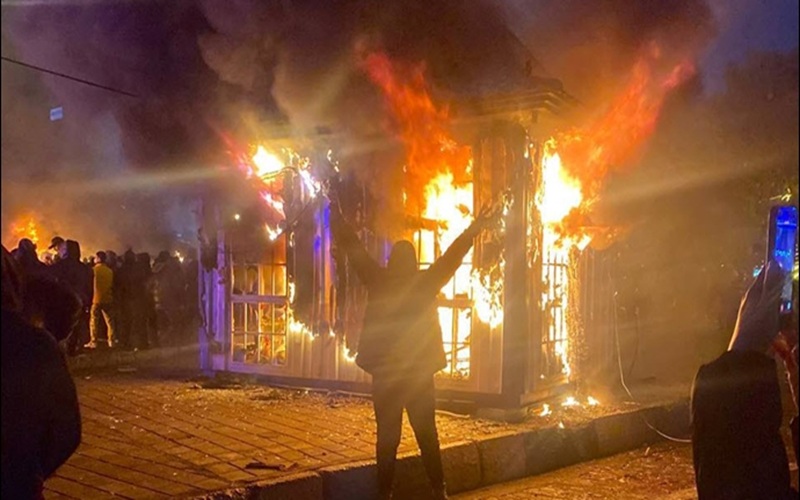

The escalating conflict among the ruling factions is not merely a power struggle. It reflects a widening rupture between the regime and Iranian society—and the growing difficulty of containing it.
The intensifying disputes within Iran’s ruling establishment raise a fundamental question: Are these merely factional disagreements, or do they point to something far more consequential?
The answer lies beyond the immediate quarrels between competing power centers. In political systems, the escalation of internal conflicts is often a reflection of deeper structural crises. When a government faces widespread public discontent, economic hardship, social unrest, political instability, and the erosion of its social base, disagreements within the ruling elite inevitably become sharper.
This is precisely what is increasingly visible in Iran.
The regime’s internal confrontations are not simply disputes over policy or administrative methods. They increasingly resemble a struggle over responsibility, power, and ultimately political survival.
When internal divisions become a crisis of survival
A government with broad social support can generally absorb internal disagreements. Competing factions can negotiate, compromise, and resolve disputes through established political mechanisms.
But when the relationship between society and the ruling establishment deteriorates beyond repair, internal disagreements take on a different character.
Each faction begins blaming the others for economic failures, political crises, social unrest, and the consequences of war and negotiations. Competition is no longer simply about which policy should be adopted. It becomes a struggle over who will retain power—and who will be held responsible when the system fails.
This is why the growing hostility between factions within Iran’s ruling structure should not be dismissed as routine political infighting.
The more fundamental issue is that the regime has increasingly fewer resources with which to restore public confidence. As its legitimacy erodes, the competition within its own ranks becomes more intense.
The result is a vicious cycle: the deeper the crisis with society becomes, the more aggressively the factions fight among themselves.
Repression and executions expose the regime’s weakness
One of the clearest manifestations of this crisis is the continued reliance on executions and repression, including during periods of war and negotiations.
When a government responds to political, social, and economic demands primarily through security and judicial measures rather than addressing the underlying grievances, it reveals the depth of the disconnect between the state and society.
Executions in such an environment cannot be viewed solely as judicial proceedings. They function as instruments of intimidation and social control.
But repression has a fundamental limitation: it can suppress dissent temporarily, yet it cannot resolve the conditions that produce dissent in the first place.
Indeed, the continued use of executions can have the opposite effect. A society subjected to relentless repression does not necessarily become more submissive. Instead, resentment accumulates, grievances deepen, and the potential for explosive confrontation grows.
This creates a dangerous feedback loop:
Social crisis leads to greater repression; greater repression widens the social divide; the widening divide produces more unrest; and more unrest prompts even harsher repression.
The regime becomes trapped inside the very cycle it created.
Why the factions are turning against one another
This is the context in which the regime’s internal disputes acquire their real significance.
As the crisis between the ruling establishment and the population deepens, the space for compromise within the political system also contracts. Different power centers increasingly accuse one another of corruption, incompetence, economic mismanagement, or failure in handling war and negotiations.
Each faction seeks to distance itself from the consequences of the regime’s policies while preserving its own position.
That dynamic explains why internal disputes can become increasingly aggressive. When a system enjoys broad public legitimacy, political actors can afford to lose an internal battle because the system itself remains secure.
When legitimacy is eroding, however, every internal defeat can become an existential threat.
The political energy of the system is consequently diverted away from resolving the country’s problems and toward factional survival.
Six uprisings and a widening political rupture
The significance of this process becomes even clearer in light of Iran’s successive waves of nationwide protest and uprising, particularly the December–January uprising of 2025–26.
After repeated cycles of protest, repression, and renewed unrest, the regime faces a society that is increasingly unwilling to accept the old methods of political control.
The ruling establishment may still possess extensive coercive power, but coercive capacity should not be confused with political stability.
A government can maintain control through force while simultaneously becoming more fragile.
Indeed, the growing dependence on executions and repression suggests that the regime has fewer political instruments available to manage its relationship with society. Instead of rebuilding trust, it is attempting to compensate for its loss of legitimacy through fear.
But fear has diminishing returns.
Every execution may silence one voice, yet the underlying grievances remain. Every crackdown may disperse one protest, yet the causes of the protest persist. Every attempt to close political space can further convince people that meaningful change cannot come through the existing structure.
The two crises are connected
The escalation of factional conflict and the continuation of executions should therefore not be viewed as separate developments.
They are two manifestations of the same underlying crisis: the collapse of the relationship between the ruling establishment and Iranian society.
The more the regime relies on repression, the more difficult it becomes for its factions to agree on how to manage the resulting consequences. The more divided the ruling establishment becomes, the less capable it is of addressing the social and economic conditions fueling discontent.
This explains why the regime’s internal disputes are likely to become sharper rather than disappear.
The question is no longer simply which faction will prevail in the next political confrontation. The deeper question is whether the ruling structure can continue to manage a society in which the political and social gap between the people and the regime has become so profound.
The evidence increasingly suggests that it cannot.
A brittle system approaching a decisive moment
The regime’s continued resort to executions and repression is sometimes presented as evidence of strength. In reality, it can be read as evidence of fragility.
A stable political system does not need to rely indefinitely on executions to preserve its authority. A government confident in its social legitimacy does not need to treat every expression of dissent as an existential threat.
The increasingly bitter accusations exchanged among the ruling factions reveal a structure under pressure from multiple directions at once.
Externally, it confronts the consequences of war and international isolation. Economically, it faces deep and persistent crises. Socially, it confronts widespread dissatisfaction. Politically, its factions increasingly blame one another. And beneath all of these problems lies the central unresolved issue: the profound rupture between the Iranian people and the ruling establishment.
That rupture cannot be repaired through executions.
Nor can it be permanently managed through repression.
Every additional act of repression adds another layer of accumulated anger to a society already demanding fundamental change.
The shouting matches, accusations, and mutual revelations among the regime’s factions are therefore more than political theater. They are symptoms of a system struggling to contain a crisis that originates outside the walls of government—in the relationship between the state and the people.
And as long as that underlying crisis remains unresolved, the confrontation within the ruling establishment is likely to intensify.
The more the regime attempts to suppress the pressure through executions and coercion, the closer it may bring itself to the very moment it is trying desperately to prevent: a renewed and potentially uncontrollable confrontation with Iranian society.