


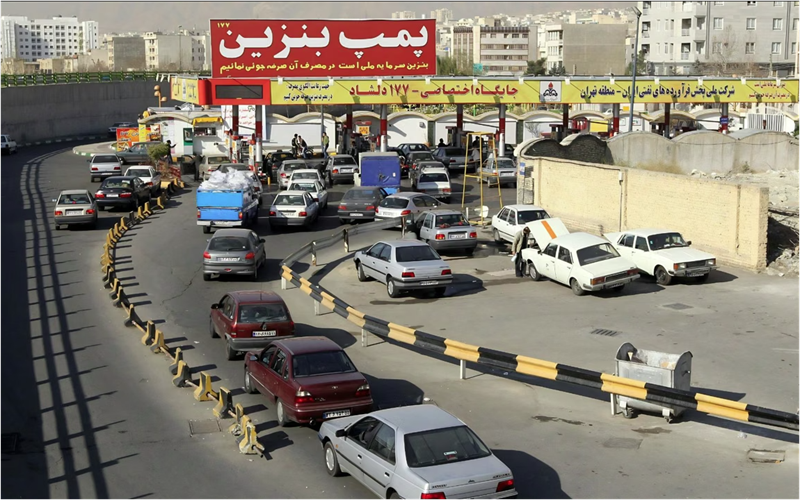

Regime officials cite wartime damage and fuel shortages to justify reducing gasoline subsidies, while lawmakers warn that higher prices could trigger widespread public anger.
Iran’s Regime Prepares the Ground for Another Fuel Price Increase
The Iranian regime has begun publicly preparing the ground for another increase in gasoline prices, a move that recalls the 2019 fuel price hike that triggered one of the largest nationwide uprisings in the country’s recent history.
Speaking on July 28, government spokeswoman Fatemeh Mohajerani, representing the administration of President Masoud Pezeshkian, confirmed a reduction in the secondary subsidized gasoline quota from 70 liters to 50 liters per month. She also indicated that the government may raise the price of non-subsidized gasoline in the near future.
Her remarks come as millions of Iranians continue to struggle with soaring inflation, declining purchasing power, and worsening living conditions.
Regime Signals Changes to Non-Subsidized Fuel Prices
During a press conference, Mohajerani was asked about widespread reports suggesting that the government is considering increasing gasoline prices and reducing fuel quotas.
She stated that no final decision had yet been announced regarding the price of gasoline purchased outside the subsidized quota, but emphasized that any future changes would be made public.
According to Mohajerani, the government currently maintains:
- A fixed subsidized quota of 60 liters per month at 1,500 tomans per liter.
- A second quota of 50 liters priced at 3,000 tomans per liter, reduced from 70 liters.
- Any gasoline consumed beyond those quotas must be purchased at the station rate of 5,000 tomans per liter.
Her comments represented the clearest official indication so far that the government is preparing public opinion for higher fuel prices.
Regime Officials Blame War Damage and Fuel Imports
Mohajerani attempted to justify the policy by citing wartime damage to fuel infrastructure following recent military conflict.
She claimed that facilities in Bandar Mahshahr had been damaged, reducing domestic production capacity and forcing the government to manage fuel consumption more aggressively.
According to her, Iran currently produces approximately 100 million liters of gasoline per day but must also import fuel, requiring valuable foreign currency that could otherwise be used for essential goods, medicine, and industrial production.
She further argued that maintaining current fuel subsidies creates an economic imbalance, noting that transportation and distribution costs alone amount to between 3,000 and 4,000 tomans per liter, while subsidized gasoline continues to be sold for only 1,500 tomans.
Mohajerani also claimed that previous fuel price adjustments had been accepted by the public whenever the government had explained its reasoning “with transparency.”
Regime’s Parliament Voices Fear Over Public Backlash
At the same time, concern over the political consequences of higher fuel prices surfaced inside the regime’s parliament.
During a parliamentary session, lawmaker Ahmad Bayat warned that rising utility costs had already generated deep public dissatisfaction, particularly among farmers.
He described dramatic increases in electricity bills for agricultural wells, claiming that costs which previously ranged from 500,000 to one million tomans had risen to between 50 million and 70 million tomans.
Bayat cautioned that additional economic pressure, including a sudden increase in gasoline prices imposed through government directives, could further inflame public anger.
His remarks were interrupted by Deputy Speaker Hamid Reza Haji Babaei, who insisted that the discussion remain limited to the official parliamentary agenda. Bayat nevertheless continued, stressing that ordinary citizens were becoming increasingly dissatisfied and that representatives were unable to answer growing public complaints.
Fuel Prices Remain a Political Flashpoint
Gasoline prices remain one of the most politically sensitive issues in Iran.
In November 2019, the regime abruptly tripled gasoline prices overnight, sparking nationwide protests that spread to nearly 200 cities. Security forces responded with a brutal crackdown that resulted in the deaths of hundreds of protesters and the arrest of thousands, according to international human rights organizations.
Since then, authorities have repeatedly delayed major fuel price reforms despite mounting fiscal pressures, fearing that another sudden increase could ignite renewed nationwide unrest.
The latest statements from Mohajerani, coupled with visible concern expressed by members of parliament, suggest that the regime is once again attempting to prepare public opinion for measures that many officials themselves acknowledge could carry significant political risks.